Advertisements
Advertisements
प्रश्न
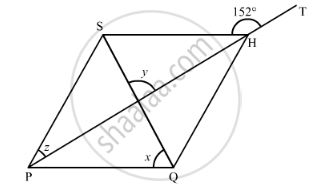
In the given figure, PQRS is a rhombus in which the diagonal PR is produced to T. If ∠SRT = 152°, find x, y and z.
Advertisements
उत्तर
Rhombus PQRS is given.
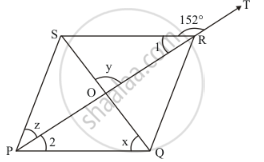
Diagonal PR is produced to T.
Also, ∠SRT = 152°.
We know that in a rhombus, the diagonals bisect each other at right angle.
Therefore,
y = 90°
Now,
∠1 + ∠SRT = 180°
∠1 +152° = 180°
∠1 = 28°
In ΔSOR, by angle sum property of a triangle, we get:
∠1 +y +∠OSR = 180°
28° +90° +∠OSR = 180°
118° +∠OSR = 180°
∠OSR = 62°
Or, ∠QSR = 62° (Because O lies on SQ)
We have, SP || PQ .Thus the alternate interior opposite angles must be equal.
Therefore,
x = ∠QSR
x = 62°
In ΔSPR,we have
Since opposite sides of a rhombus are equal.
Therefore,
PS = SR
Also,
Angles opposite to equal sides are equal.
Thus,
z = ∠1
But ∠1 = 28°
Thus, z = 20°
Hence the required values for x,y and z are 62°,90° and 28° respectively.
APPEARS IN
संबंधित प्रश्न
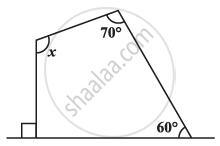
Find the angle measure x in the given Figure
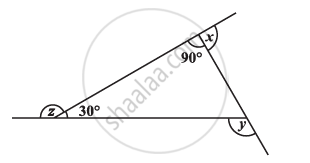
Find x + y + z
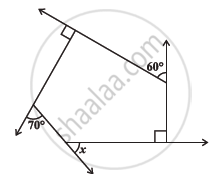
Find x in the following figures.
The diagonals of a rectangle ABCD meet at O, If ∠BOC = 44°, find ∠OAD.
If the degree measures of the angles of quadrilateral are 4x, 7x, 9x and 10x, what is the sum of the measures of the smallest angle and largest angle?
In ΔABC, ∠A = 30°, ∠B = 40° and ∠C = 110°. The angles of the triangle formed by joining the mid-points of the sides of this triangle are
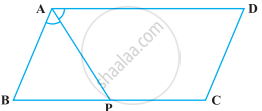
In the following figure, P is the mid-point of side BC of a parallelogram ABCD such that ∠BAP = ∠DAP. Prove that AD = 2CD.
If three angles of a quadrilateral are each equal to 75°, the fourth angle is ______.
A quadrilateral has three acute angles. If each measures 80°, then the measure of the fourth angle is ______.
Sum of all the angles of a quadrilateral is 180°.
