Advertisements
Advertisements
प्रश्न
The figure formed by joining the mid-points of the adjacent sides of a square is a
विकल्प
rhombus
square
rectangle
parallelogram
Advertisements
उत्तर
We get a square by joining the mid-points of the sides of a square.
It is given a square ABCD in which P, Q, R and S are the mid-points AB, BC, CD and DArespectively.
PQ, QR, RS and SP are joined.
Join AC and BD.
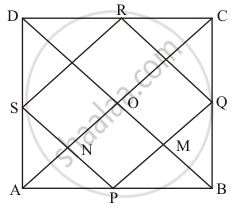
In , ΔABC P and Q are the mid-points AB and BC respectively.
Therefore,
PQ || AC and ` PQ = 1/2 AC `……(i)
Similarly, In ΔADC, R and S are the mid-points CD and AD respectively.
Therefore,
SR || AC and`SR = 1/2 AC`……(ii)
From (i) and (ii), we get
PQ || SR and PQ = SR
Therefore, PQRS is a parallelogram. …… (iii)
Now ABCD is a square.
Therefore,
AB = CD
`1/2 AB = 1/2 CD`
PB = RC …… (iv)
Similarly,
BQ = CQ …… (v)
In ΔPBQ and ΔRCQ, we have:
PB = RC (From equation (iv))
∠PBQ =∠RCQ (Each is a right angle)
BQ = CQ (From equation (v))
So, by SAS congruence criteria, we get:
ΔPBQ ≅ ΔRCQ
By Corresponding parts of congruent triangles property we have:
PQ = QR…… (vi)
From (iii) and (vi) we obtain that PQRS is a parallelogram such that PS = PQ.
But, PQRS is a parallelogram.
QR = PS
So,PQ =QR
and RS = PS…… (vii)
Now, PQ || AC (From equation (i))
Therefore,
PM || NO…… (viii)
SinceP and S are the mid-points AB and AD respectively
PS || BD
Therefore,
PN || MO …… (ix)
Thus, in quadrilateral PMON, we have:
PM || NO
and PN || MO (From equation (viii) and (ix))
Therefore, quadrilateral PMON is a parallelogram.
Also,
∠MPN = ∠MON
∠MPN = ∠BOA (Because ∠MON = ∠BOA)
∠MPN = 90° (Because diagonals of a square are perpendicular)
∠QPS = 90°
Therefore,PQRS is a quadrilateral such that PQ = QR ,
RS = QR and RS = PS .Also, ∠QPS = 90°.
Hence, PQRS is a square.
Hence the correct choice is (b).
APPEARS IN
संबंधित प्रश्न
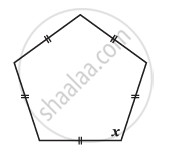
Find the angle measure x in the given Figure
In a quadrilateral ABCD, the angles A, B, C and D are in the ratio 1 : 2 : 4 : 5. Find the measure of each angles of the quadrilateral
ABCD is a parallelogram in which ∠A = 70°. Compute ∠B, ∠C and ∠D .
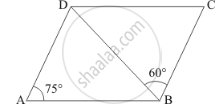
In Fig. below, ABCD is a parallelogram in which ∠DAB = 75° and ∠DBC = 60°. Compute
∠CDB and ∠ADB.
The two diagonals are equal in a
If an angle of a parallelogram is two-third of its adjacent angle, the smallest angle of the parallelogram is
In ΔABC, ∠A = 30°, ∠B = 40° and ∠C = 110°. The angles of the triangle formed by joining the mid-points of the sides of this triangle are
Can all the angles of a quadrilateral be right angles? Give reason for your answer.
One angle of a quadrilateral is of 108º and the remaining three angles are equal. Find each of the three equal angles.
The polygon in which sum of all exterior angles is equal to the sum of interior angles is called ______.
