Advertisements
Advertisements
Question
The figure formed by joining the mid-points of the adjacent sides of a square is a
Options
rhombus
square
rectangle
parallelogram
Advertisements
Solution
We get a square by joining the mid-points of the sides of a square.
It is given a square ABCD in which P, Q, R and S are the mid-points AB, BC, CD and DArespectively.
PQ, QR, RS and SP are joined.
Join AC and BD.
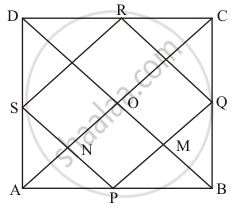
In , ΔABC P and Q are the mid-points AB and BC respectively.
Therefore,
PQ || AC and ` PQ = 1/2 AC `……(i)
Similarly, In ΔADC, R and S are the mid-points CD and AD respectively.
Therefore,
SR || AC and`SR = 1/2 AC`……(ii)
From (i) and (ii), we get
PQ || SR and PQ = SR
Therefore, PQRS is a parallelogram. …… (iii)
Now ABCD is a square.
Therefore,
AB = CD
`1/2 AB = 1/2 CD`
PB = RC …… (iv)
Similarly,
BQ = CQ …… (v)
In ΔPBQ and ΔRCQ, we have:
PB = RC (From equation (iv))
∠PBQ =∠RCQ (Each is a right angle)
BQ = CQ (From equation (v))
So, by SAS congruence criteria, we get:
ΔPBQ ≅ ΔRCQ
By Corresponding parts of congruent triangles property we have:
PQ = QR…… (vi)
From (iii) and (vi) we obtain that PQRS is a parallelogram such that PS = PQ.
But, PQRS is a parallelogram.
QR = PS
So,PQ =QR
and RS = PS…… (vii)
Now, PQ || AC (From equation (i))
Therefore,
PM || NO…… (viii)
SinceP and S are the mid-points AB and AD respectively
PS || BD
Therefore,
PN || MO …… (ix)
Thus, in quadrilateral PMON, we have:
PM || NO
and PN || MO (From equation (viii) and (ix))
Therefore, quadrilateral PMON is a parallelogram.
Also,
∠MPN = ∠MON
∠MPN = ∠BOA (Because ∠MON = ∠BOA)
∠MPN = 90° (Because diagonals of a square are perpendicular)
∠QPS = 90°
Therefore,PQRS is a quadrilateral such that PQ = QR ,
RS = QR and RS = PS .Also, ∠QPS = 90°.
Hence, PQRS is a square.
Hence the correct choice is (b).
APPEARS IN
RELATED QUESTIONS
Find the angle measure x in the given Figure
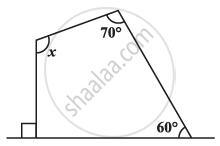
Find the angle measure x in the given Figure
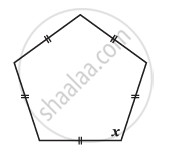
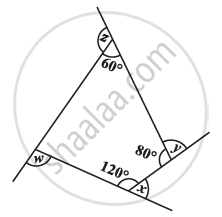
Find x + y + z + w
The angles of a quadrilateral are in the ratio 3 : 5 : 9 : 13 Find all the angles of the quadrilateral.
PQRS is a square such that PR and SQ intersect at O. State the measure of ∠POQ.
In the given figure, ABCD is a rectangle in which diagonal AC is produced to E. If ∠ECD = 146°, find ∠AOB.
Diagonals necessarily bisect opposite angles in a
One angle of a quadrilateral is of 108º and the remaining three angles are equal. Find each of the three equal angles.
The angle between two altitudes of a parallelogram through the vertex of an obtuse angle of the parallelogram is 60º. Find the angles of the parallelogram.
Sum of all the angles of a quadrilateral is 180°.
