Advertisements
Advertisements
प्रश्न
The figure formed by joining the mid-points of the adjacent sides of a parallelogram is a
विकल्प
rectangle
parallelogram
rhombus
square
Advertisements
उत्तर
It is given a parallelogram ABCD in which P,Q,R and S are the mid-points AB, BC, CDand DA respectively.
PQ, QR, RS and SP are joined.

In ΔABC, P and Q are the mid-points AB and BC respectively.
Therefore,
PQ || AC and `PQ = 1/2 AC `……(i)
Similarly, In ΔADC, R and S are the mid-points CD and AD respectively.
Therefore,
SR || AC and `PQ = 1/2 AC ` ……(ii)
From (i) and (ii), we get
PQ || SR and PQ = SR
Therefore, PQRS is a parallelogram.
Hence the correct choice is (b).
APPEARS IN
संबंधित प्रश्न
In a parallelogram ABCD, determine the sum of angles ∠C and ∠D .
ABCD is a square. AC and BD intersect at O. State the measure of ∠AOB.
P and Q are the points of trisection of the diagonal BD of a parallelogram AB Prove that CQ is parallel to AP. Prove also that AC bisects PQ.
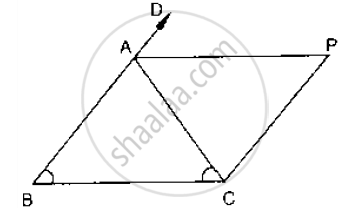
In Fig. below, AB = AC and CP || BA and AP is the bisector of exterior ∠CAD of ΔABC.
Prove that (i) ∠PAC = ∠BCA (ii) ABCP is a parallelogram
In a parallelogram ABCD, if ∠D = 115°, then write the measure of ∠A.
In a parallelogram ABCD, the bisector of ∠A also bisects BC at X. Find AB : AD.
The figure formed by joining the mid-points of the adjacent sides of a rhombus is a
In the given figure, ∠A = 64°, ∠ABC = 58°. If BO and CO are the bisectors of ∠ABC and ∠ACB respectively of ΔABC, find x° and y°
In the given Figure, if AB = 2, BC = 6, AE = 6, BF = 8, CE = 7, and CF = 7, compute the ratio of the area of quadrilateral ABDE to the area of ΔCDF. (Use congruent property of triangles)
Prove that the quadrilateral formed by the bisectors of the angles of a parallelogram is a rectangle.
