Advertisements
Advertisements
प्रश्न
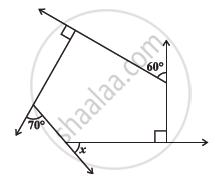
Find x in the following figures.
Advertisements
उत्तर
Since, sum of the exterior angles of any polygon is 360°.
∴ x + 90° + 60° + 90° + 70° = 360°
∴ x + 310° = 360°
∴ x = 360° − 310°
∴ x = 50°
संबंधित प्रश्न
In a quadrilateral ABCD, CO and DO are the bisectors of `∠`C and ∠D respectively. Prove that
`∠`COD = `1/2` (`∠`A+ `∠`B).
Two opposite angles of a parallelogram are (3x – 2)° and (50 – x)°. Find the measure of each angle of the parallelogram .
If an angle of a parallelogram is two-third of its adjacent angle, find the angles of the parallelogram .
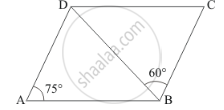
In Fig. below, ABCD is a parallelogram in which ∠DAB = 75° and ∠DBC = 60°. Compute
∠CDB and ∠ADB.
If an angle of a parallelogram is two-third of its adjacent angle, the smallest angle of the parallelogram is
Can all the four angles of a quadrilateral be obtuse angles? Give reason for your answer.
Can all the angles of a quadrilateral be acute angles? Give reason for your answer.
Can all the angles of a quadrilateral be right angles? Give reason for your answer.
The angles P, Q, R and S of a quadrilateral are in the ratio 1:3:7:9. Then PQRS is a ______.
The polygon in which sum of all exterior angles is equal to the sum of interior angles is called ______.
