Advertisements
Advertisements
प्रश्न
Two opposite angles of a parallelogram are (3x – 2)° and (50 – x)°. Find the measure of each angle of the parallelogram .
Advertisements
उत्तर
We know that
Opposite sides of a parallelogram are equal
∴ 3x - 2 = 50 - x
⇒ 3x + x = 50 + 2
⇒ 4x = 52
⇒ x = 13°
∴(3x - 2)° = (3 × 13 - 2) = 37°
(50 - x)° = (50 -13°) = 37°
Adjacent angles of a parallelogram are supplementary
∴ x + 37 = 180°
∴ x = 180° - 37° = 143°
Hence, four angles are : 37°,143°, 37°,143°
APPEARS IN
संबंधित प्रश्न
Find the angle measure x in the given Figure
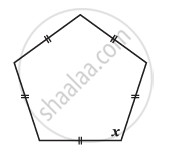
In a quadrilateral ABCD, the angles A, B, C and D are in the ratio 1 : 2 : 4 : 5. Find the measure of each angles of the quadrilateral
Find the measure of all the angles of a parallelogram, if one angle is 24° less than twice the smallest angle
Diagonals necessarily bisect opposite angles in a
If the diagonals of a rhombus are 18 cm and 24 cm respectively, then its side is equal to
In a rhombus ABCD, if ∠ACB = 40°, then ∠ADB =
In ΔABC, ∠A = 30°, ∠B = 40° and ∠C = 110°. The angles of the triangle formed by joining the mid-points of the sides of this triangle are
Can the angles 110º, 80º, 70º and 95º be the angles of a quadrilateral? Why or why not?
Can all the four angles of a quadrilateral be obtuse angles? Give reason for your answer.
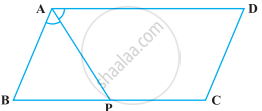
In the following figure, P is the mid-point of side BC of a parallelogram ABCD such that ∠BAP = ∠DAP. Prove that AD = 2CD.