Advertisements
Advertisements
Question
Two opposite angles of a parallelogram are (3x – 2)° and (50 – x)°. Find the measure of each angle of the parallelogram .
Advertisements
Solution
We know that
Opposite sides of a parallelogram are equal
∴ 3x - 2 = 50 - x
⇒ 3x + x = 50 + 2
⇒ 4x = 52
⇒ x = 13°
∴(3x - 2)° = (3 × 13 - 2) = 37°
(50 - x)° = (50 -13°) = 37°
Adjacent angles of a parallelogram are supplementary
∴ x + 37 = 180°
∴ x = 180° - 37° = 143°
Hence, four angles are : 37°,143°, 37°,143°
APPEARS IN
RELATED QUESTIONS
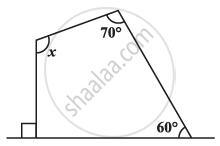
Find the angle measure x in the given Figure
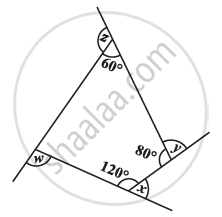
Find x + y + z + w
If an angle of a parallelogram is two-third of its adjacent angle, find the angles of the parallelogram .
ABCD is a parallelogram in which ∠A = 70°. Compute ∠B, ∠C and ∠D .
If PQRS is a square, then write the measure of ∠SRP.
The diagonals of a rectangle ABCD meet at O, If ∠BOC = 44°, find ∠OAD.
The diagonals AC and BD of a rectangle ABCD intersect each other at P. If ∠ABD = 50°, then ∠DPC =
A quadrilateral has three acute angles. If each measures 80°, then the measure of the fourth angle is ______.
Which of the following can be four interior angles of a quadrilateral?
The angles P, Q, R and S of a quadrilateral are in the ratio 1:3:7:9. Then PQRS is a ______.
