Advertisements
Advertisements
Question
If an angle of a parallelogram is two-third of its adjacent angle, find the angles of the parallelogram .
Advertisements
Solution
Let the measure of the angle be x
∴ The measure of the angle adjacent is `(2x)/3`
We know that the adjacent angle of a parallelogram is supplementary
Hence x + `(2x) / 3` = 180°
2x + 3x = 540°
⇒ 5x = 540°
⇒ x = 108°
Adjacent angles are supplementary
⇒ x +108° = 180°
⇒ x =180° -108° = 72°
⇒ x = 72°
Hence, four angles are : 180°, 72°,108°, 72°
APPEARS IN
RELATED QUESTIONS
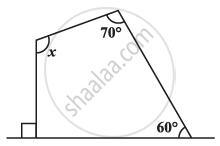
Find the angle measure x in the given Figure
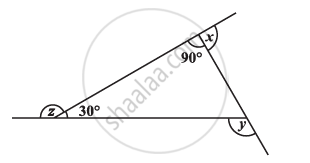
Find x + y + z
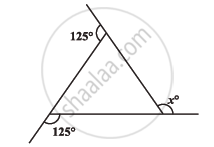
Find x in the following figure:
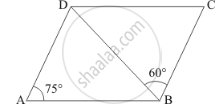
In Fig. below, ABCD is a parallelogram in which ∠DAB = 75° and ∠DBC = 60°. Compute
∠CDB and ∠ADB.
If the angles of a quadrilateral are in the ratio 3 : 5 : 9 : 13, then find the measure of the smallest angle.
In the given figure, ABCD is a rectangle in which diagonal AC is produced to E. If ∠ECD = 146°, find ∠AOB.
The two diagonals are equal in a
In ΔABC, ∠A = 30°, ∠B = 40° and ∠C = 110°. The angles of the triangle formed by joining the mid-points of the sides of this triangle are
The angle between two altitudes of a parallelogram through the vertex of an obtuse angle of the parallelogram is 60º. Find the angles of the parallelogram.
A quadrilateral has three acute angles. If each measures 80°, then the measure of the fourth angle is ______.
