Advertisements
Advertisements
Question
In a quadrilateral ABCD, bisectors of angles A and B intersect at O such that ∠AOB = 75°, then write the value of ∠C + ∠D.
Advertisements
Solution
The quadrilateral can be drawn as follows:
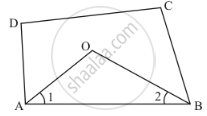
We have AO and BO as the bisectors of angles ∠A and ∠B respectively.
In ΔAOB,We have,
∠AOB + ∠1 +∠2 = 180°
∠AOB = 180° -(∠1 +∠2 )
∠AOB = 180° -`(1/2∠A + 1/2 ∠B)`
∠AOB = 180° - `1/2(∠A +∠B)` …… (1)
By angle sum property of a quadrilateral, we have:
∠A + ∠B +∠C + ∠D = 360°
∠A+ ∠B = 360° -(∠C +∠D)
Putting in equation (1):
`∠AOB =180° - 1/2[360° - (∠C + ∠D )]`
`∠AOB = 180° - 180° +(∠C +∠D)/2]`
`∠AOB = 1/2 (∠C +∠D)` ……(2)
It is given that ∠AOB = 75° in equation (2), we get:
`75° = 1/2 (∠C +∠D)`
`1/2(∠C+∠D) = 75°`
∠C + ∠D = 150°
Hence, the sum of ∠Cand ∠D is 150°.
APPEARS IN
RELATED QUESTIONS
Find the angle measure x in the given Figure
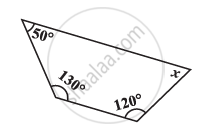
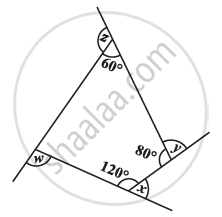
Find x + y + z + w
The angles of a quadrilateral are in the ratio 3 : 5 : 9 : 13 Find all the angles of the quadrilateral.
In the given figure, ABCD is a rectangle in which diagonal AC is produced to E. If ∠ECD = 146°, find ∠AOB.
In ΔABC, ∠A = 30°, ∠B = 40° and ∠C = 110°. The angles of the triangle formed by joining the mid-points of the sides of this triangle are
Can the angles 110º, 80º, 70º and 95º be the angles of a quadrilateral? Why or why not?
Can all the four angles of a quadrilateral be obtuse angles? Give reason for your answer.
The angles of a quadrilateral are in the ratio 1 : 2 : 3 : 4. The smallest angle is ______.
Which of the following can be four interior angles of a quadrilateral?
In a quadrilateral PQRS, ∠P = 50°, ∠Q = 50°, ∠R = 60°. Find ∠S. Is this quadrilateral convex or concave?
