Advertisements
Advertisements
Question
The two diagonals are equal in a
Options
parallelogram
rhombus
rectangle
trapezium
Advertisements
Solution
Two diagonals are equal only in a rectangle.
This can be proved as follows:
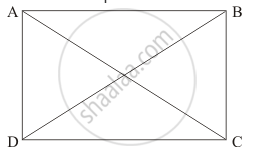
The rectangle is given as ABCD, with the two diagonals as AD and BC.
In ΔADB and ΔBCD:
AD = BC (Opposite sides of a rectangle are equal.)
CD = CD (Common)
∠ADC = ∠BCD (Each angle in a rectangle is a right angle)
Thus,
ΔADB ≅ ΔBCD (By SAS Congruence Rule)
By Corresponding parts of congruent triangles property we have:
AC = BD
Therefore, in a rectangle the two diagonals are equal.
Hence the correct choice is (c).
APPEARS IN
RELATED QUESTIONS
The angles of a quadrilateral are in the ratio 3 : 5 : 9 : 13 Find all the angles of the quadrilateral.
If the angles of a quadrilateral are in the ratio 3 : 5 : 9 : 13, then find the measure of the smallest angle.
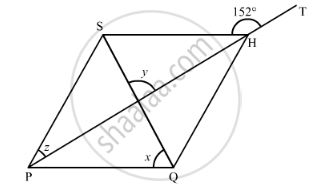
In the given figure, PQRS is a rhombus in which the diagonal PR is produced to T. If ∠SRT = 152°, find x, y and z.
If an angle of a parallelogram is two-third of its adjacent angle, the smallest angle of the parallelogram is
If the degree measures of the angles of quadrilateral are 4x, 7x, 9x and 10x, what is the sum of the measures of the smallest angle and largest angle?
The diagonals AC and BD of a rectangle ABCD intersect each other at P. If ∠ABD = 50°, then ∠DPC =
All the angles of a quadrilateral are equal. What special name is given to this quadrilateral?
The angle between two altitudes of a parallelogram through the vertex of an obtuse angle of the parallelogram is 60º. Find the angles of the parallelogram.
The sum of all ______ of a quadrilateral is 360°.
The polygon in which sum of all exterior angles is equal to the sum of interior angles is called ______.
