Advertisements
Advertisements
Question
If the diagonals of a rhombus are 18 cm and 24 cm respectively, then its side is equal to
Options
16 cm
15 cm
20 cm
17 cm
Advertisements
Solution
Let ABCD be rhombus with diagonals AC and BD 18cm and 24cm respectively.
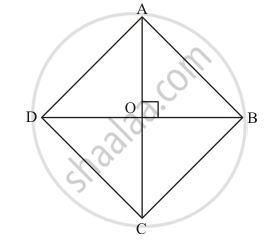
We know that diagonals of the rhombus bisect each other at right angles.
Therefore,
`AO = 1/2 AC `
`AO = 1/2 (18cm) `
AO = 9cm
Similarly,
`BO = 1/2 BD `
`BO = 1/2(24cm)`
BO = 12cm
Also, ΔAOB is a right angled triangle.
By Pythagoras theorem, we get:
`AB^2 = AO^2 + BO^2`
`AB = sqrt(AO^2 + BO^2)`
`AB = sqrt(9^2 + 12^2)`
`AB = sqrt225`
AB = 15cm
Hence the correct choice is (b).
APPEARS IN
RELATED QUESTIONS
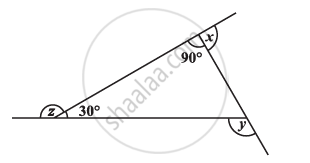
Find x + y + z
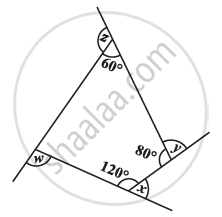
Find x + y + z + w
PQRS is a square such that PR and SQ intersect at O. State the measure of ∠POQ.
If PQRS is a square, then write the measure of ∠SRP.
In a quadrilateral ABCD, bisectors of angles A and B intersect at O such that ∠AOB = 75°, then write the value of ∠C + ∠D.
The diagonals AC and BD of a rectangle ABCD intersect each other at P. If ∠ABD = 50°, then ∠DPC =
All the angles of a quadrilateral are equal. What special name is given to this quadrilateral?
Can all the angles of a quadrilateral be acute angles? Give reason for your answer.
Can all the angles of a quadrilateral be right angles? Give reason for your answer.
In a quadrilateral PQRS, ∠P = 50°, ∠Q = 50°, ∠R = 60°. Find ∠S. Is this quadrilateral convex or concave?
