Advertisements
Advertisements
Question
If the degree measures of the angles of quadrilateral are 4x, 7x, 9x and 10x, what is the sum of the measures of the smallest angle and largest angle?
Options
140°
150°
168°
180°
Advertisements
Solution
We have,
∠A = 4x,
∠B = 7x,
∠C = 9x,
and ∠D = 10x,
By angle sum property of a quadrilateral, we get:
∠A +∠B + ∠C + ∠D = 360
4x + 7x + 9x 10x = 360
30x = 360
`x = (360)/30`
x = 12
Smallest angle:
∠A = 4x
∠A = 48°
Also, Largest angle:
∠D = 10x
∠D = 10(12°)
∠D = 120°
Thus, the sum of the smallest and the largest becomes:
∠A +∠D = 48° + 120°
∠A + ∠D = 168°
Hence, the correct choice is (c).
APPEARS IN
RELATED QUESTIONS
The angles of a quadrilateral are in the ratio 3 : 5 : 9 : 13 Find all the angles of the quadrilateral.
In a quadrilateral ABCD, bisectors of angles A and B intersect at O such that ∠AOB = 75°, then write the value of ∠C + ∠D.
Diagonals necessarily bisect opposite angles in a
If the diagonals of a rhombus are 18 cm and 24 cm respectively, then its side is equal to
Can the angles 110º, 80º, 70º and 95º be the angles of a quadrilateral? Why or why not?
One angle of a quadrilateral is of 108º and the remaining three angles are equal. Find each of the three equal angles.
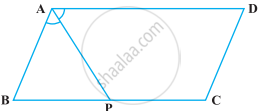
In the following figure, P is the mid-point of side BC of a parallelogram ABCD such that ∠BAP = ∠DAP. Prove that AD = 2CD.
If three angles of a quadrilateral are each equal to 75°, the fourth angle is ______.
A quadrilateral has three acute angles. If each measures 80°, then the measure of the fourth angle is ______.
In a quadrilateral PQRS, ∠P = 50°, ∠Q = 50°, ∠R = 60°. Find ∠S. Is this quadrilateral convex or concave?
