Advertisements
Advertisements
Question
The diagonals AC and BD of a rectangle ABCD intersect each other at P. If ∠ABD = 50°, then ∠DPC =
Options
70°
90°
80°
100°
Advertisements
Solution
Figure can be drawn as follows:
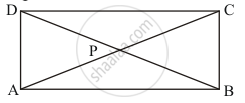
The diagonals AC and BD of rectangle ABCD intersect at P.
Also, it is given that ∠ABD = 50°
We need to find ∠DPC
It is given that∠ABD = 50°
Therefore, ∠ABP = 50°(Because P lies on BD)
Also, diagonals of rectangle are equal and they bisect each other.
Therefore,
AP = PB
Thus,∠ABP = ∠BAP (Angles opposite to equal sides are equal)
∠BAP = 50° [∠ABP = 50° (Given)]
By angle sum property of a triangle:
∠BAP + ∠ABP + ∠APB = 180°
50° + 50 +∠APB = 180°
100° + ∠APB = 180°
∠APB = 80°
But ∠APB and ∠DPC are vertically opposite angles.
Therefore, we get:
∠DPC = ∠APB
∠DPC = 80° [(∠APB = 80° lready proved)]
Hence the correct choice is (c).
APPEARS IN
RELATED QUESTIONS
Find the angle measure x in the given Figure
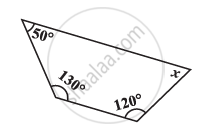
Find the angle measure x in the given Figure
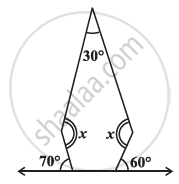
Three angles of a quadrilateral are respectively equal to 110°, 50° and 40°. Find its fourth angle
In a quadrilateral ABCD, the angles A, B, C and D are in the ratio 1 : 2 : 4 : 5. Find the measure of each angles of the quadrilateral
In a quadrilateral ABCD, CO and DO are the bisectors of `∠`C and ∠D respectively. Prove that
`∠`COD = `1/2` (`∠`A+ `∠`B).
Find the measure of all the angles of a parallelogram, if one angle is 24° less than twice the smallest angle
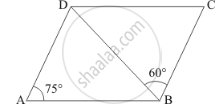
In Fig. below, ABCD is a parallelogram in which ∠DAB = 75° and ∠DBC = 60°. Compute
∠CDB and ∠ADB.
PQRS is a square such that PR and SQ intersect at O. State the measure of ∠POQ.
If an angle of a parallelogram is two-third of its adjacent angle, the smallest angle of the parallelogram is
In ΔABC, ∠A = 30°, ∠B = 40° and ∠C = 110°. The angles of the triangle formed by joining the mid-points of the sides of this triangle are
