Advertisements
Advertisements
Question
In a quadrilateral ABCD, CO and DO are the bisectors of `∠`C and ∠D respectively. Prove that
`∠`COD = `1/2` (`∠`A+ `∠`B).
Advertisements
Solution
In ΔDOC
`∠`1+ `∠`COD + `∠`2 =180° [Angle sum property of a triangle]
⇒ `∠`COD = 180 - `∠`1- `∠`2
⇒ `∠`COD =180 - `∠`1+ `∠`2
⇒ `∠`COD = 180- `[1/2∠c+1/2∠d]`
[ ∵ OC and OD are bisectors of `∠`C and `∠`D represents ]
⇒ `∠`COD = 180-`1/2` (`∠`C and `∠`D)] ............1
In quadrilateral ABCD
`∠`A + `∠`B + `∠`C + `∠`D = 360°
`∠`C + `∠`D = 360 - `∠`A + `∠`B ..............(2) [ Angle sum property of quadrilateral]
Substituting (ii) in (i)
⇒ `∠`COD = 180 -`1/2`(360 - `∠`A + `∠`B ))
⇒ `∠`COD = 180 -180 +`1/2`(`∠`A +`∠`B )
⇒ `∠`COD =`1/2`(`∠`A +`∠`B )
APPEARS IN
RELATED QUESTIONS
Find the angle measure x in the given Figure
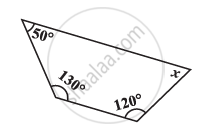
Three angles of a quadrilateral are respectively equal to 110°, 50° and 40°. Find its fourth angle
ABCD is a parallelogram in which ∠A = 70°. Compute ∠B, ∠C and ∠D .
The diagonals of a rectangle ABCD meet at O, If ∠BOC = 44°, find ∠OAD.
In the given figure, ABCD is a rectangle in which diagonal AC is produced to E. If ∠ECD = 146°, find ∠AOB.
The diagonals AC and BD of a rectangle ABCD intersect each other at P. If ∠ABD = 50°, then ∠DPC =
Can all the angles of a quadrilateral be right angles? Give reason for your answer.
The angle between two altitudes of a parallelogram through the vertex of an obtuse angle of the parallelogram is 60º. Find the angles of the parallelogram.
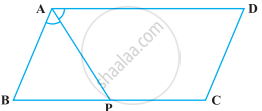
In the following figure, P is the mid-point of side BC of a parallelogram ABCD such that ∠BAP = ∠DAP. Prove that AD = 2CD.
Which of the following can be four interior angles of a quadrilateral?
