Topics
Living World and Classification of Microbes
Health and Diseases
Force and Pressure
- Introduction to Effects of Force
- Types of Forces>Contact and Non-Contact Forces
- Balanced and Unbalanced Forces
- Inertia and Mass
- Types of Inertia
- Thrust and Pressure
- Pressure on Solids
- Pressure of liquid
- Gas Pressure
- Atmospheric Pressure
- Buoyancy Force (Upthrust Force)
- Archimedes Principle
- Density of substance and Relative density
Current Electricity and Magnetism
Inside the Atom
Composition of Matter
- Matter (Substance)
- Characteristics of Particles (Molecules) of Matter
- States of Matter
- The Solid State
- The Liquid State
- The Gaseous State
- Elements
- Earth and Elements
- Non-Metals
- Type of Element: Metalloid
- Compound
- Types of Compound
- Mixture
- Types of Mixtures
- Introduction to Solutions
- Suspension Solution
- Colloidal Solution
- Molecular Formula of Compounds
- Periodic Trends in the Modern Periodic Table
Metals and Nonmetals
Pollution
- Pollution
- Air Pollution
- Prevention and Control of Air Pollution
- Water Pollution
- Effects of Water Pollution
- Prevention and Control of Water Pollution
- Soil Pollution
- Effects of Soil Pollution
- Prevention and Control of Soil Pollution
- Relationship of Soil Pollution with Air and Water Pollution
- Laws for Control, Regulation, and Prevention of Pollution by Indian Government
Disaster Management
Cell and Cell Organelles
- Cell: Structural and Functional Unit of Life
- Prokaryotic and Eukaryotic Cell
- Plant Cell Vs Animal Cell
- Cell Organelles
- Structure of the Cell > Cell Wall: “Supporter and Protector”
- Structure of the Cell > Plasma Membrane / Cell Membrane
- Structure of the Cell > Cytoplasm: “Area of Movement”
- Structure of the Cell > Nucleus: “Brain” of the Cell
- Endoplasmic Reticulum (ER)
- Golgi Apparatus - "The delivery system of the cell"
- Lysosome - “Suicidal Bag”
- Mitochondria - “Power House of the Cell”
- Plastids
- Non-living Substances Or Cell Inclusion
Human Body and Organ System
- Human Body
- Human Organ System
- Mechanism of Respiration > Breathing
- Human Respiratory System
- Blood Circulatory System
- Human Heart
- Blood Vessels
- Circulation of Blood in the Heart (Functioning of Heart)
- Heart Beat
- Blood
- Plasma (The Liquid Portion of Blood)
- Composition of Blood > Cellular Elements: Red Blood Cells (Erythrocytes)
- Composition of Blood > Cellular Elements: White Blood Cells (Leukocytes)
- Composition of Blood > Cellular Elements: Blood Platelets (Thrombocytes)
- Functions of Blood
- Blood Transfusion and Blood Groups (ABO and Rh system)
- Blood Pressure (B.P.)
- Heart Related Conditions
Introduction to Acid and Base
Chemical Change and Chemical Bond
Measurement and Effects of Heat
Sound
Reflection of Light
Man Made Materials
Ecosystems
Life Cycle of Stars
- Birth of Stars
- The Process of Star Formation
Maharashtra State Board: Class 8
Birth of Stars:
Stars are born in giant clouds of gas and dust scattered across the galaxy, called interstellar clouds. These clouds are enormous, spanning several light-years in size. To put this into perspective, a light-year is the distance light travels in one year, which is about 9.5 trillion kilometres (or 9.5 x 10¹² km). This means it would take several years for light to travel from one end of an interstellar cloud to the other, highlighting their immense size.
- Interstellar clouds are the birthplace of stars and can span several light years.
- Gravity causes these clouds to contract, increasing their density and temperature.
- When nuclear fusion begins, the star starts emitting light and becomes self-luminous.
- Stars are essentially gigantic spheres of hot, glowing gas powered by nuclear fusion.
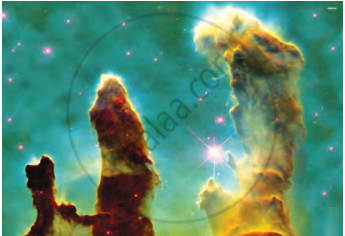
A picture of interstellar clouds taken by the Hubble space telescope
Maharashtra State Board: Class 8
The Process of Star Formation:
- Interstellar Clouds: These clouds, made mostly of hydrogen gas and tiny particles of dust, exist in the vast spaces between stars in a galaxy. They are cold and spread out, but something-a shockwave from a nearby star explosion or gravitational disturbances-causes parts of the cloud to start contracting.
- Contraction of the Cloud: When a section of the cloud begins to collapse due to gravity, it pulls in more gas and dust. As it contracts, the material becomes denser, and the gas particles collide more frequently, causing the temperature to rise.
- Formation of a Hot, Dense Sphere: The collapsing cloud continues to shrink, forming a dense, hot core at its centre. This core is made of gas that is heating up rapidly due to the compression caused by gravity.
- Nuclear Fusion Starts: When the core becomes extremely dense and hot (millions of degrees), nuclear fusion begins. In this process, hydrogen nuclei (protons) combine to form helium nuclei, releasing a tremendous amount of energy in the process. This energy is what makes the star shine.
- A Star is Born: Once nuclear fusion starts, the gas sphere stabilises and becomes self-luminous, emitting light and heat into space. This marks the birth of a star. The energy from fusion counteracts the force of gravity, preventing further collapse, and the star enters its stable phase.
