Topics
Mathematical Logic
- Statements and Truth Values in Mathematical Logic
- Logical Connectives
- Tautology, Contradiction, and Contingency
- Quantifier, Quantified and Duality Statements in Logic
- Negations of Compound Statements
- Converse, Inverse, and Contrapositive
- Algebra of Statements
- Application of Logic to Switching Circuits
- Overview of Mathematical Logic
Matrices
- Elementry Transformations
- Adjoint and Inverse of a Matrix
- Application of Matrices
- Overview of Matrices
Trigonometric Functions
- Trigonometric Equations and Their Solutions
- Solutions of Triangle>Polar Co-Ordinates
- Solving a Triangle>Solving a Triangle
- Basics of Inverse Trigonometric Functions
- Graphs of Inverse Trigonometric Functions
- Domain, Range & Principal Value
- Properties of Inverse Trigonometric Functions > Self-adjusting Property
- Overview of Trigonometric Functions
- Properties of Inverse Trigonometric Functions > Reciprocal Property
- Properties of Inverse Trigonometric Functions > Complementary Property
- Properties of Inverse Trigonometric Functions > Addition & Subtraction Formula for Inverse Tangent
- Properties of Inverse Trigonometric Functions > Double-angle Property
- Properties of Inverse Trigonometric Functions > Triple-angle Property
- Properties of Inverse Trigonometric Functions > Addition–Subtraction Formula for Inverse Sine & Cosine
- Properties of Inverse Trigonometric Functions > Negative Argument Property
Pair of Straight Lines
Vectors
- Overview of Vectors
- Basic Concepts of Vector Algebra
- Types of Vectors in Algebra
- Algebra of Vectors > Scalar Multiplication
- Algebra of Vectors > Addition & Subtraction of Two Vectors
- Collinearity and Coplanarity of Vectors
- Vectors in Coordinate Geometry
- Components of Vector in Algebra
- Vector Joining Two Points in Algebra
- Section Formula in Vector Algebra
- Product of Two Vectors > Scalar (Dot) Product
- Product of Two Vectors > Vector (Cross) Product
- Direction Ratios, Direction Cosine & Direction Angles in Vector
- Scalar Triple Product
- Vector Triple Product
Line and Plane
Linear Programming
Differentiation
- Introduction & Derivatives of Some Standard Functions
- Derivatives of Composite Functions
- Geometrical Meaning of Derivative
- Derivative of Inverse Trigonometric Function
- Logarithmic Differentiation
- Differentiation of Implicit Functions
- Derivatives of Functions in Parametric Forms
- Higher Order Derivatives
- Overview of Differentiation
Applications of Derivatives
Indefinite Integration
Definite Integration
- Definite Integral as Limit of Sum
- Integral Calculus
- Methods of Evaluation and Properties of Definite Integral
- Overview of Definite Integration
Application of Definite Integration
- Application of Definite Integration
- Area Bounded by Two Curves
- Overview of Application of Definite Integration
Differential Equations
- Basic Concepts of Differential Equations
- Order and Degree of a Differential Equation
- Formation of Differential Equations
- Forms of Solving Differential Equations> Homogeneous Differential Equations
- Forms of Solving Differential Equations>Linear Differential Equations
- Applications of Differential Equation
- Solution of a Differential Equation
- Overview of Differential Equations
Probability Distributions
- Random Variables
- Probability Distribution of Discrete Random Variables
- Probability Distribution of a Continuous Random Variable
- Variance of a Random Variable
- Expected Value and Variance of a Random Variable
- Overview of Probability Distributions
Binomial Distribution
Introduction
Vectors can be combined in more than one way, and each type of product gives different information. The two most important products are the scalar (dot) product and the vector (cross) product, which are used to find angles, projections, area, and direction-related results.
Maharashtra State Board: Class 12
Definition: Scalar Product (Dot Product)
If \[\vec{a}\] and \[\vec{b}\] are two vectors and \[\theta\] is the angle between them, then their scalar product is given by:
Properties of Dot Product
- Commutative: \[\vec{a} \cdot \vec{b} = \vec{b} \cdot \vec{a}\]
-
Distributive: \[\vec{a} \cdot (\vec{b} + \vec{c}) = \vec{a} \cdot \vec{b} + \vec{a} \cdot \vec{c}\]
-
\[\vec{a} \cdot \vec{a} = |\vec{a}|^2\]
-
If \[\vec{a} \cdot \vec{b} = 0\], the vectors are perpendicular if both are non-zero.
-
\[\vec{a} \cdot \vec{b} = a_1b_1 + a_2b_2 + a_3b_3\]
-
\[\hat{i} \cdot \hat{i} = \hat{j} \cdot \hat{j} = \hat{k} \cdot \hat{k} = 1\]
\[\hat{i} \cdot \hat{j} = \hat{j} \cdot \hat{k} = \hat{k} \cdot \hat{i} = 0\]
Definition: Projection of One Vector on Another
Projection is the part of one vector in the direction of another vector.
Scalar projection of \[\vec{a}\] on \[\vec{b}\]
Vector projection of \[\vec{a}\] on \[\vec{b}\]
Example 1
For any two vectors \[\vec{a}\] and \[\vec{b}\], we always have \[|\vec{a} + \vec{b}| \leq |\vec{a}| + |\vec{b}|\] (triangle inequality).
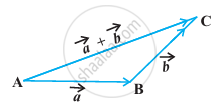
Fig 10.21
Solution: The inequality holds trivially in case either \[\vec{a} = \vec{0}\] or \[\vec{b} = \vec{0}\] (How?). So, let \[|\vec{a}| \neq 0 \neq |\vec{b}|\]. Then,
\[|\vec{a} + \vec{b}|^2 = (\vec{a} + \vec{b})^2 = (\vec{a} + \vec{b}) \cdot (\vec{a} + \vec{b})\]
\[= \vec{a} \cdot \vec{a} + \vec{a} \cdot \vec{b} + \vec{b} \cdot \vec{a} + \vec{b} \cdot \vec{b}\]
\[= |\vec{a}|^2 + 2\vec{a} \cdot \vec{b} + |\vec{b}|^2\] (scalar product is commutative)
\[\leq |\vec{a}|^2 + 2|\vec{a} \cdot \vec{b}| + |\vec{b}|^2\] (since \[x \leq |x| \forall x \in \mathbf{R}\])
\[\leq |\vec{a}|^2 + 2|\vec{a}| |\vec{b}| + |\vec{b}|^2\] (from Example 19)
\[= (|\vec{a}| + |\vec{b}|)^2\]
Hence \[|\vec{a} + \vec{b}| \leq |\vec{a}| + |\vec{b}|\]
Maharashtra State Board: Class 12
Key Points: Scalar (Dot) Product
- The dot product of two vectors is a scalar quantity.
- The dot product uses the cosine of the angle between the vectors.
\[ \vec{a} \cdot \vec{b} = |\vec{a}||\vec{b}| \cos\theta \] - The dot product is useful in finding the angle between two vectors and projection.
- For two non-zero vectors, \[ \vec{a} \cdot \vec{b} = 0 \] indicates that the vectors are perpendicular.
