Concepts of Linear Programming
Topics
Mathematical Logic
Matrices
Differentiation
Applications of Derivatives
Integration
Definite Integration
Applications of Definite Integration
- Standard Forms of Parabola and Their Shapes
- Ellipse and its Types
- Area Under Simple Curves
- Overview of Application of Definite Integration
Differential Equation and Applications
- Basic Concepts of Differential Equations
- Order and Degree of a Differential Equation
- Formation of Differential Equation by Eliminating Arbitary Constant
- Forms of Solving Differential Equations> Variable Separable
- Forms of Solving Differential Equations> Homogeneous Differential Equations
- Forms of Solving Differential Equations>Linear Differential Equations
- Applications of Differential Equation
- Overview of Differential Equations
Commission, Brokerage and Discount
- Commission and Brokerage Agent
- Concept of Discount
- Overview of Commission, Brokerage and Discount
Insurance and Annuity
- Insurance
- Types of Insurance
- Annuity
- Overview of Insurance and Annuity
Linear Regression
- Regression
- Types of Linear Regression
- Fitting Simple Linear Regression
- The Method of Least Squares
- Lines of Regression of X on Y and Y on X Or Equation of Line of Regression
- Properties of Regression Coefficients
- Overview: Linear Regression
Time Series
- Introduction to Time Series
- Uses of Time Series Analysis
- Components of a Time Series
- Mathematical Models
- Measurement of Secular Trend
- Overview of Time Series
Index Numbers
- Weighted Aggregate Method
- Cost of Living Index Number
- Method of Constructing Cost of Living Index Numbers - Aggregative Expenditure Method
- Overview of Index Numbers
- Method of Constructing Cost of Living Index Numbers - Family Budget Method
- Uses of Cost of Living Index Number
Linear Programming
Assignment Problem and Sequencing
- Assignment Problem
- Hungarian Method of Solving Assignment Problem
- Special Cases of Assignment Problem
- Sequencing Problem
- Types of Sequencing Problem
- Finding an Optimal Sequence
- Overview of Assignment Problem and Sequencing
Probability Distributions
Advertisements
Maharashtra State Board: Class 12
Defintion: Linear Programming Problem (L.P.P.)
A Linear Programming Problem (LPP) is a problem in which a linear objective function is to be maximised or minimised subject to a set of linear constraints and non-negative conditions on the variables.
Definition: Optimisation Problem
An optimisation problem is a problem in which the value of one quantity has to be made as large as possible or as small as possible under given restrictions. If the quantity and restrictions are linear, the problem becomes a Linear Programming Problem (LPP).
Standard Structure of an LPP
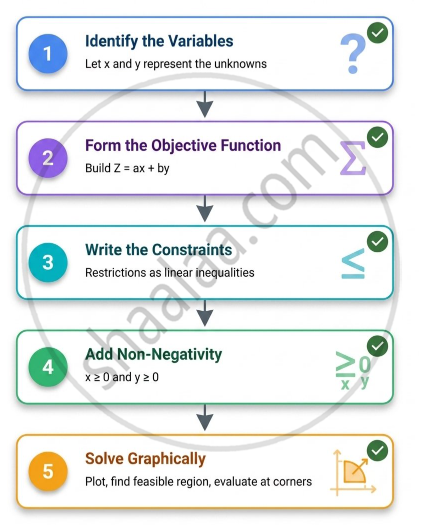
Real Life Examples
Example 1: Furniture Dealer
A furniture dealer deals in two items: tables and chairs. He has Rs 50,000 to invest and space for at most 60 pieces. A table costs Rs 2500 and gives a profit of Rs 250, while a chair costs Rs 500 and gives a profit of Rs 75. The problem is to decide how many tables and chairs he should buy so that total profit is maximum.
Test Yourself
Video Tutorials
Shaalaa.com | Linear Programming part 1 (Introduction)
Related QuestionsVIEW ALL [38]
A rubber company is engaged in producing three types of tyres A, B and C. Each type requires processing in two plants, Plant I and Plant II. The capacities of the two plants, in number of tyres per day, are as follows:
| Plant | A | B | C |
| I | 50 | 100 | 100 |
| II | 60 | 60 | 200 |
The monthly demand for tyre A, B and C is 2500, 3000 and 7000 respectively. If plant I costs Rs 2500 per day, and plant II costs Rs 3500 per day to operate, how many days should each be run per month to minimize cost while meeting the demand? Formulate the problem as LPP.
