Advertisements
Online Mock Tests
Chapters
2: Polynomials
3: Pair of Linear Equations in Two Variables
4: Quadratic Equations
5: Arithmetic Progressions
6: Co-ordinate Geometry
▶ 7: Triangles
8: Circles
9: Constructions
10: Trigonometric Ratios
11: Trigonometric Identities
12: Heights and Distances
13: Areas Related to Circles
14: Surface Areas and Volumes
15: Statistics
16: Probability
![R.D. Sharma solutions for Mathematics [English] Class 10 chapter 7 - Triangles - Shaalaa.com](/images/mathematics-english-class-10_6:df8cedf76b7f4149972b35ec991c0c9d.jpg "R.D. Sharma solutions for Mathematics [English] Class 10 chapter 7 - Triangles")
Advertisements
Solutions for Chapter 7: Triangles
Below listed, you can find solutions for Chapter 7 of CBSE, Karnataka Board R.D. Sharma for Mathematics [English] Class 10.
R.D. Sharma solutions for Mathematics [English] Class 10 7 Triangles EXERCISE 7.1 [Page 7.3]
BASIC
All circles are ______.
congruent
similar
All squares are ______.
similar
congruent
All ______ triangles are similar.
isosceles
equilateral
Two triangles are similar, if their corresponding angles are ______.
proportional
equal
Two triangles are similar, if their corresponding sides are ______.
proportional
equal
Two polygons of the same number of sides are similar, if (a) their corresponding angles are ______ and (b) their corresponding sides are ______. (equal, proportional)
Write the truth value (T/F) of the following statement:
Any two similar figures are congruent.
Write the truth value (T/F) of the following statement:
Any two congruent figures are similar.
Write the truth value (T/F) of the following statement:
Two polygons are similar, if their corresponding sides are proportional.
Write the truth value (T/F) of the following statement:
Two polygons are similar if their corresponding angles are proportional.
Write the truth value (T/F) of the following statement:
Two triangles are similar if their corresponding sides are proportional.
Write the truth value (T/F) of the following statement:
Two triangles are similar if their corresponding angles are equal.
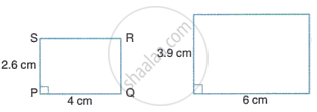
State whether the following rectangles are similar or not. Justify your answer.
R.D. Sharma solutions for Mathematics [English] Class 10 7 Triangles EXERCISE 7.2 [Pages 7.19 - 7.20]
BASIC
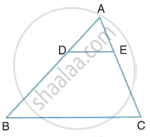
In ΔABC, D and E are points on the sides AB and AC respectively such that DE || BC
If AD = 6 cm, DB = 9 cm and AE = 8 cm, find AC.
In ΔABC, D and E are points on the sides AB and AC respectively such that DE || BC.
If `(AD)/(DB) = 3/4` and AC = 15 cm, find AE.
In ΔABC, D and E are points on the sides AB and AC respectively such that DE || BC.
If AD = 2.5 cm, BD = 3.0 cm and AE = 3.75 cm, find the length of AC.
In ΔABC, D and E are points on the sides AB and AC respectively such that DE || BC.
If AD = 4, AE = 8, DB = x – 4, and EC = 3x – 19, find x.
In ΔABC, D and E are points on the sides AB and AC respectively such that DE || BC.
If AD = 8 cm, AB = 12 cm and AE = 12 cm, find CE.
In a ΔABC, D and E are points on the sides AB and AC respectively such that DE || BC.
If AD = 2.4 cm, AE = 3.2 cm, DE = 2 cm and BC = 5 cm, find BD and CE.
In ΔABC, D and E are points on the sides AB and AC respectively such that DE || BC.
If AD = x, DB = x – 2, AE = x + 2 and EC = x – 1, find x.
In a ΔABC, D and E are points on the sides AB and AC respectively. For the following case show that DE || BC:
AB = 12 cm, AD = 8 cm, AE = 12 cm and AC = 18 cm.
In a ΔABC, D and E are points on the sides AB and AC respectively. For the following case show that DE || BC:
AD = 5.7 cm, BD = 9.5 cm, AE = 3.3 cm and EC = 5.5 cm.
In the figure, state if PQ || EF.
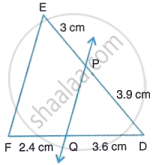
Find the value of x for which DE || AB in figure.

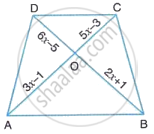
In the figure, if AB || CD, find the value of x.
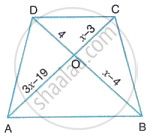
In the figure, AB || CD. If OA = 3x – 19, OB = x – 4, OC = x – 3 and OD = 4, find x.
BASED ON LOTS
If D and E are points on sides AB and AC respectively of a ΔABC such that DE || BC and BD = CE. Prove that ΔABC is isosceles.
State the converse of basic proportionality theorem. Also, find `(BF)/(FC)` in figure, given that AB || DC || EF and `(AE)/(ED) = 2/3`. Also, find the length of EF if AB = 10 cm and DC = 15 cm.
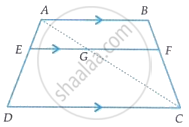
State the basic proportionality theorem. Use the theorem to prove the following:
In ΔABC, AD is the angle bisector of angle A. BA is produced to E such that CE || AD. Prove that `(BD)/(DC) = (BA)/(AC)`.
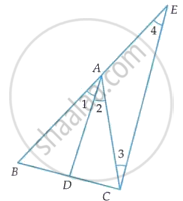
R.D. Sharma solutions for Mathematics [English] Class 10 7 Triangles EXERCISE 7.3 [Pages 7.28 - 7.29]
BASIC
In a ΔABC, AD is the bisector of ∠A, meeting side BC at D.
If BD = 2.5 cm, AB = 5 cm and AC = 4.2 cm, find DC.
In a ΔABC, AD is the bisector of ∠A, meeting side BC at D.
If BD = 2 cm, AB = 5 cm and DC = 3 cm, find AC.
In a ΔABC, AD is the bisector of ∠A, meeting side BC at D.
If AB = 10 cm, AC = 6 cm and BC = 12 cm, find BD and DC.
In the following figure, AE is the bisector of the exterior ∠CAD meeting BC produced in E. If AB = 10 cm, AC = 6 cm and BC = 12 cm, find CE.
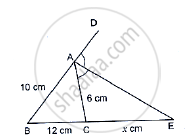
In the following figure, ΔABC is a triangle such that `(AB)/(AC) = (BD)/(DC)`, ∠B = 70°, ∠C = 50°. Find ∠BAD.
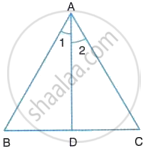
In the following figure, check whether AD is the bisector of ∠A of ∆ABC in the following:
AB = 4 cm, AC = 6 cm, BD = 1.6 cm and CD = 2.4 cm
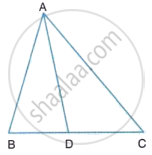
In the following figure, check whether AD is the bisector of ∠A of ∆ABC in the following:
AB = 8 cm, AC = 24 cm, BD = 6 cm and BC = 24 cm
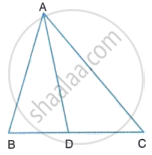
BASED ON LOTS
D, E and F are the points on sides BC, CA and AB respectively of ΔABC such that AD bisects ∠A, BE bisects ∠B and CF bisects ∠C. If AB = 5 cm, BC = 8 cm and CA = 4 cm, determine AF, CE and BD.
R.D. Sharma solutions for Mathematics [English] Class 10 7 Triangles EXERCISE 7.4 [Pages 7.66 - 7.68]
BASIC
In figure, ∆ACB ~ ∆APQ. If BC = 8 cm, PQ = 4 cm, BA = 6.5 cm, AP = 2.8 cm, find CA and AQ.
In the following figure, AB || QR. Find the length of PB.
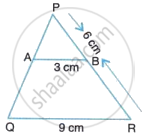
In the following figure, XY || BC. Find the length of XY.
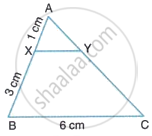
In the following figure, DE || BC such that AE = (1/4) AC. If AB = 6 cm, find AD.
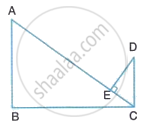
In the following figure, if AB ⊥ BC, DC ⊥ BC and DE ⊥ AC, prove that ΔCED ~ ΔABC.
Diagonals AC and BD of a trapezium ABCD with AB || DC intersect each other at the point O. Using similarity criterion for two triangles, show that `(OA)/(OC) = (OB)/(OD)`.
BASED ON LOTS
In a right angled triangle with sides a and b and hypotenuse c, the altitude drawn on the hypotenuse is x. Prove that ab = cx.
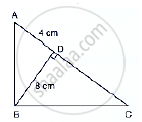
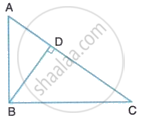
In the following figure, ∠ABC = 90° and BD ⊥ AC. If BD = 8 cm and AD = 4 cm, find CD.
In the following figure, ∠ABC = 90° and BD ⊥ AC. If AD = 4 cm and CD = 5 cm, find BD and AB.
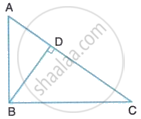
In the following figure, ∠ABC = 90° and BD ⊥ AC. If AB = 5.7 cm, BD = 3.8 cm and CD = 5.4 cm, find AC.
In figure, ∠A = ∠CED, prove that ∆CAB ~ ∆CED. Also, find the value of x.

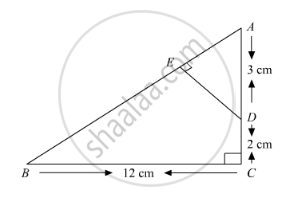
In the figure, ΔABC is right angled at C and DE ⊥ AB. Prove that ΔABC ~ ΔADE and hence find the lengths of AE and DE.
The perimeters of two similar triangles are 25 cm and 15 cm respectively. If one side of first triangle is 9 cm, what is the corresponding side of the other triangle?
A girl of height 90 cm is walking away from the base of a lamp-post at a speed of 1.2 m/sec. If the lamp is 3.6 m above the ground, find the length of her shadow after 4 seconds.
A vertical stick of length 6 m casts a shadow 4 m long on the ground and at the same time a tower casts a shadow 28 m long. Find the height of the tower.
BASED ON HOTS
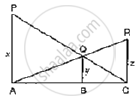
In the following figure, PA, QB and RC are each perpendicular to AC. Prove that `bb(1/x + 1/z = 1/y)`.
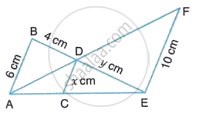
In the figure, we have AB || CD || EF. If AB = 6 cm, CD = x cm, EF = 10 cm, BD = 4 cm and DE = y cm, calculate the values of x and y.
The corresponding sides of ΔABC and ΔPQR are in the ratio 3 : 5. AD ⊥ BC and PS ⊥ QR, as shown in the following figures:
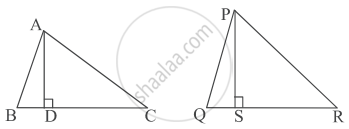
- Prove that ΔADC ~ ΔPSR.
- If AD = 4 cm, find the length of PS.
- Using (ii) find ar(ΔABC) : ar(ΔPQR).
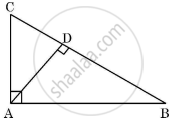
In the adjoining figure, ΔCAB is a right triangle, right angled at A and AD ⊥ BC. Prove that ΔADB ~ ΔCDA. Further, if BC = 10 cm and CD = 2 cm, find the length of AD.
R.D. Sharma solutions for Mathematics [English] Class 10 7 Triangles EXERCISE 7.5 [Pages 7.77 - 7.78]
BASIC
Triangles ABC and DEF are similar. If area (ΔABC) = 36 cm2, area (ΔDEF) = 64 cm2 and DE = 6.2 cm, find AB.
Triangles ABC and DEF are similar If AB = 1.2 cm and DE = 1.4 cm, find the ratio of the areas of ΔABC and ΔDEF.
In the following figure, ΔACB ~ ΔAPQ. If BC = 10 cm, PQ = 5 cm, BA = 6.5 cm and AP = 2.8 cm, find CA and AQ. Also, find the area (ΔACB): area (ΔAPQ).
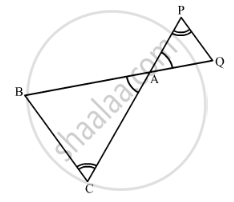
In the following figure, DE || BC. If DE = 4 cm, BC = 6 cm and Area (ΔADE) = 16 cm2, find the area of ΔABC.
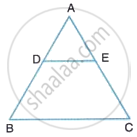
In the following figure, DE || BC. If DE = 4 cm, BC = 8 cm and Area (ΔADE) = 25 cm2, find the area of ΔABC.
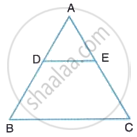
In the following figure, DE || BC. If DE : BC = 3 : 5. Calculate the ratio of the areas of ∆ADE and the trapezium BCED.
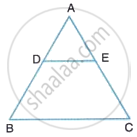
In the following, DE || BC. If DE = 6 cm, BC = 12 cm, find the ratio of Area (ΔADE) and Area (quad. DECB).
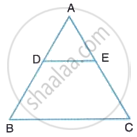
The areas of two similar triangles are 81 cm2 and 49 cm2 respectively. Find the ratio of their corresponding heights. What is the ratio of their corresponding medians?
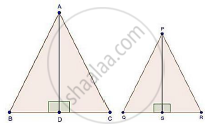
The areas of two similar triangles are 169 cm2 and 121 cm2 respectively. If the longest side of the larger triangle is 26 cm, find the longest side of the smaller triangle.
The areas of two similar triangles are 25 cm2 and 36 cm2 respectively. If the altitude of the first triangle is 2.4 cm, find the corresponding altitude of the other.
The corresponding altitudes of two similar triangles are 6 cm and 9 cm respectively. Find the ratio of their areas.
The areas of two similar triangles are 100 cm2 and 49 cm2 respectively. If the altitude the bigger triangle is 5 cm, find the corresponding altitude of the other.
The areas of two similar triangles are 121 cm2 and 64 cm2 respectively. If the median of the first triangle is 12.1 cm, find the corresponding median of the other.
The areas of two similar triangles ABC and PQR are in the ratio 9 : 16. If BC = 4.5 cm, find the length of QR.
ABC is a triangle and PQ is a straight line meeting AB in P and AC in Q. If AP = 1 cm, PB = 3 cm, AQ = 1.5 cm, QC = 4.5 m, prove that area of ΔAPQ is one-sixteenth of the area of ΔABC.
If D is a point on the side AB of ΔABC such that AD : DB = 3 : 2 and E is a point on BC such that DE || AC. Find the ratio of areas of ΔABC and ΔBDE.
If ΔABC and ΔBDE are equilateral triangles, where D is the mid-point of BC, find the ratio of areas of ΔABC and ΔBDE.
Diagonals of a trapezium PQRS intersect each other at the point O, PQ || RS and PQ = 3RS. Find the ratio of the areas of triangles POQ and ROS.
BASED ON LOTS
AD is an altitude of an equilateral triangle ABC. On AD as base, another equilateral triangle ADE is constructed. Prove that Area (ΔADE) : Area (ΔABC) = 3 : 4.
In the following figure, ΔАВC and ΔDBC are on the same base BC. If AD and BC intersect at O, prove that `(Area (ΔABC))/(Area (ΔDBC)) = (AO)/(DO)`.
R.D. Sharma solutions for Mathematics [English] Class 10 7 Triangles EXERCISE 7.6 [Pages 7.97 - 7.99]
BASIC
The sides of certain triangles are given below. Determine which of them are right triangles.
a = 7 cm, b = 24 cm and c = 25 cm
The sides of certain triangles are given below. Determine which of them are right triangles.
a = 9 cm, b = 16 cm and c = 18 cm
The sides of certain triangles are given below. Determine which of them are right triangles.
a = 1.6 cm, b = 3.8 cm and c = 4 cm
The sides of certain triangles are given below. Determine which of them are right triangles.
a = 8 cm, b = 10 cm and c = 6 cm
A ladder 17 m long reaches a window of a building 15 m above the ground. Find the distance of the foot of the ladder from the building.
Two poles of heights 6 m and 11 m stand on a plane ground. If the distance between the feet of the poles is 12 m, find the distance between their tops.
In an isosceles triangle ABC, AB = AC = 25 cm, BC = 14 cm. Calculate the altitude from A on BC.
The foot of a ladder is 6 m away from a wall and its top reaches a window 8 m above the ground. If the ladder is shifted in such a way that its foot is 8 m away from the wall, to what height does its tip reach?
An aeroplane leaves an airport and flies due north at a speed of 300 km/hr. At the same time, another aeroplane leaves the same airport and flies due west at a speed of 400 km/hr. How far apart will be the two planes after `1 1/2` hours?
A triangle has sides 5 cm, 12 cm and 13 cm. Find the length to one decimal place, of the perpendicular from the opposite vertex to the side whose length is 13 cm.
ABCD is a square. F is the mid-point of AB. BE is one third of BC. If the area of ΔFBE = 108 cm2, find the length of AC.
In an isosceles triangle ABC, if AB = AC = 13 cm and the altitude from A on BC is 5 cm, find BC.
A guy wire attached to a vertical pole of height 18 m is 24 m long and has a stake attached to the other end. How far from the base of the pole should the stake be driven so that the wire will be taut?
The lengths of the diagonals of a rhombus are 24 cm and 10 cm. Find each side of the rhombus.
Each side of a rhombus is 10 cm. If one of its diagonals is 16 cm find the length of the other diagonal.
Calculate the height of an equilateral triangle each of whose sides measures 12 cm.
Determine whether the triangle having sides (a – 1) cm, `2sqrta` cm and (a + 1) cm is a right-angled triangle.
BASED ON LOTS
In an equilateral ΔABC, AD ⊥ BC, prove that AD2 = 3BD2.
∆ABD is a right triangle right-angled at A and AC ⊥ BD. Show that
(i) AB2 = BC × BD
(ii) AC2 = BC × DC
(iii) AD2 = BD × CD
(iv) `(AB^2)/(AC^2) = (BD)/(DC)`
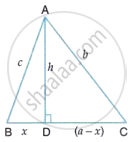
In the given figure, ∠B < 90° and segment AD ⊥ BC, show that
(i) b2 = h2 + a2 + x2 – 2ax
(ii) b2 = a2 + c2 – 2ax
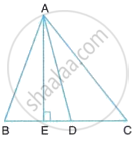
In the following figure, D is the mid-point of side BC and AE ⊥ BC. If BC = a, AC = b, AB = c, ED = x, AD = p and AE = h, prove that:
(i) `b^2 = p^2 + ax + a^2/4`
(ii) `c^2 = p^2 - ax + a^2/4`
(iii) `b^2 + c^2 = 2p^2 + a^2/2`
In right-angled triangle ABC in which ∠C = 90°, if D is the mid-point of BC, prove that AB2 = 4AD2 – 3AC2.
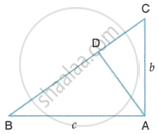
Using Pythagoras theorem determine the length of AD in terms of b and c shown in figure.
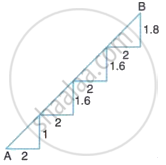
There is a staircase as shown in the given figure, connecting points A and B. Measurements of steps are marked in the figure. Find the straight line distance between A and B.
In a quadrilateral ABCD, ∠B = 90°. If AD2 = AB2 + BC2 + CD2 then prove that ∠ACD = 90°.
In ∆ABC, ray AD bisects ∠A and intersects BC in D. If BC = a, AC = b and AC = c, prove that \[BD = \frac{ac}{b + c}\].
In ∆ABC, ray AD bisects ∠A and intersects BC in D. If BC = a, AC = b and AC = c, prove that \[DC = \frac{ab}{b + c}\].
In ∆ABC, ∠A = 60°. Prove that BC2 = AB2 + AC2 − AB × AC.
In ∆ABC, ∠C is an obtuse angle. AD ⊥ BC and AB2 = AC2 + 3BC2. Prove that BC = CD.
A point D is on the side BC of an equilateral triangle ABC such that \[DC = \frac{1}{4}BC\]. Prove that AD2 = 13CD2.
In ∆ABC, if BD ⊥ AC and BC2 = 2 AC × CD, then prove that AB = AC.
In ∆ABC, given that AB = AC and BD ⊥ AC. Prove that BC2 = 2 AC × CD.
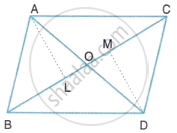
ABCD is a rectangle. Points M and N are on BD such that AM ⊥ BD and CN ⊥ BD. Prove that BM2 + BN2 = DM2 + DN2.
In ∆ABC, ∠ABC = 135°. Prove that AC2 = AB2 + BC2 + 4 ar (∆ABC).
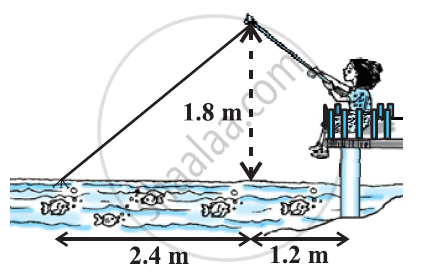
Nazima is fly fishing in a stream. The tip of her fishing rod is 1.8 m above the surface of the water and the fly at the end of the string rests on the water 3.6 m away and 2.4 m from a point directly under the tip of the rod. Assuming that her string (from the tip of her rod to the fly) is taut, how much string does she have out (see Figure)? If she pulls in the string at the rate of 5 cm per second, what will be the horizontal distance of the fly from her after 12 seconds?
R.D. Sharma solutions for Mathematics [English] Class 10 7 Triangles VERY SHORT ANSWER TYPE QUESTIONS (VSAQS) [Pages 7.100 - 7.102]
Answer each of the following questions either in one word or one sentence or as per requirement of the questions:
BASIC
State basic proportionality theorem and its converse.
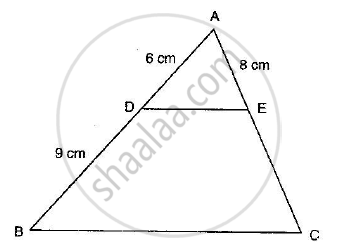
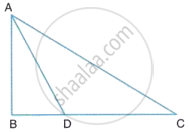
In the adjoining figure, find AC.
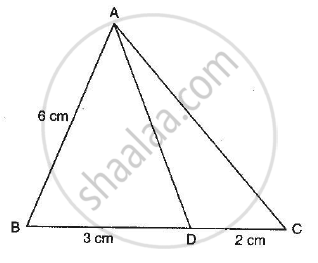
In the adjoining figure, if AD is the bisector of ∠A, what is AC?
Given `triangle ABC ~ triangle PQR`, if `(AB)/(PQ) = 1/3`, then find `(Area (triangle ABC))/(Area (triangle PQR))`.
State SSS similarity criterion.
State SAS similarity criterion.
In the adjoining figure, DE is parallel to BC and AD = 1 cm, BD = 2 cm. What is the ratio of the area of ∆ABC to the area of ∆ADE?
In the figure given below DE || BC. If AD = 2.4 cm, DB = 3.6 cm and AC = 5 cm. Find AE.
If the areas of two similar triangles ABC and PQR are in the ratio 9 : 16 and BC = 4.5 cm, what is the length of QR?
The areas of two similar triangles are 169 cm2 and 121 cm2 respectively. If the longest side of the larger triangle is 26 cm, what is the length of the longest side of the smaller triangle?
If ABC and DEF are similar triangles such that ∠A = 57° and ∠E = 73°, what is the measure of ∠C?
If the altitude of two similar triangles are in the ratio 2 : 3, what is the ratio of their areas?
If ∆ABC and ∆DEF are two triangles such that \[\frac{AB}{DE} = \frac{BC}{EF} = \frac{CA}{FD} = \frac{3}{4}\], then write Area (∆ABC) : Area (∆DEF).
If ∆ABC and ∆DEF are similar triangles such that AB = 3 cm, BC = 2 cm, CA = 2.5 cm and EF = 4 cm, write the perimeter of ∆DEF.
State Pythagoras theorem and its converse.
The lengths of the diagonals of a rhombus are 30 cm and 40 cm. Find the side of the rhombus.
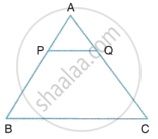
In the given figure, PQ || BC and AP : PB = 1 : 2. Find \[\frac{area \left(∆APQ \right)}{area \left(∆ABC \right)}\].
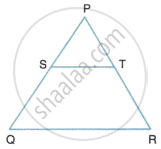
In the given figure, S and T are points on the sides PQ and PR respectively of ∆PQR such that PT = 2 cm, TR = 4 cm and ST is parallel to QR. Find the ratio of the areas of ∆PST and ∆PQR.
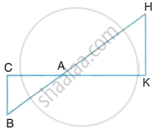
In the given figure, ∆AHK is similar to ∆ABC. If AK = 10 cm, BC = 3.5 cm and HK = 7 cm, find AC.
In the given figure, DE || BC in ∆ABC such that BC = 8 cm, AB = 6 cm and DA = 1.5 cm. Find DE.
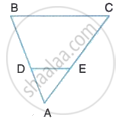
In the given figure, DE || BC and \[AD = \frac{1}{2}BD\]. If BC = 4.5 cm, find DE.
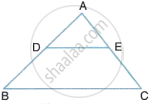
In the given figure, DE || BC, AD = 1 cm and BD = 2 cm. What is the ratio of the ar (ΔABC) to the ar (ΔADE)?
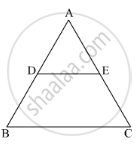
In the following figure, DE || BC. Find the length of side AD, given that AE = 1.8 cm, BD = 7.2 cm and CE = 5.4 cm.
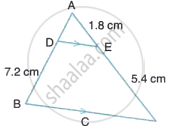
ABC is an isosceles triangle right angled at C with AC = 4 cm. Find the length of AB.
In the given figure, ABCD is a quadrilateral. Diagonal BD bisects ∠B and ∠D both.

Prove that:
- ΔABD ~ ΔCBD
- AB = BC
In the following figure, `(EA)/(EC) = (EB)/(ED)`, prove that ΔEAB ~ ΔECD.
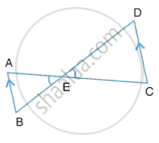
In the following, ABC is a triangle in which DE || BC, AD = 3 cm, BD = 4 cm and AC = 14 cm. Find the length of AЕ.
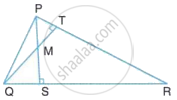
In the following figure, PQR is a triangle in which PS and QT are altitudes from P and Q respectively, intersecting each other at M. Prove that ΔQSM ~ ΔРТМ.
A 1.5 m tall boy is walking away from the base of a lamp post which is 12 m high, at the speed of 2.5 m/sec. Find the length of his shadow after 3 seconds.
In ΔABC and ΔPQR, AD and PS are altitudes such that ΔABD ~ ΔPQS and ΔACD ~ ΔPRS. Prove that ΔABC ~ ΔPQR.
In the adjoining figure, AP = 1 cm, BP = 2 cm, AQ = 1.5 cm, and AC = 4.5 cm.
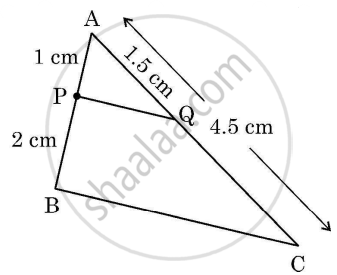
Prove that ΔАPQ ~ ΔАВС. Hence, find the length of PQ if BC = 3.6 cm.
R.D. Sharma solutions for Mathematics [English] Class 10 7 Triangles FILL IN THE BLANK TYPE QUESTIONS (FBQs) [Pages 7.103 - 7.105]
BASIC
If in two triangles ABC and PQR, `(AB)/(QR) = (BC)/(PR) = (CA)/(PQ)`, then ΔPQR ∼ ______.
D and E are respectively the points on the sides AB and AC of ΔABC such that AD = 2 cm, BD = 3 cm, BC = 7.5 cm and DE || BC. Then DE = ______.
If in two triangles DEF and PQR, ∠D = ∠Q and ∠R = ∠E, then `(DE)/(QR) = (DF)/(PQ)` = ______.
If ΔАВС ~ ΔEDF, then ______.
In ΔABC and ΔDEF, if ∠B = ∠E, ∠F = ∠C and AB = 3DE. Then, the two triangles are but not ______.
In ΔABC ∼ ΔQRP, `(ar(ΔABC))/(ar(ΔPQR)) = 9/4`, AB = 18 cm and BC = 15 cm, then PR = ______.
In an equilateral trnangle ABC, D is the mid-point of AB and E is the mid point of AC. Then ar (ΔABC) : ar (ΔADE) = ______.
If in ΔABC and ΔDEF, `(AB)/(DE) = (BC)/(FD)`, then they will be similar, when ______.
It is given that ΔABC ~ ΔPQR, with `(BC)/(QR) = 1/3`, then `(ar(ΔPRQ))/(ar(ΔBCA))` = ______.
It is given that ΔАBC ~ ΔDFE, ∠A = 30°, ∠C = 50°, AB = 5cm, AC = 8 cm and DF = 7.5 cm. Then DE = ______ and F = ______.
In ΔABC, if AB = 24 cm, BC = 10 cm and AC = 26 cm, then ∠B = ______.
The lengths of the diagonals of a rhombus are 16 cm and 12 cm. Then the length of the side of the rhombus is ______.
In an isosceles triangle ABC, if AC = BC and AB2 = 2AC2, then ∠C = ______.
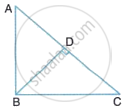
In figure, ∠BAC = 90° and AD ⊥ BC. Then, BD . CD = ______.
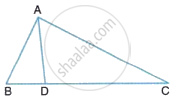
In figure, ∠ABC = 90°, BC = 10 cm, CD = 6 cm, then AD = ______.
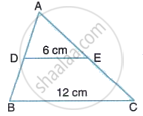
In figure, if DE || BC, then `(ar(ΔADE))/(ar(DECB)` = ______.
If ΔABC ~ ΔDEF, AB = 4 cm, DE = 6 cm, EF = 9 cm and FD = 12 cm, then the perimeter of ΔABC is ______.
The altitude of an equilateral triangle of side 8 cm is ______.
Corresponding sides of two similar triangles are in the ratio 2 : 3. If the area of the smaller triangle is 48 cm2, then the area of the larger triangle is ______.
Areas of two similar triangles are 36 cm and 100 cm If the length of a side of the larger triangle is 20 cm, then the length of the corresponding sides of the smaller triangle is ______.
Diagonals of a trapezium PQRS intersect each other at the point O. If PQ || RS and PQ = 3RS, then `(ar(ΔPOQ))/(ar(ΔROS))` = ______.
ABCD is a trapezium in which AB || DC and P and Q are the points on AD and BC, respectively, such that PQ || DC. If PD = 18 cm, BQ = 35 cm and QC = 15 cm, then AD = ______.
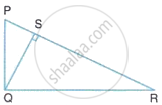
In figure, PQR is a right triangle right angled at Q and QS ⊥ PR. If PQ = 6 cm and PS = 4 cm, then perimeter of ΔQSR is ______.
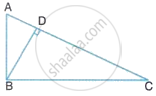
In figure, ABC is a triangle right angled at B and BD ⊥ AC. If AD = 4 cm and CD = 5 cm, then BD = ______ and AB = ______.
BASED ON LOTS
In figure, if ∠ACB = ∠CDA, AC = 8 cm and AD = 3 cm, then BD = ______.
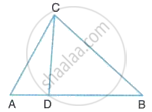
A 15 metres high tower casts a shadow 24 metres long at a certain time and at the same time, a telephone pole casts a shadow 16 metres long. The height of the telephone pole is ______.
In figure, if ∠A = ∠C, AB = 6 cm, BP = 15 cm, AP = 12 cm and CP = 4 cm, then PD = ______ and CD = ______.
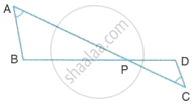
A flag pole 18 m high casts a shadow 9.6 m long. The distance of the top of the pole from the far end of the shadow is ______.
If it is given that ΔАBС ~ ΔEDF such that AB = 5 cm, AC = 7 cm, DF = 15 cm and DE = 12 cm. Then, BC = ______ and EF = ______.
In two triangles ABC and DEF, ∠A = ∠D and the sum of the angles A and B is equal to the sum of the angles D and E. If BC = 6 cm and EF = 8 cm, then ar (ΔABC) : ar (ΔDEF) = ______.
In ΔABC, sides AB and AC are extended to D and E respectively, such that AB = BD and AC = CE. If BC = 6 cm, then DE = ______.
In figure, AB || PR and ar (ΔPAB) : ar (ΔPQR) = 1 : 2 Then PQ : AQ = ______.
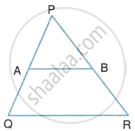
In figure, ∠ABC = 90°, AD = 15 cm and DC = 20 cm. If BD is the bisector of ∠ABC, then perimeter of ΔABC is ______.
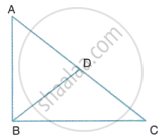
In figure, ∠AВC = 90°, AB : BD : DC = 3 : 1 : 3. If AC = 20 cm, then AD = ______.
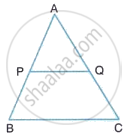
In figure, PQ || BC and PQ: BC = 1 : 3. If ar (ΔABC) = 144 cm2, then ar (ΔAPQ) = ______.
ΔABC is an equilateral triangle of side 2a, then length of one of its altitude is ______.
Solutions for 7: Triangles
R.D. Sharma solutions for Mathematics [English] Class 10 chapter 7 - Triangles
Shaalaa.com has the CBSE, Karnataka Board Mathematics Mathematics [English] Class 10 CBSE, Karnataka Board solutions in a manner that help students grasp basic concepts better and faster. The detailed, step-by-step solutions will help you understand the concepts better and clarify any confusion. R.D. Sharma solutions for Mathematics Mathematics [English] Class 10 CBSE, Karnataka Board 7 (Triangles) include all questions with answers and detailed explanations. This will clear students' doubts about questions and improve their application skills while preparing for board exams.
Further, we at Shaalaa.com provide such solutions so students can prepare for written exams. R.D. Sharma textbook solutions can be a core help for self-study and provide excellent self-help guidance for students.
Concepts covered in Mathematics [English] Class 10 chapter 7 Triangles are Ratios of Areas of Two Triangles, Similarity of Triangles (Corresponding Sides & Angles), Property of an Angle Bisector of a Triangle, Property of Three Parallel Lines and Their Transversals, Basic Proportionality Theorem, Overview of Similarity, Theorem of Areas of Similar Triangles.
Using R.D. Sharma Mathematics [English] Class 10 solutions Triangles exercise by students is an easy way to prepare for the exams, as they involve solutions arranged chapter-wise and also page-wise. The questions involved in R.D. Sharma Solutions are essential questions that can be asked in the final exam. Maximum CBSE, Karnataka Board Mathematics [English] Class 10 students prefer R.D. Sharma Textbook Solutions to score more in exams.
Get the free view of Chapter 7, Triangles Mathematics [English] Class 10 additional questions for Mathematics Mathematics [English] Class 10 CBSE, Karnataka Board, and you can use Shaalaa.com to keep it handy for your exam preparation.
