Advertisements
Chapters
1: Natural Resources and Their Use
Theme B - Tapestry of the Past
▶ 2: Reshaping India’s Political Map
3: The Rise of the Marathas
4: The Colonial Era in India
Theme D - Governance and Democracy
5: Universal Franchise and India’s Electoral System
6: The Parliamentary System: Legislature and Executive
Theme E - Economic Life Around Us
7: Factors of Production
![NCERT solutions for Social Science Exploring Society India and Beyond Part 1 [English] Class 8 chapter 2 - Reshaping India’s Political Map - Shaalaa.com](/images/social-science-exploring-society-india-and-beyond-part-1-english-class-8_6:3e627fd65b524f34acf9d20b9e3e4ded.jpg "NCERT solutions for Social Science Exploring Society India and Beyond Part 1 [English] Class 8 chapter 2 - Reshaping India’s Political Map")
Advertisements
Solutions for Chapter 2: Reshaping India’s Political Map
Below listed, you can find solutions for Chapter 2 of CBSE NCERT for Social Science Exploring Society India and Beyond Part 1 [English] Class 8.
NCERT solutions for Social Science Exploring Society India and Beyond Part 1 [English] Class 8 2 Reshaping India’s Political Map Intext Questions [Pages 21 - 52]
The Big Questions
How did foreign invasions and the rise of new dynasties reshape India’s political boundaries during this period?
How did Indian society respond to invasions?
How did India’s economy adapt during times of political instability?
What impact did this period have on the lives of the people?
LET’S EXPLORE
Looking at Fig., why do you think Ala-ud-din Khilji called himself ‘the second Alexander’?
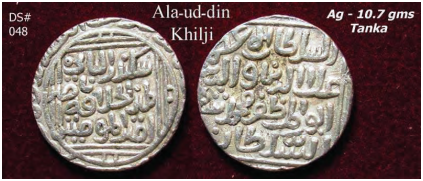
What kind of resources do you think were needed to maintain an army and wage war in those days? Discuss in groups the various types of expenditure involved, from weapons or food for soldiers to animals used in warfare, road construction, etc.
THINK ABOUT IT
Why do we use the term ‘image’ rather than common terms like ‘idol’ or ‘icon’? The latter two terms are considered pejorative in the context of Judaism, Christianity and Islam, whose orthodox sects condemn ‘idolatry’ or the worship of ‘idols’ or ‘icons’.
India’s classical texts used words like mūrti, vigraha, pratimā, rūpa, etc., to designate images, often statues, used for worship in temples or homes. In English, ‘image’ is a neutral term.
During the time of the Tughlaqs, the Musunuri Nayakas, Telugu chieftains, rallied over 75 more chieftains of the region, formed a confederacy that defeated smaller provinces, formed a confederacy that defeated the Delhi Sultanate forces, and expelled Muhammad bin Tughlaq’s army from Warangal (present-day Telangana) around 1330-1336. Do you think it would have been an easy task to bring together 75 leaders in those days?
DON’T MISS OUT
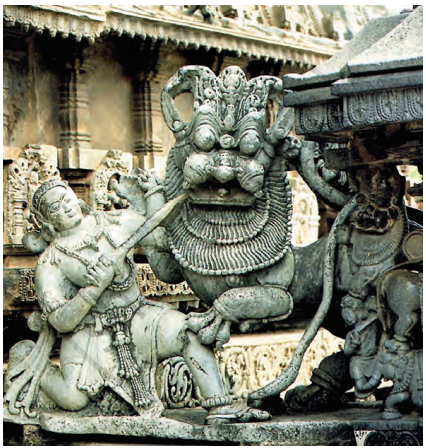
The sculpture in Fig. narrates the story behind the Hoysalas’ emblem. Kannada folklore recounts the story of Sala, a young man who fought a lion to save his guru, giving the dynasty its name - ‘Hoy (strike)! Sala’.
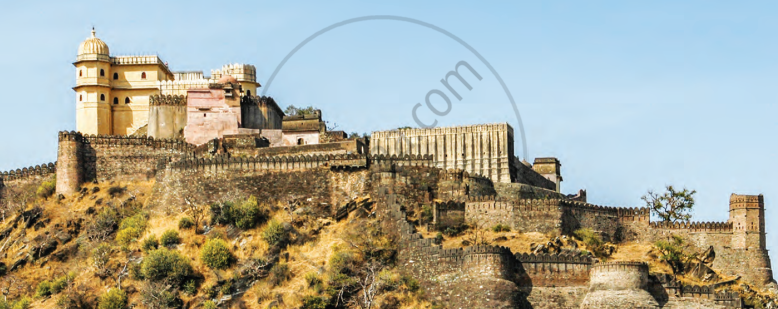
Kumbhalgarh Fort Fig. was built by Rana Kumbha in the 15th century in the Aravalli hills and served as a stronghold for the rulers of Mewar, a prominent Rajput kingdom (in the central and southern parts of today’s Rajasthan). Surrounded by forests and steep slopes, it is famous for its massive 36-kilometre-long wall, one of the longest continuous walls in the world.
LET’S EXPLORE
Why do you think such locations were chosen for many of the medieval forts? Discuss pros and cons. (Hint: think of issues of strategy, security, vulnerability, etc.)
THINK ABOUT IT
Have you noticed the term pati in titles like ‘Gajapati’? Pati means ‘lord’ or ‘master’ and was commonly used by many ruling dynasties of this period to signify power and stature. The Vijayanagara kings were called ‘Narapati’, the Bahmani Sultanate rulers ‘Ashwapati’, and the Maratha rulers ‘Chhatrapati’ - each title reflecting different aspects of kingship and power. Can you guess what these three terms might mean?
LET’S EXPLORE
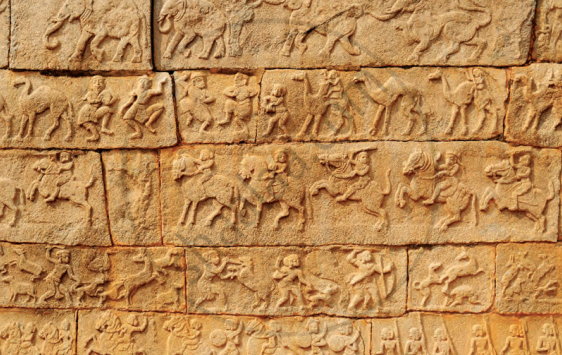
In Fig., what elements do you observe? What do they tell you about life then? (Hint: observe the weapons, the animals, the activities.)
THINK ABOUT IT
What strikes you in Babur’s impressions of India? Discuss in groups.
THINK ABOUT IT
Why do you think Akbar employed different strategies to expand his empire, while the earlier rulers of Delhi relied mostly on military might?
LET’S EXPLORE
Compare the maps. What differences do you notice? What is the ‘reshaping’ that has occurred?
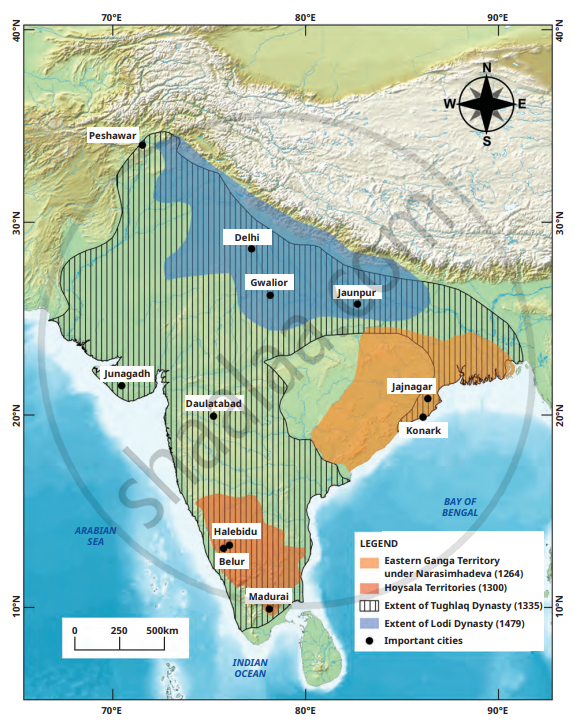
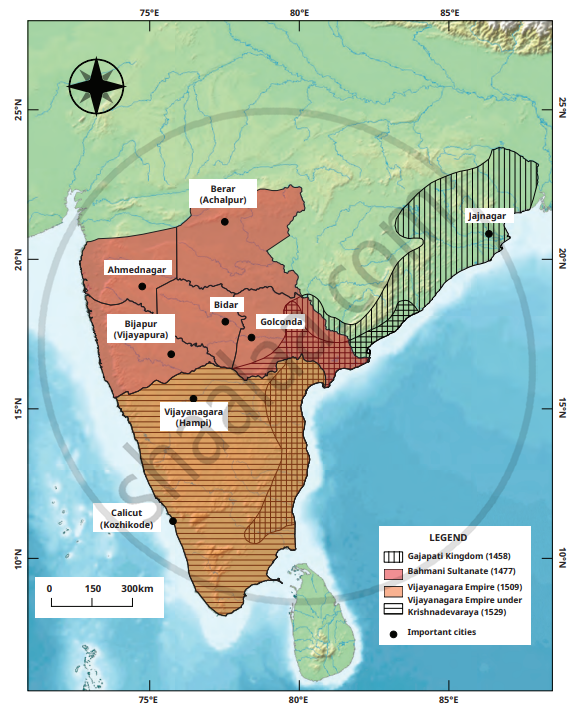
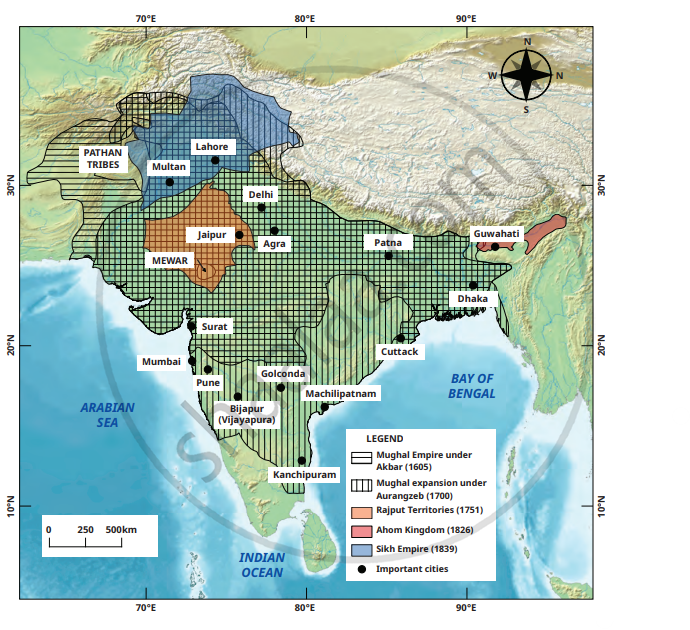
THINK ABOUT IT
We saw above that Delhi sultans’ average reign lasted about nine years. This figure becomes 27 years in the case of Mughal emperors up to Aurangzeb and 16 years if we consider all Mughal rulers, up to the end of the empire in the 19th century. What do you make of these numbers of years of reign?
LET’S EXPLORE
In his last letters to two of his sons, Aurangzeb wrote, “I came alone and am going away alone. I know not who I am and what I have been doing. … I have not done well for the country and the people, and of the future there is no hope. I was helpless [in life] and I am departing helpless.” What do these words tell us about Aurangzeb? How do you feel about them?
Discuss in class how the paik system affected the daily lives of the people in the Ahom kingdom, both in terms of challenges and benefits, and helped the king manage both the army and the economy.
LET’S EXPLORE
How did the Ahoms use the rivers, hills and forests of Assam to their advantage? Can you think of ways in which the geography helped them build defences and fight wars?
THINK ABOUT IT
Why do you think Guru Tegh Bahadur endured torture rather than convert? Why did he think his sacrifice would make a difference?
What values did the Sikh Gurus and the Khalsa embody?
How are they relevant in today’s world?
NCERT solutions for Social Science Exploring Society India and Beyond Part 1 [English] Class 8 2 Reshaping India’s Political Map Questions and activities [Page 59]
Compare the political strategies of the Delhi Sultanate and the Mughals. What similarities existed between them?
Compare the political strategies of the Delhi Sultanate and the Mughals. What differences existed between them?
Why did kingdoms like the Vijayanagara Empire and the Ahom Kingdom manage to resist conquest for a longer time compared to others? What geographical, military, and social factors contributed to their success?
Imagine you are a scholar in the court of Akbar or Krishnadevaraya. Write a letter to a friend describing the politics, trade, culture, and society you are witnessing.
How come Akbar, a ruthless conqueror in his young days, grew tolerant and benevolent after some years? What could have led to such a change?
What might have happened if the Vijayanagara Empire had won the Battle of Talikota? Imagine and describe how it could have changed the political and cultural history of south India.
Many values promoted by early Sikhism, including equality, seva, and justice, remain relevant today. Select one of these values and discuss how it remains relevant in contemporary society.
Imagine you are a trader in a port city (Surat, Calicut or Hooghly). Describe the scenes you see as regards goods, people you trade with, movement of ships, etc.
Solutions for 2: Reshaping India’s Political Map
NCERT solutions for Social Science Exploring Society India and Beyond Part 1 [English] Class 8 chapter 2 - Reshaping India’s Political Map
Shaalaa.com has the CBSE Mathematics Social Science Exploring Society India and Beyond Part 1 [English] Class 8 CBSE solutions in a manner that help students grasp basic concepts better and faster. The detailed, step-by-step solutions will help you understand the concepts better and clarify any confusion. NCERT solutions for Mathematics Social Science Exploring Society India and Beyond Part 1 [English] Class 8 CBSE 2 (Reshaping India’s Political Map) include all questions with answers and detailed explanations. This will clear students' doubts about questions and improve their application skills while preparing for board exams.
Further, we at Shaalaa.com provide such solutions so students can prepare for written exams. NCERT textbook solutions can be a core help for self-study and provide excellent self-help guidance for students.
Concepts covered in Social Science Exploring Society India and Beyond Part 1 [English] Class 8 chapter 2 Reshaping India’s Political Map are .
Using NCERT Social Science Exploring Society India and Beyond Part 1 [English] Class 8 solutions Reshaping India’s Political Map exercise by students is an easy way to prepare for the exams, as they involve solutions arranged chapter-wise and also page-wise. The questions involved in NCERT Solutions are essential questions that can be asked in the final exam. Maximum CBSE Social Science Exploring Society India and Beyond Part 1 [English] Class 8 students prefer NCERT Textbook Solutions to score more in exams.
Get the free view of Chapter 2, Reshaping India’s Political Map Social Science Exploring Society India and Beyond Part 1 [English] Class 8 additional questions for Mathematics Social Science Exploring Society India and Beyond Part 1 [English] Class 8 CBSE, and you can use Shaalaa.com to keep it handy for your exam preparation.
