Advertisements
Chapters
2: Cell: The Building Block of Life
3: Tissues in Action
▶ 4: Describing Motion Around Us
5: Exploring Mixtures and their Separation
6: How Forces Affect Motion
7: Work, Energy, and Simple Machines
Chapter 8: Journey Inside the Atom
Chapter 9: Atomic Foundations of Matter
Chapter 10: Sound Waves: Characteristics and Applications
Chapter 11: Reproduction: How Life Continues
Chapter 12: Patterns in Life: Diversity and Classification
Chapter 13: Earth as a System: Energy, Matter, and Life
![NCERT solutions for Science Exploration [English] Class 9 chapter 4 - Describing Motion Around Us - Shaalaa.com](/images/science-exploration-english-class-9_6:fe60d22a299f466891137f05891ccc52.jpg "NCERT solutions for Science Exploration [English] Class 9 chapter 4 - Describing Motion Around Us")
Advertisements
Solutions for Chapter 4: Describing Motion Around Us
Below listed, you can find solutions for Chapter 4 of CBSE NCERT for Science Exploration [English] Class 9.
NCERT solutions for Science Exploration [English] Class 9 4 Describing Motion Around Us Intext Questions [Pages 48 - 53]
Think It Over
How much distance should we maintain from the truck ahead to avoid a collision if it suddenly applies the brakes?
Does this distance depend upon the speed with which we are moving?
Pause and Ponder
In the example of an athlete running back and forth on a straight track (Fig.), when will the displacement of the athlete be zero? What will be the total distance travelled in that case?
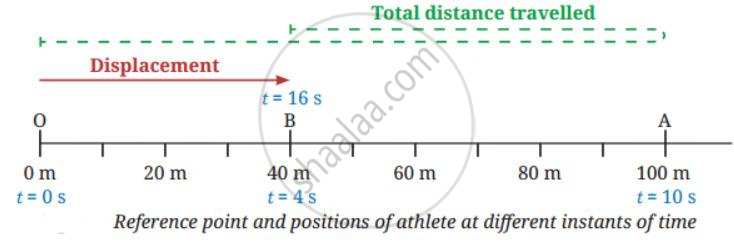
Fuel used up in a vehicle depends on which of the following? Justify your answer.
- Total distance travelled
- Displacement
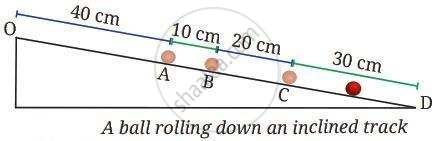
A ball rolls down an inclined track as shown in Fig 1. Is its motion, a straight line motion? Assuming the starting point of the ball (O) to be the origin, can its motion from O to D be depicted using a horizontal line as shown in Fig. 2? Are the values of total distance travelled and magnitude of displacement from O equal or different at positions A, B, C and D?
1.
2.

During a family road trip, you drive 200 km north in three hours. Afterwards, you drive 200 km south in two hours. Find the average speed and average velocity for your entire trip.
Under what condition(s) is the magnitude of average velocity of an object equal to its average speed?
Under what condition(s) is the magnitude of average velocity of an object zero while its average speed is not zero?
NCERT solutions for Science Exploration [English] Class 9 4 Describing Motion Around Us Revise, Reflect, Refine [Pages 68 - 70]
My father went to a shop from home which is located at a distance of 250 m on a straight road. On reaching there, he discovered that he forgot to carry a cloth bag. He came home to take it, went to the shop again, bought provisions and came back home. How much was the total distance travelled by him? What was his displacement from home?
A student runs from the ground floor to the fourth floor of a school building to collect a book and then comes down to their classroom on the second floor. If the height of each floor is 3 m, find:
- the total vertical distance travelled, and
- their displacement from the starting point
A girl is riding her scooter and finds that its speedometer reading is constant. Is it possible for her scooter to be accelerating and if so, how?
A car starts from rest and its velocity reaches 24 m s–1 in 6 s. Find the average acceleration and the distance travelled in these 6 s.
A motorbike moving with initial velocity 28 m s–1 and constant acceleration stops after travelling 98 m. Find the acceleration of the motorbike and the time taken to come to a stop.
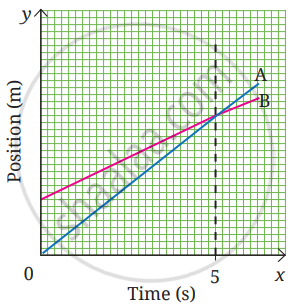
Fig. shows a position-time graph of two objects A and B that are moving along the parallel tracks in the same direction. Do objects A and B ever have equal velocity? Justify your answer.
A graph in Fig. shows the change in position with time for two objects A and B moving in a straight line from 0 to 10 seconds. Choose the correct option(s).
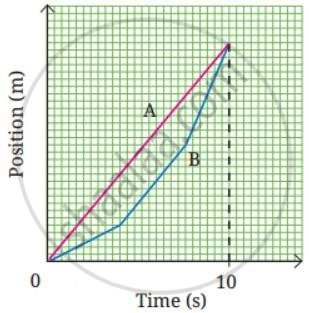
The average velocity of both over the 10 s time interval is equal since they have the same initial and final positions.
The average speeds of both over the 10 s time interval are equal since both cover equal distance in equal time.
The average speed of A over the 10 s time interval is lower than that of B since it covers a shorter distance than B in 10 seconds.
The average speed of A over the 10 s time interval is greater than that of B since B’s speed is lower than A’s in some segments.
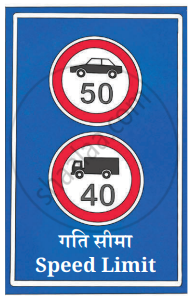
A truck driver driving at the speed of 54 km h–1 notices a road sign with a speed limit of 40 km h–1 (Fig.) for trucks. He slows down to 36 km h–1 in 36 s. What was the distance travelled by him during this time? Assume the acceleration to be constant while slowing down.
A car starts from rest and accelerates uniformly to 20 m s–1 in 5 seconds. It then travels at 20 m s–1 for 10 seconds and finally applies the brake (with uniform acceleration) to stop in 6 seconds. Find the total distance travelled.
A bus is travelling at 36 km h–1 when the driver sees an obstacle 30 m ahead. The driver takes 0.5 seconds to react before pressing the brake. Once the brake is applied, the velocity of the bus reduces with constant acceleration of 2.5 m s–2. Will the bus be able to stop before reaching the obstacle?
A student said, “The Earth moves around the Sun”. In this context, discuss whether an object kept on the Earth can be considered to be at rest.
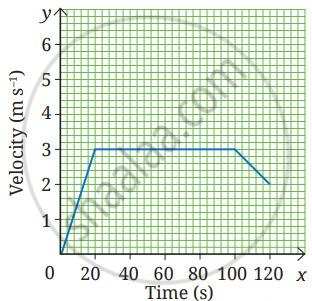
The velocity-time graph from 0 s to 120 s for a cyclist is shown in the Fig. Shade the areas (in different colours) representing the displacement of the cyclist
- while cyclist is moving with constant velocity.
- when the velocity of cyclist is decreasing.
Also, calculate the displacement and average acceleration in the 120 s time interval.
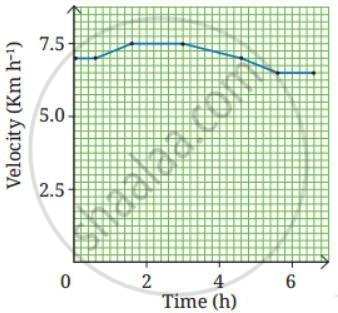
A girl is preparing for her first marathon by running on a straight road. She uses a smartwatch to calculate her running speed at different intervals. The graph (Fig.) depicts her velocity versus time. Estimate the running distance based on the graph.
On entering a state highway, a car continues to move with a constant velocity of 6 m s–1 for 2 minutes and then accelerates with a constant acceleration 1 m s–2 for 6 seconds. Find the displacement of the car on the state highway in the 2 min 6 s time interval by drawing a velocity-time graph for its motion.
Two cars A and B start moving with a constant acceleration from rest in a straight line. Car A attains a velocity of 5 m s–1 in 5 s. Car B attains a velocity of 3 m s–1 in 10 s. Plot the velocity-time graphs for both the cars in the same graph. Using the graph, calculate the displacement mentioned in the two time intervals (Hint: Calculate the acceleration in both cases. Then calculate their velocities at five instants of time to plot the graph).
Rohan studies science from 6 PM to 7:30 PM at home. Consider the tip of the minute’s hand of the wall clock. During the given time interval, what is its:
- distance travelled,
- displacement,
- speed, and
- velocity.
The length of the minute’s hand is 7 cm (Fig.).

NCERT solutions for Science Exploration [English] Class 9 4 Describing Motion Around Us The Journey Beyond [Page 71]
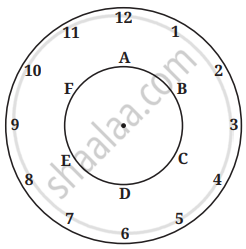
Take a cardboard disc (radius ~ 8 cm) (Fig.). Write numbers 1 to 12 on the outer part (7 cm from the centre) and the letters ‘ABCDEF’ on the inner part (4 cm from the centre), using the same font size. Spin the disc slowly, then faster and observe how the numbers and letters appear. Why do the numbers fade or disappear while the letters remain visible? Are the speeds of the numbers and letters the same or different? Justify your answer.
Many smartphones have an inbuilt accelerometer that can detect very small accelerations. Install an app, such as Phyphox (phyphox.org) and open ‘Accelerometer’ (without g). Note the readings when (i) the phone is on an outstretched palm, and (ii) the phone is kept on the floor. What differences do you observe? What does this tell you about motion and acceleration in real situations? (Such tiny, involuntary movements are also studied in medical research, for example, in movement disorders) This activity is recommended to be performed as a classroom group activity facilitated by teacher.
For motion in a straight line with constant acceleration, we derived two primary equations given by Eq. (v = u + at) and (s = ut + `1/2 xx at^2`). Using these two equations, three more equations can be derived, out of which we derived one given in Eq. (v2 = u2 + 2as). Derive the remaining two equations given below
`s = vt - 1/2 at^2 s = 1/2 (u + v)t`
In mathematics, you have learnt the formula for calculating the area of a trapezium. Using that formula, derive the second equation given above.
Plot graphs for data given in the Table, using different X and Y scales, on different graph papers. Compare the graphs to find how the appearance of graph is affected by the choice of scales and decide which scale is better and why. Now repeat this with any graph plotting app. Such apps generally automatically adjust the axes to fit the data well on the screen.
| Time | Position |
| 0 s | 0 m |
| 2 s | 1 m |
| 4 s | 4 m |
| 6 s | 9 m |
| 8 s | 16 m |
| 10 s | 25 m |
| 12 s | 36 m |
Talk to a motor mechanic about how a vehicle’s braking or stopping distance is affected by: (i) wet roads, (ii) worn-out tyres, (iii) higher vehicle mass, (iv) driving at night, (v) fog, (vi) severe weather (rain, snow, storm), and (vii) driver reaction time. Using this information, design safety posters for your school and prepare a short skit to present it in the assembly.
Solutions for 4: Describing Motion Around Us
NCERT solutions for Science Exploration [English] Class 9 chapter 4 - Describing Motion Around Us
Shaalaa.com has the CBSE Mathematics Science Exploration [English] Class 9 CBSE solutions in a manner that help students grasp basic concepts better and faster. The detailed, step-by-step solutions will help you understand the concepts better and clarify any confusion. NCERT solutions for Mathematics Science Exploration [English] Class 9 CBSE 4 (Describing Motion Around Us) include all questions with answers and detailed explanations. This will clear students' doubts about questions and improve their application skills while preparing for board exams.
Further, we at Shaalaa.com provide such solutions so students can prepare for written exams. NCERT textbook solutions can be a core help for self-study and provide excellent self-help guidance for students.
Concepts covered in Science Exploration [English] Class 9 chapter 4 Describing Motion Around Us are .
Using NCERT Science Exploration [English] Class 9 solutions Describing Motion Around Us exercise by students is an easy way to prepare for the exams, as they involve solutions arranged chapter-wise and also page-wise. The questions involved in NCERT Solutions are essential questions that can be asked in the final exam. Maximum CBSE Science Exploration [English] Class 9 students prefer NCERT Textbook Solutions to score more in exams.
Get the free view of Chapter 4, Describing Motion Around Us Science Exploration [English] Class 9 additional questions for Mathematics Science Exploration [English] Class 9 CBSE, and you can use Shaalaa.com to keep it handy for your exam preparation.
