Advertisements
Advertisements
Question
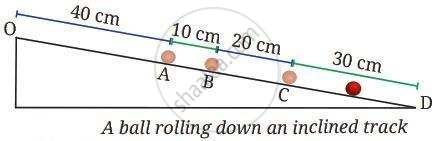
A ball rolls down an inclined track as shown in Fig 1. Is its motion, a straight line motion? Assuming the starting point of the ball (O) to be the origin, can its motion from O to D be depicted using a horizontal line as shown in Fig. 2? Are the values of total distance travelled and magnitude of displacement from O equal or different at positions A, B, C and D?
1.
2.

Advertisements
Solution
Yes, the ball exhibits straight-line motion because it moves along a straight inclined path without reversing its direction.
Its movement from O to D can also be represented by a horizontal straight line, as shown in Fig. 2. This representation is valid because the ball travels along a single straight path in one direction. By taking O as the reference point, the positions A, B, C, and D can be marked on a horizontal line according to their distances from O, even though the actual path is inclined.
At positions A, B, C, and D, the total distance travelled by the ball from O is equal to the magnitude of its displacement.
Reason: Since the ball moves continuously in one direction without changing course or turning back, the path length covered from O to any position is exactly the same as the straight-line distance from O to that position. Therefore, at each of the points A, B, C, and D, the distance travelled and the magnitude of displacement are equal.
