Advertisements
Advertisements
Question
Talk to a motor mechanic about how a vehicle’s braking or stopping distance is affected by: (i) wet roads, (ii) worn-out tyres, (iii) higher vehicle mass, (iv) driving at night, (v) fog, (vi) severe weather (rain, snow, storm), and (vii) driver reaction time. Using this information, design safety posters for your school and prepare a short skit to present it in the assembly.
Advertisements
Solution
The mechanic explained that a vehicle’s braking or stopping distance increases under the following conditions:
- Wet roads: Tyres have less grip, so the vehicle takes longer to stop.
- Worn-out tyres: Reduced tyre tread decreases friction, increasing stopping distance.
- Higher vehicle mass: A heavier vehicle has more momentum and requires a longer distance to stop.
- Driving at night: Poor visibility delays the driver’s reaction time.
- Fog: Reduced visibility makes it difficult to see obstacles early, increasing stopping distance.
- Severe weather (rain, snow, storm): Slippery roads and poor visibility increase braking distance.
- Driver reaction time: A distracted or tired driver reacts more slowly, causing the vehicle to travel farther before braking.
Safety Poster:
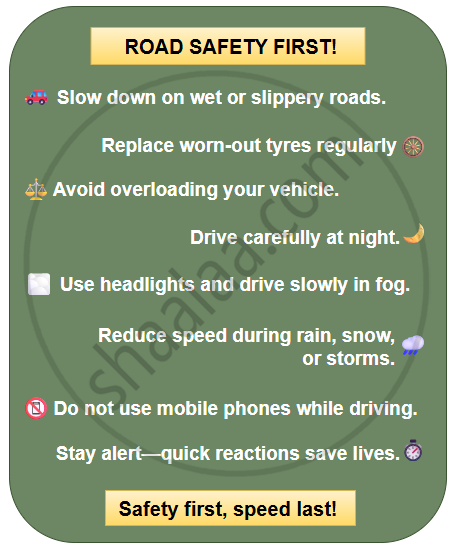
3-Minute Assembly Skit Sketch:
- The Narrator (Holds a stopwatch or whiteboard)
- Alex (The Distracted/Careless Driver)
- The Mechanic (Dressed in overalls, holding a wrench or clipboard)
[SCENE START]
(Alex stands centre-stage, holding a cardboard steering wheel, looking casual. The Mechanic stands to the right, looking sharp. The Narrator stands to the left.)
| Narrator: | Good morning, school! Today, we are looking inside the anatomy of a car crash. Alex is driving down a neighbourhood street at 50 kilometres per hour. Everything seems fine. |
| Alex: | (Smiling) Great music, roads look okay. Let me just check this text message real quick... (Pretends to look down at a phone) |
| Narrator: |
Suddenly, a ball rolls into the street, followed by a child! FREEZE!
(Alex freezes in place.)
|
| Narrator: | Enter the Mechanic. What are Alex’s chances of stopping in time? |
| Mechanic: | (Steps forward, tapping the clipboard) Mechanically? Right now? Terrible. It rained an hour ago. The road is slick. Plus, I looked at Alex’s car yesterday, and those front tyres are completely bald. No tread left to grip the asphalt! |
| Narrator: | Let’s calculate the human factor. Alex is looking at a phone screen. |
| Mechanic: | Exactly. The average alert driver takes 1 second to react. Because Alex is texting, that reaction time triples to 3 seconds. At 50 kilometres per hour, Alex’s car will travel 42 meters before his foot even touches the brake pedal! That’s almost half a football field while blind folded! |
| Narrator: | And once he finally hits the brakes on this wet road with bald tyres? |
| Mechanic: | Normally, a car stops in about 12 meters at this speed. But with water on the road and bald tyres? Multiply that braking distance by three. It will take 36 meters just to slide to a halt! |
| Narrator: | Total stopping distance needed: 78 meters. Alex, UNFREEZE! (Alex unfreezes, gasps, stomps hard on an imaginary brake pedal, and loses balance, sliding forward dramatically before stopping.) |
| Alex: | (Looking terrified, staring ahead) I... I wouldn’t have stopped in time. I would have hit them. |
| Mechanic: | (Puts a hand on Alex’s shoulder) The brakes work fine, Alex. But they can’t beat the laws of physics. When you add heavy rain, bad tyres, or a distracted brain, your stopping distance multiplies faster than you can think. |
| Narrator: | (Steps to center stage) Keep your tyres treaded, your eyes on the road, and your speed low during bad weather. Don’t let a 2-second distraction turn into a lifetime of regret. |
| All Together: | Drive smart, stay alert, and arrive safe! |
[SCENE END]
Notes
Students may perform the above skit in their classroom or during the school assembly to promote road safety awareness.
