Advertisements
Online Mock Tests
Chapters
1: Cell Cycle and Cell Division
2: Structure of Chromosome
3: Genetics
Unit 2: Plant Physiology
4: Absorption by Roots
5: Transpiration
6: Photosynthesis
7: Chemical Coordination in Plants
Unit 3: Human Anatomy and Physiology
8: Circulatory System
▶ 9: Human Excretory System
10: Nervous System
11: Sense Organs
12: Endocrine System
13: Reproductive System
Unit 4: Population
14: Population
Unit 5: Human Evolution
15: Human Evolution
Unit 6: Pollution
16: Pollution
![Lakhmir Singh solutions for Biology [English] Class 10 ICSE chapter 9 - Human Excretory System - Shaalaa.com](/images/biology-english-class-10-icse_6:7181a54a5d284da8b50dd2f92022a1f6.jpg "Lakhmir Singh solutions for Biology [English] Class 10 ICSE chapter 9 - Human Excretory System")
Advertisements
Solutions for Chapter 9: Human Excretory System
Below listed, you can find solutions for Chapter 9 of CISCE Lakhmir Singh for Biology [English] Class 10 ICSE.
Lakhmir Singh solutions for Biology [English] Class 10 ICSE 9 Human Excretory System Intex Quesions [Pages 143 - 151]
THINK AND ANSWER
Give reason why ammonotelism is found in most aquatic animals while terrestrial animals are ureotelic.
Does being uricotelic act as a flight adaptation in birds?
TEST YOUR UNDERSTANDING -1
True or False.
Carbon dioxide is expelled from sweat glands.
True or False.
Bony fishes excrete nitrogenous waste in the form of uric acid.
True or False.
Human kidneys expel out ammonia, uric acid and urea.
Fill in the Blanks
The process of elimination of metabolic nitrogenous wastes is called ______.
______ secretes the bile pigments, some of which are excreted through urine.
The prime function of sweat glands is ______.
______ are the long tubes which carry urine from the kidney to the urinary bladder.
The opening of the urinary bladder through which the urine is passed out of the body is called ______.
TEST YOUR UNDERSTANDING - 2
True or False.
Kidneys are situated one on either side of the backbone in the thoracic cavity.
True or False.
The medulla region of the kidney is divided into few conical pyramids.
True or False.
Malpighian body consists of glomerulus and Bowman's capsule.
True or False.
Vasa recta forms the tuft of blood capillaries in the glomerulus.
True or False.
The ascending limb of the Henle's loop opens in the collecting duct.
Give One- or Two-Word Answer.
Part of renal tubule which looks like a hairpin.
Give One- or Two-Word Answer:
Another name of Malpighian body.
Give One- or Two-Word Answer:
Blood vessel coming out of glomerulus.
TEST YOUR UNDERSTANDING - 3 Multiple Choice Questions
Which among the following is not a step in urine formation?
Ultrafiltration
Reabsorption
Tubular Secretion
Efferent Arteriole
The factor(s) responsible for ultrafiltration is/are:
Difference in the width of afferent and efferent arteriole
Generation of the hydrostatic pressure
Ureteral peristalsis
Both the difference in the width of afferent and efferent arterioles and the generation of hydrostatic pressure.
The percentage of the constituents in the glomerular filtrate that are reabsorbed is ______.
25%
55%
95%
99%
The step involved in the elimination of the drugs is ______.
Ultrafiltration
Reabsorption
Tubular secretion
Glomerular filtration
Minimum reabsorption and secretion occur in ______.
PCT
DCT
Henle's loop
Collecting duct
TEST YOUR UNDERSTANDING - 4
Give One Word Answer:
Process of regulating body fluids and their composition.
Give One Word Answer:
The brain part responsible for regulation of urine formation.
Give One Word Answer:
Another name for ADH.
Fill in the Blanks
The process of elimination of urine through the urethral opening is called ______.
The excess sugar present in the urine indicates towards a disorder called ______.
______ hormone is secreted from the posterior pituitary to regulate urine formation.
Kidney failure leads to the accumulation of urea in the body leading to a disease called ______.
Artificial kidney helps in removing wastes from the blood by ______.
Lakhmir Singh solutions for Biology [English] Class 10 ICSE 9 Human Excretory System EXERCISE [Pages 153 - 156]
Objective Questions True or False
True or False.
Inner structure of the kidney has two zones, an outer medulla and inner cortex.
True or False.
Urea, a common nitrogenous waste is produced by the liver.
True or False.
Osmoregulation is the process of expelling the urine out of the body.
True or False.
Ultrafiltration occurs in the PCT.
True or False.
Accumulation of urea in the blood is called diuresis.
Fill in the Blanks
______ limb of the loop of Henle continues into the DCT.
Ultrafiltration is the ______ step in urine formation.
Urine is removed from the body by a process called ______.
______ is the part closest to the Bowman's capsule.
Blood from the dorsal aorta is poured into the ______ artery.
Match the Following:
| Column I | Column II |
|---|---|
| (i) Kidney | (a) Cup shaped |
| (ii) Bowman's capsule | (b) U shaped |
| (iii) Henle's loop | (c) Bean shaped |
| (iv) Vasa recta | (d) Hairpin shaped |
| (v) Uraemia | (e) Deposits of salts |
| (vi) Kidney stones | (f) Excess of urea |
| (vii) Diabetes insipidus | (g) Excess of glucose |
| (viii) Glycosuria | (h) Insufficient ADH |
Give One Word Answer:
What is the name of the blood vessel running parallel to the loop of Henle?
Give One Word Answer:
Bowman's capsule together with the glomerulus is called ______.
Give One Word Answer:
Which hormone regulates the amount of water to be excreted?
Give One Word Answer:
In which part of the body does the filtrate get concentrated finally to form urine?
Give One Word Answer:
Give the name of the method by which the nitrogenous wastes are removed from the blood of a patient with malfunctioning kidneys.
Give a technical term:
The duct which transports urine from the kidney to the urinary bladder.
Name the following:
The blood vessel which supplies blood to the liver.
Multiple Choice Questions
Human beings expel the nitrogenous wastes mostly in the form of ______.
Urea
Uric acid
Ammonia
Ammonium chloride
Vasa recta is ______.
L-shaped
M-shaped
U-shaped
V-shaped
The blood vessel carrying blood away from the glomerulus is ______.
afferent arteriole
efferent arteriole
vasa recta
renal artery
Which of the following is the function of kidneys?
Excretion
Osmoregulation
Homeostasis
All of these
All of these constitute the part of nephron except:
Bowman's capsule
Henle's loop
DCT
Renal pelvis
The disorder caused due to insufficient ADH hormone is ______.
Diabetes mellitus
Diabetes insipidus
Haematuria
Ketonuria
The pH of the urine can be described as ______.
Strongly acidic
Strongly alkaline
Slightly acidic
Neutral
The notch present in the median surface of each kidney is called ______.
Hilum
Ureter
Pelvis
Cortex
The process of regulating body fluids and their compositions is called ______.
Haemostasis
Osmoregulation
Thermoregulation
Micturition
The gland responsible for regulating the urine output is the ______.
Thyroid
Adrenal
Pituitary
Thymus
The structural and functional units of excretion in the human kidney is the ______.
Ureter
Bowman’s capsule
Renal pelvis
Nephron
Correct and rewrite the statement by changing the biological term that is underlined for the statement:
The kidney is composed of number of neurons.
Choose the Odd One Out:
Bile, Urea, Uric acid, Ammonia
Descriptive Questions Short Answer Questions
State the importance of the excretory system.
Explain how the output of urine is regulated.
Discuss the importance of tubular secretion in the formation of urine.
Briefly give the role of the collecting duct in the process of urine formation.
Define the following:
Excretion
Define the following:
Nephron
Define the following:
Bowman's capsule
Define the following:
Malpighian body
What is kidney?
Give two importance of kidney.
Differentiate between the Following:
Excretion and Defaecation
Differentiate between the Following:
Reabsorption and Secretion
Differentiate between the Following:
Cortex and Medulla
Differentiate between the Following:
PCT and DCT
Differentiate between the Following:
Bowman's capsule and Malpighian body
Long Answer Questions
Discuss the role of the renal tubules in the urinary system.
Why do we say that kidney is a homeostat organ? Briefly explain.
Explain the process of reabsorption? Why is it important?
Why is it suggested to drink at least 1 to 1.5 litres of water daily?
Define the following term:
Micturition
How is micturition controlled?
Give a brief account of the accessory excretory organs and the substances removed by them.
Justify the statement, “Artificial kidney is a boon for the patients suffering with malfunctioning kidneys.”
Diagram Based Questions
The figure alongside shows a part of a nephron. Answer the questions that follow:
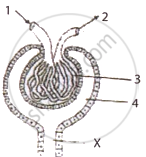
- In which region of the kidney is the above structure present?
- Label the parts numbered 1 to 4.
- What is the technical term for the process that occurs in part 3?
- Why is fluid X not called urine? Justify your answer.
- Draw a neat, labelled diagram of the urinary system of a human.
The diagram given alongside represents an organ system in the human body. Study the same and answer the questions that follow:
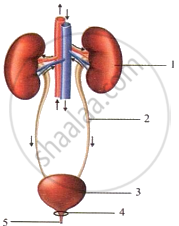
- Identify the system
- Label the parts marked 2 and 4. Mention the function of part 5.
- Name the structural and functional units of the part marked 1.
- What is the fluid that accumulates in part 3?
Which is the main nitrogenous waste present in it? - Draw a neat, labelled diagram showing the longitudinal section of part 1.
The diagram given alongside is that of a structure present in a human kidney:
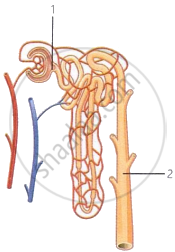
Study the same and answer the questions that follow:
- Name the structure represented in the diagram.
- What is the liquid entering part ‘1’ called?
Name two substances present in this liquid that are reabsorbed in the tubule - What is the fluid that comes to part ‘2’ called? Name the main nitrogenous waste in it.
- Mention the three main steps involved in the formation of the fluid mentioned in (c) above.
- Name the substance which may be present in the fluid in part ‘2’ if a person suffers from Diabetes mellitus
The diagram given alongside shows a section of a human kidney. Study the diagram carefully and answer the questions that follow:
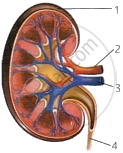
- Label the parts numbered 1 to 4.
- Why does part 2 have a striped appearance?
- What is the fluid that passes down part 4? Name the main nitrogenous waste present in it.
- Mention the structural and functional units of kidneys.
- Name the two major steps in the formation of the fluid mentioned in (c).
DO IT RIGHT
| Sumit had been observing that his neighbour was going to the hospital every alternate day. After a month, he asked his neighbour (a middle-aged man) whether he was keeping well. The man was touched by the boy's concern and told him that he was going to the hospital as his kidneys are not functioning well. He was undergoing dialysis to remove the impurities from his body. Remembering his chapter on excretion, he understood this major illness. Wishing the man good health, he returned home and started his research on ways/methods doctors around the world try to improve or rectify the working of this organ. He also learnt about kidney (organ) donation. |
- Do some research on this topic and write an article.
- Make a model of dialysis machine.
- Do you know about organ donation? Have you met anyone who has donated his/her kidney?
- In which places in India do we have extensive medical service on kidney transplant?
Solutions for 9: Human Excretory System
Lakhmir Singh solutions for Biology [English] Class 10 ICSE chapter 9 - Human Excretory System
Shaalaa.com has the CISCE Mathematics Biology [English] Class 10 ICSE CISCE solutions in a manner that help students grasp basic concepts better and faster. The detailed, step-by-step solutions will help you understand the concepts better and clarify any confusion. Lakhmir Singh solutions for Mathematics Biology [English] Class 10 ICSE CISCE 9 (Human Excretory System) include all questions with answers and detailed explanations. This will clear students' doubts about questions and improve their application skills while preparing for board exams.
Further, we at Shaalaa.com provide such solutions so students can prepare for written exams. Lakhmir Singh textbook solutions can be a core help for self-study and provide excellent self-help guidance for students.
Concepts covered in Biology [English] Class 10 ICSE chapter 9 Human Excretory System are .
Using Lakhmir Singh Biology [English] Class 10 ICSE solutions Human Excretory System exercise by students is an easy way to prepare for the exams, as they involve solutions arranged chapter-wise and also page-wise. The questions involved in Lakhmir Singh Solutions are essential questions that can be asked in the final exam. Maximum CISCE Biology [English] Class 10 ICSE students prefer Lakhmir Singh Textbook Solutions to score more in exams.
Get the free view of Chapter 9, Human Excretory System Biology [English] Class 10 ICSE additional questions for Mathematics Biology [English] Class 10 ICSE CISCE, and you can use Shaalaa.com to keep it handy for your exam preparation.
