Advertisements
Online Mock Tests
Chapters
1: Cell Cycle and Cell Division
2: Structure of Chromosome
▶ 3: Genetics
Unit 2: Plant Physiology
4: Absorption by Roots
5: Transpiration
6: Photosynthesis
7: Chemical Coordination in Plants
Unit 3: Human Anatomy and Physiology
8: Circulatory System
9: Human Excretory System
10: Nervous System
11: Sense Organs
12: Endocrine System
13: Reproductive System
Unit 4: Population
14: Population
Unit 5: Human Evolution
15: Human Evolution
Unit 6: Pollution
16: Pollution
![Lakhmir Singh solutions for Biology [English] Class 10 ICSE chapter 3 - Genetics - Shaalaa.com](/images/biology-english-class-10-icse_6:7181a54a5d284da8b50dd2f92022a1f6.jpg "Lakhmir Singh solutions for Biology [English] Class 10 ICSE chapter 3 - Genetics")
Advertisements
Solutions for Chapter 3: Genetics
Below listed, you can find solutions for Chapter 3 of CISCE Lakhmir Singh for Biology [English] Class 10 ICSE.
Lakhmir Singh solutions for Biology [English] Class 10 ICSE 3 Genetics Intex Quesions [Pages 36 - 45]
THINK AND ANSWER
Strands of DNA in each cell of your body is 6 feet (1 feet = 0.30 m = 30.48 cm).
Calculate the total length of all DNA strands if your body has 37.2 trillion cells.
TEST YOUR UNDERSTANDING - 1
True or False.
In a dihybrid cross, the genotype RRyy will represent round and yellow traits.
True or False.
The dominant gene is supressed by the recessive gene.
True or False.
Mendel experimented with many other types of plants.
Fill in the Blanks
The phenotypic ratio in a monohybrid cross between red and white flowers will be ______.
The gene pair that are not similar in an individual is called ______.
Multiple Choice Questions
When the first generation progeny cross among themselves to produce second generation progeny, the generation is known as ______.
F1 generation
F2 generation
F3 generation
Both F1 generation and F3 generation
Mendel named discrete units as ______.
genes
factors
alleles
chromosomes
TEST YOUR UNDERSTANDING - 2
True or False.
In a dissimilar pair of characters, both the traits express themselves.
True or False.
The dominant trait appears only in F2 generation in a cross between white and red flowers.
True or False.
Law of dominance explains the separation of gametes during fertilisation.
Fill in the Blanks
The concept of dominant and recessive alleles arises from ______.
In independent assortment, ______ of one pair of characters are ______ of characters at the time of gamete formation.
The scientific name of pea plant is ______.
The Law of Independent Assortment is based on ______ cross.
Multiple Choice Questions
Which of the following law is deduced from a dihybrid cross?
Law of Segregation
Law of Dominance
Law of Independent Assortment
Both law of segregation and law of dominance
In a dihybrid cross, genotype is ______.
1 : 2 : 2 : 6 : 1 : 2 : 1 : 2
1 : 2 : 2 : 3 : 1 : 2 : 1 : 2 : 2
9 : 3 : 3 : 1
1 : 2 : 2 : 4 : 1 : 2 : 1 : 2 : 1
There are ______ laws of Mendel.
1
2
3
4
THINK AND ANSWER
What were the drawbacks of Mendel's experiments?
Name two scientists who worked on chromosomes.
Who discovered DNA fingerprinting in India?
Why did Arun Kumar Sharma receive the Om Prakash Bhasin award and the Shanti Swarup Bhatnagar Prize?
TEST YOUR UNDERSTANDING - 3
True or False.
In females, ovum contain XY chromosomes.
True or False.
With the help of Punnett Square, gametes produced by parents can easily be identified.
Fill in the Blanks
The study of inheritance of characters (traits) is called ______.
______ is a sequence of nucleotide in the genetic material which codes for a particular protein.
Multiple Choice Questions
Haemophilia is based on ______.
Law of Segregation
Law of Dominance
X-linked genes
Chromosome
Sex-linked diseases are more prominent in men because ______.
they have more number of genes
their genes are dominant
they have less number of genes
their genes are recessive
Lakhmir Singh solutions for Biology [English] Class 10 ICSE 3 Genetics EXERCISE [Pages 47 - 52]
Objective Questions
True or False.
The law of dominance was given by De Vries and Correns.
True or False.
The ratio 9 : 3 : 3 : 1 was obtained in a monohybrid cross.
True or False.
Mendel selected golden pea for his experiments.
True or False.
In Mendel's experiment, pod shape was round and elongated.
True or False.
In Mendel's experiment the genotype of dihybrid cross ratio was 9 : 3 : 3 : 1.
True or False.
Colour blindness is X-linked whereas haemophilia is Y-linked disease.
Fill in the Blanks
Mendel selected ______ for his experiments on heredity.
______ contrasting characters were selected by Mendel for his experiments.
The phenotypic ratio in F1 generation in monohybrid cross was ______.
Mother is a ______ carrier of colour blindness disease.
In a monohybrid cross, the genotypic ratio is ______.
Match the Following.
| Column I | Column II |
| (i) Homozygous | (a) Tt |
| (ii) Heterozygous | (b) TT |
| (iii) Homozygous Dominant | (c) TT |
| (iv) Heterozygous Dominant | (d) Tt |
| (v) Autosomes | (e) XY |
| (vi) Sex chromosomes | (f) 22 pairs |
Give One Word Answer.
Name the small part of DNA that codes for proteins.
Give One Word Answer.
The name given to chromosomes XY and XX.
Give One Word Answer.
The person known as the Father of Genetics.
Give the names of the scientists who rediscovered Mendelism.
Give One Word Answer.
An allele that does not express when present along with a dominant allele.
Give One Word Answer.
The chromosome responsible for male sex in humans.
Multiple Choice Questions
Mendel thought that the characteristics of pea plants are determined by the ______.
inheritance of units or factors from both parents
inheritance of units or factors from one parent
relative health of the parent plants at the time of pollination
none of the above
An allele is ______.
different word for a gene
a homozygous genotype
a heterozygous genotype
one of the several possible forms of a gene
In a monohybrid cross between two heterozygous individuals, percentage of pure homozygous individuals obtained in F1 generation will be ______.
25%
50%
75%
100%
A cross between two tall plants resulted in offspring having few dwarf plants. What would be the genotypes of both the parents?
Tt and Tt
TT and Tt
TT and TT
Tt and tt
In a dihybrid cross, if you get 9:3:3:1 ratio it denotes that ______.
The allels of two genes are segregating independently
It is a case of multiple allelism
It is a multigenic inheritance
The allels of two genes are interacting with each other
The characters which appear in the F1 generations are called ______.
recessive characters
dominant characters
both recessive and dominant characters
none of these
In the F2 generation of a Mendelian dihybrid cross the number of phenotypes and genotypes are ______.
phenotypes - 4; genotypes - 16
phenotypes - 9; genotypes - 4
phenotypes - 4; genotypes - 8
phenotypes - 4; genotypes - 9
Out of seven contrasting pairs, the colour-based contrasting traits studied by Mendel in pea plant were:
Seed
Flower
Pod
All of these
The number of contrasting traits studied by Mendel in pea plants were:
6
7
8
10
Genes which code for a pair of contrasting traits are known as ______.
linked genes
alleles
dominant genes
recessive genes
Colour blindness is a ______ disease which causes inability in a person to distinguish different colours.
sex-linked dominant
sex-linked recessive
sickle cell anaemia
Down's syndrome
Descriptive Questions Short Answer Questions
Define Mendel's law of dominance.
What is sex chromosomes?
Briefly explain the following term:
Monohybrid cross
State Mendel’s Law of Segregation.
What is Punnett square? Why is it used?
Differentiate between genotype and phenotype.
Explain the term gene.
Define the following term:
Variations
Define the term heredity.
Define the following:
Allele
Define the term Mutation.
Define the following:
Autosomes
Define the term Gamete.
Why does variations occur in organisms?
What is pathogenic variation?
Give four examples of common disorders caused by mutant genes.
Differentiate between the following:
Dominant and Recessive genes
Differentiate between first filial generation (F1) and second filial generation (F2)
Distinguish between the following pair:
Autosomes and Sex chromosomes
Differentiate Between Monohybrid and Dihybrid cross.
Differentiate between genotype and phenotype.
Long Answer Questions
What are the seven characters selected by Mendel for his experiments on Pisum sativum? Select any two characters from your list and draw a diagrammatic sketch of the dihybrid cross as performed by Mendel for his experiments.
How is sex determined in human beings?
Write about the sex-linked disease:
Haemophilia
Write about the sex-linked disease:
Colour blindness
Why do genetic diseases occur? Briefly explain.
Why is the sex of a baby dependent on the father?
Briefly explain about mutation.
Diagram Based Questions
A homozygous dominant tall pea plant bearing red flowers (TTRR) is crossed with a homozygous recessive dwarf pea plant bearing white flowers (ttrr).
- What is the phenotype and genotype of F1 individuals?
- Write the possible combination of gametes that are obtained when two F1 hybrid plants are crossed.
- Mention the phenotypic ratio of the F2 generation.
- State Mendel’s Law of Independent Assortment.
- Name two X-linked disorders found in humans.
In Mendel’s experiments, tall pea plants (T) are dominant over dwarf pea plants (t).
- What is the phenotype and genotype of the F1 generation if a homozygous tall plant is crossed with a homozygous dwarf plant?
- Draw a Punnett square board to show the gametes and offspring when both the parents are heterozygous for tallness.
- What is the phenotypic ratio and genotypic ratio of the above cross in (b)?
- State Mendel’s Law of Dominance.
- What is a Dihybrid Cross?
A pea plant which is homozygous for green pods which are inflated [GGII] is crossed with a homozygous plant for yellow pods which are constricted [ggii]. Answer the following questions:
- Give the phenotype and genotype of the F1 generation.
Which type of pollination has occurred to produce F1 generation? - Write the phenotypic ratio of the F2 generation
- Write the possible combinations of the gametes that can be obtained if two F1 hybrid plants are crossed.
- State Mendel’s law of ‘Segregation of Gametes’.
- What is the scientific name of the plant which Mendel used for his experiments on inheritance?
In a homozygous pea plant, axial flowers (A) are dominant over terminal flowers (a).
- What is the phenotype and genotype of the F1 generation if a plant bearing pure axial flowers is crossed with a plant bearing pure terminal flowers?
- Draw a Punnett square board to show the gametes and offsprings when both the parent plants are heterozygous for axial flowers.
- What is the phenotypic ratio and genotypic ratio of the above cross shown in (ii)?
- State Mendel’s Law of Dominance.
- Name two genetic disorders commonly seen in human males.
A homozygous tall plant (T) bearing red-coloured (R) flowers is crossed with a homozygous dwarf (t) plant bearing white (r) flowers:
- Give the genotype and phenotype of the plants of F1 generation.
- Mention the possible combinations of the gametes that can be obtained from the F1 hybrid plant.
- State Mendel’s law of independent assortment.
- Mention the phenotypes of the offsprings obtained in F2 generation.
- What is the phenotypic ratio obtained in F2 generation?
DO IT RIGHT
Suresh wondered if there was any Indian Scientist who worked on chromosomes and DNA. On asking his aunt (a Biotechnologist), he learnt about Har Gobind Khorana. Wanting to know more, he explored on this topic and did some research, getting help from his aunt. He then tabulated his findings and prepared a talk show on FM radio for the younger generation. Do your research and find out about Indian scientists in this field.
Saroj prepared a set of questions for her classmates.
- Mendel chose pod shape of pea that are inflated or constricted. What kind of shape do they mean in Maths?
- Mendel took tall or short pea plants. Find out the tallest and shortest pea plant recorded in India. Write their heights in centimetres.
- What will be the ratio of red and yellow fruits produced by tomato plant which is self pollinated?
- How many normal boy(s) and girl(s) are born when a colour blind man marries a normal female?
In a homozygous plant, round seeds (R) are dominant over wrinkled seeds (r):
Draw a Punnett square to show the gametes and offspring when both the plants have heterozygous round seeds (Rr).
Draw a Punnett square showing the gametes, phenotype and genotype ratios.
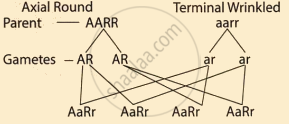
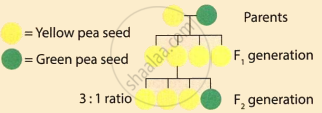
Assuming that both parent plants in the diagram below are homozygous, why would all of the F1 generation have yellow phenotypes?
Crossword - Unit I
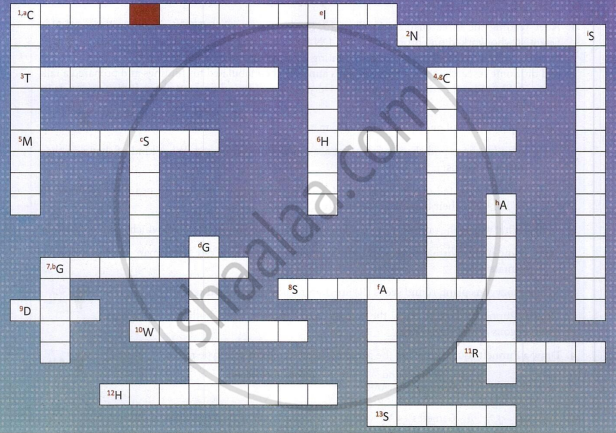
ACROSS
- A method by which new cells are originated from pre-existing cells
- Important structure in the cell to control all cellular processes
- Stage of cell division characterised by the reorganisation of interphase nuclei
- Structural and functional unit of life
- Cell division in which replication of chromosomes is followed by separation of the products
- An individual or cell having a single complete set of chromosomes
- Reproductive unit of an animal or plant
- Pairing of homologous chromosomes occurring in prophase I of meiosis
- Hereditary material in organisms
- Scientist who had worked with DNA replication
- Unit of recombination
- Genetic heritage passed down by parents to their offspring
- Male gametes
DOWN
- Point at which microtubules of the mitotic or meiotic spindle gets attached
- Sequence of nucleotide in the genetic material that codes for a particular protein
- Necessary to equally divide the chromosomes during cell division
- Genetic makeup of an organism, or an organism's complete set of genes
- Resting phase of cell
- Alternative forms of a gene
- Division of cytoplasm during cell division
- 22 pairs of chromosomes which are same in both males and females
- J or L shaped and the centromere is slightly displaced from the centre
Solutions for 3: Genetics
Lakhmir Singh solutions for Biology [English] Class 10 ICSE chapter 3 - Genetics
Shaalaa.com has the CISCE Mathematics Biology [English] Class 10 ICSE CISCE solutions in a manner that help students grasp basic concepts better and faster. The detailed, step-by-step solutions will help you understand the concepts better and clarify any confusion. Lakhmir Singh solutions for Mathematics Biology [English] Class 10 ICSE CISCE 3 (Genetics) include all questions with answers and detailed explanations. This will clear students' doubts about questions and improve their application skills while preparing for board exams.
Further, we at Shaalaa.com provide such solutions so students can prepare for written exams. Lakhmir Singh textbook solutions can be a core help for self-study and provide excellent self-help guidance for students.
Concepts covered in Biology [English] Class 10 ICSE chapter 3 Genetics are .
Using Lakhmir Singh Biology [English] Class 10 ICSE solutions Genetics exercise by students is an easy way to prepare for the exams, as they involve solutions arranged chapter-wise and also page-wise. The questions involved in Lakhmir Singh Solutions are essential questions that can be asked in the final exam. Maximum CISCE Biology [English] Class 10 ICSE students prefer Lakhmir Singh Textbook Solutions to score more in exams.
Get the free view of Chapter 3, Genetics Biology [English] Class 10 ICSE additional questions for Mathematics Biology [English] Class 10 ICSE CISCE, and you can use Shaalaa.com to keep it handy for your exam preparation.
