Advertisements
Online Mock Tests
Chapters
1: Cell Cycle and Cell Division
2: Structure of Chromosome
3: Genetics
Unit 2: Plant Physiology
4: Absorption by Roots
5: Transpiration
6: Photosynthesis
▶ 7: Chemical Coordination in Plants
Unit 3: Human Anatomy and Physiology
8: Circulatory System
9: Human Excretory System
10: Nervous System
11: Sense Organs
12: Endocrine System
13: Reproductive System
Unit 4: Population
14: Population
Unit 5: Human Evolution
15: Human Evolution
Unit 6: Pollution
16: Pollution
![Lakhmir Singh solutions for Biology [English] Class 10 ICSE chapter 7 - Chemical Coordination in Plants - Shaalaa.com](/images/biology-english-class-10-icse_6:7181a54a5d284da8b50dd2f92022a1f6.jpg "Lakhmir Singh solutions for Biology [English] Class 10 ICSE chapter 7 - Chemical Coordination in Plants")
Advertisements
Solutions for Chapter 7: Chemical Coordination in Plants
Below listed, you can find solutions for Chapter 7 of CISCE Lakhmir Singh for Biology [English] Class 10 ICSE.
Lakhmir Singh solutions for Biology [English] Class 10 ICSE 7 Chemical Coordination in Plants Intex Quesions [Pages 106 - 115]
TEST YOUR UNDERSTANDING - 1 Fill in the Blanks
The chemicals that help in control, coordination and growth of plants are known as ______.
______ are responsible for phototropic response of the plants.
True or False.
Auxins regulate cell division and cell differentiation in plants.
True or False.
Auxins speed up the growth of the roots.
True or False.
Abscisic acid promotes plant growth.
Multiple Choice Questions
Mark the odd one out:
Auxins
Cytokinins
Gibberellins
Abscisic acid
The fruit ripening hormone is ______.
Cytokinin
Ethylene
Gibberellin
Auxin
TEST YOUR UNDERSTANDING - 2 Fill in the Blanks
______ is response of plant to light.
Tendrils are positively ______ and they always grow towards the support.
True or False.
Auxins always accumulate on the illuminated portion of the stem and this result in rapid division of cells in the shaded side.
True or False.
Chemotropism is a directional response of plants to a chemical substance.
True or False.
Roots are negatively geotropic and positively hydrotropic.
Multiple Choice Questions
Stem tendrils are present in:
Bitter gourd
Bottle gourd
Grapes
All of these
Tropic movements help the plant to obtain ______.
Water
Nutrient
Both water and nutrient
None of these
THINK AND ANSWER
Why insectivorous plants are called partial heterotrophs?
How does pitcher plant trap insects?
Which hormone is responsible for nastic movements?
How are the tropic movements of plants helpful to the farmers?
TEST YOUR UNDERSTANDING - 3 Fill in the Blanks
______ movements are independent of direction of stimulus.
The non-directional movement in response to light intensity is termed as ______.
______ regulate many functions in plants.
True or False.
Nastic movement is independent to stimuli shown by plants.
True or False.
Dandelion flowers are sensitive to light.
True or False.
The folding of leaves of Mimosa pudica on touching is a growth movement.
Lakhmir Singh solutions for Biology [English] Class 10 ICSE 7 Chemical Coordination in Plants EXERCISE [Pages 116 - 120]
Objective Questions
True or False.
Plant hormones are associated with the directional growth movements in plants.
True or False.
Thigmonastic movements are growth movements.
True or False.
Unequal rate of growth in shoots results in bending of shoots towards light.
True or False.
Hydrotropism is movement of the plant in response to gravity.
True or False.
The opening and closing of stomata are not regulated by plant hormones.
True or False.
Closing and opening of flower in response to light intensity is a growth movement.
Fill in the Blanks
In tropic movements the plant parts move in response to the direction of the ______.
A plant hormone that is found in higher concentration in ripe banana is ______.
The hormone responsible for apical dominance is ______.
The plant hormone that induces root hair growth is ______.
Non-directional movements in plant parts in response to external stimulus are ______ movements.
The growth of pollen tube towards the ovule is an example of ______ movement.
Match the Following.
| Column I | Column II |
| (i) Auxin | (a) Fruit ripening |
| (ii) Gibberellins | (b) Climbers |
| (iii) Ethylene | (c) Abscisic acid |
| (iv) Cytokinin | (d) Thigmonasty |
| (v) Tendrils | (e) Apical dominance |
| (vi) Closing of leaves on touching | (f) Cell division |
| (vii) Growth inhibitor in plants | (g) Internodal elongation |
Give One Word Answer.
The hormone that promotes the growth of a tendril around a support.
Give One Word Answer.
Hormone that promotes ripening of fruit.
Give One Word Answer.
Hormone used to break seed dormancy.
Name the following:
Growth-retarding hormone in plants.
Name the following:
Hormone that stimulates growth by cell division.
Multiple Choice Questions
Directional movement of plants in response to external stimuli is called ______.
Nastic
Growth
Tropism
Thigmonasty
The reason behind the change in shape of plant cell in response to stimulus is ______.
Chemical changes
Electrical impulses
Change in amount of water in the cells
Change in the shape of specialised proteins
The hormones which help in the growth of plant stem are ______.
Cytokinin and Auxin
Auxin and Gibberellin
Cytokinin and Auxin
Ethylene
Mark the odd one out:
Auxins
Cytokinins
Gibberellins
Abscisic acid
Closing of Venus fly trap leaf when it captures prey is an example of ______.
Thigmotropism
Chemotropism
Geotropism
Phototropism
Which of the following is not a growthdependent response?
Movement of roots towards gravity
Drooping of leaves of touch-me-not plants
Movement of shoot towards light
Movement of tendrils in pea plant
Descriptive Questions Short Answer Questions
Name one example of the movement of a plant part which is not a growth movement and can be observed easily. Name the plant where this is observed.
What is the stimulus in phototropism?
What is the stimulus in hydrotropism?
What is the stimulus in chemotropism?
How does auxins promote apical dominance?
What is meant by abscission?
Which plant hormone is responsible for abscission?
Distinguish between tropic movements and nastic movements in plants. Give examples to illustrate your answer.
Name the plant part which bends in the direction of gravity but away from light.
Name the plant part which bends towards light but away from the force of gravity.
Name the plant part which bends towards the source of water.
Name two types of tendrils with an example of each.
How do the tendrils respond to the stimulus of touch of a support?
Expand the following biological abbreviations :
(i) ABA
Expand the following biological abbreviations :
IAA
Expand the following biological abbreviations :
ATP
Identify the ODD term in the set and name the CATEGORY to which the remaining three belong:
Auxin, Ethylene, Adrenaline, Cytokinin
Differentiate between the Following:
Hydrotropism and Geotropism
Differentiate between:
Positive and negative tropism
Differentiate between the Following:
Chemotropism and Thigmotropism
Distinguish between tropic movements and nastic movements in plants. Give examples to illustrate your answer.
Differentiate between the Following:
Auxin and Abscisic acid
Long Answer Questions
How do tropic movements help the plants in their survival?
What would happen if plants could not respond using tropisms?
The tea bushes are pruned at regular intervals. Why? Which phenomenon is overcome by frequent pruning? Name the hormone responsible for this phenomenon.
How does control and coordination takes place in plants?
Explain response of plant parts to light with the help of a diagram.
What will happen to a ripe fruit placed in bag with raw fruits? Name the hormone responsible for it. What are other effects of this hormone on the plant?
What is the difference between thigmotropism and thigmonasty?
Diagram Based Questions
Study the given figure and answer the following:
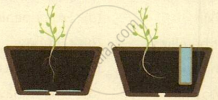
- What type of phenomenon is exhibited by the plant?
- What will happen if after few days clay pot with water is shifted to the other side?
Study the given figure and answer the following:
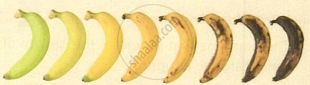
- What phenomenon is being shown in the above figure?
- Name the hormone responsible for the above changes.
- Mention another feature of this hormone.
Study the below given figure and answer the following.
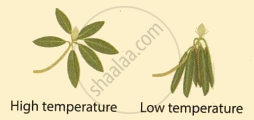
- Can you identify the tree?
- What tropism does it show?
- Why do you think it occurs?
DO IT RIGHT
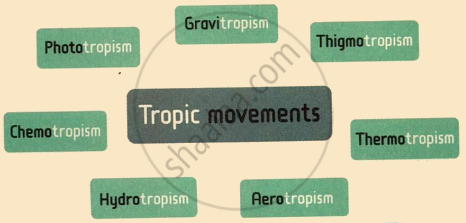
1. Look at the figure. Make a table and ask at least 10 people if they know about these plant hormones.
2. Find out if these hormones are synthetically sold in the market and under what names (products).
3. Write the chemical formula for each hormone.
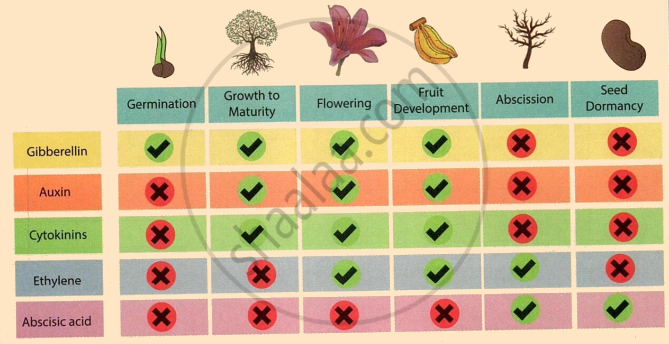
4. Take a printout of something similar to the figure given below. Add clippings and pictures to this. Fix this in your bulletin board in school.
Crossword - Unit II
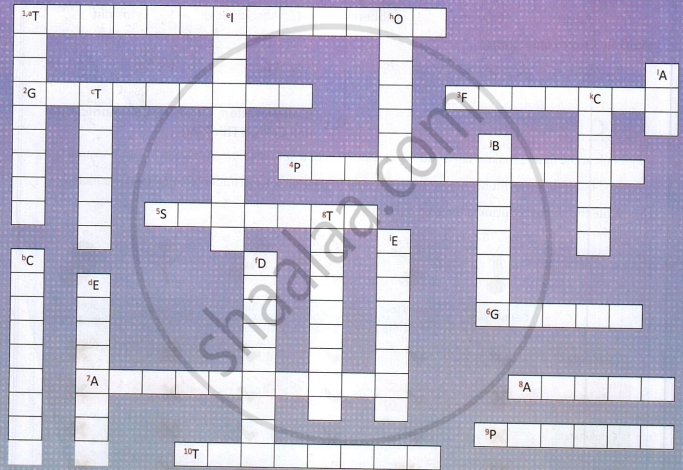
ACROSS
- Giving out of water vapour by the plants through stomatal openings
- Removal of excess water through the leaf veins
- After shrinkage of plasma membrane the cells become ______
- Process by which plant cells lose water when placed in hypertonic solution
- Minute pore in the epidermis of leaf that help in exchange of gases
- Stacks of thylakoid in the chloroplast
- Shedding of leaves, flowers and fruits due to imbalance of hormones
- Promotes cell differentiation and enlargement of cell in plants
- Natural purifiers of air
- Relative concentration of a solution that determines the movement of water in a cell
DOWN
- Phenomenon of swelling of a cell due to absorption of high fluid content
- Promotes cell division in plants
- Thread-like outgrowths from the plant parts that provide support to the plant in standing upright
- Nastic movement where a plant part bend outward and often downward
- Absorption of water by the cells due to surface attraction leading to the swelling of the cells
- Process of movement of molecules from a region of higher to a region of lower concentration
- Flattened disc-like structures in the chloroplast
- Movement of water molecules from high to lower concentration through a semi-permeable membrane
- Another name for ripening hormone
- Secretion of xylem sap from a cut or injured plant part
- Waxy layer secreted by epidermal cells on the surface of the leaf
- Electrons convert ______ to ATP
Solutions for 7: Chemical Coordination in Plants
Lakhmir Singh solutions for Biology [English] Class 10 ICSE chapter 7 - Chemical Coordination in Plants
Shaalaa.com has the CISCE Mathematics Biology [English] Class 10 ICSE CISCE solutions in a manner that help students grasp basic concepts better and faster. The detailed, step-by-step solutions will help you understand the concepts better and clarify any confusion. Lakhmir Singh solutions for Mathematics Biology [English] Class 10 ICSE CISCE 7 (Chemical Coordination in Plants) include all questions with answers and detailed explanations. This will clear students' doubts about questions and improve their application skills while preparing for board exams.
Further, we at Shaalaa.com provide such solutions so students can prepare for written exams. Lakhmir Singh textbook solutions can be a core help for self-study and provide excellent self-help guidance for students.
Concepts covered in Biology [English] Class 10 ICSE chapter 7 Chemical Coordination in Plants are .
Using Lakhmir Singh Biology [English] Class 10 ICSE solutions Chemical Coordination in Plants exercise by students is an easy way to prepare for the exams, as they involve solutions arranged chapter-wise and also page-wise. The questions involved in Lakhmir Singh Solutions are essential questions that can be asked in the final exam. Maximum CISCE Biology [English] Class 10 ICSE students prefer Lakhmir Singh Textbook Solutions to score more in exams.
Get the free view of Chapter 7, Chemical Coordination in Plants Biology [English] Class 10 ICSE additional questions for Mathematics Biology [English] Class 10 ICSE CISCE, and you can use Shaalaa.com to keep it handy for your exam preparation.
