Advertisements
Online Mock Tests
Chapters
1: Cell Cycle and Cell Division
2: Structure of Chromosome
3: Genetics
Unit 2: Plant Physiology
4: Absorption by Roots
5: Transpiration
6: Photosynthesis
7: Chemical Coordination in Plants
Unit 3: Human Anatomy and Physiology
8: Circulatory System
9: Human Excretory System
10: Nervous System
11: Sense Organs
12: Endocrine System
▶ 13: Reproductive System
Unit 4: Population
14: Population
Unit 5: Human Evolution
Chapter 15: Human Evolution
Unit 6: Pollution
Chapter 16: Pollution
![Lakhmir Singh solutions for Biology [English] Class 10 ICSE chapter 13 - Reproductive System - Shaalaa.com](/images/biology-english-class-10-icse_6:7181a54a5d284da8b50dd2f92022a1f6.jpg "Lakhmir Singh solutions for Biology [English] Class 10 ICSE chapter 13 - Reproductive System")
Advertisements
Solutions for Chapter 13: Reproductive System
Below listed, you can find solutions for Chapter 13 of CISCE Lakhmir Singh for Biology [English] Class 10 ICSE.
Lakhmir Singh solutions for Biology [English] Class 10 ICSE 13 Reproductive System Intex Quesions [Pages 213 - 226]
TEST YOUR UNDERSTANDING - 1 Multiple Choice Questions
Fertilisation results immediately in the formation of ______.
a zygote
an embryo
a placenta
a foetus
Characters that are transmitted from parents to offspring during sexual reproduction show:
only similarities with parents
only variations with parents
both similarities and variations with parents
neither similarities nor variations with parents
The offspring formed as a result of asexual reproduction exhibit no variations because ______.
it is a lengthy process
genetic material comes from two parents of different species
genetic material comes from two parents of same species
genetic material comes from only one parent
Fill in the Blanks
The ______ and ______ are two types of reproduction found in living organisms.
The offsprings which are exact carbon copy of the parent, so they are called ______.
There are ______ types of asexual reproduction.
TEST YOUR UNDERSTANDING - 2
One of the following is not a part of the human male reproductive system. This is:
testis
oviduct
seminal vesicle
prostrate gland
The correct sequence of organs in the male reproductive system for transport of sperms is
testis → vasdeferens → urethra
testis → ureter → urethra
testis → urethra → ureter
testis → vasdeferens → ureter
In human males, the testes lie in the scrotum outside the body because it helps in the ______.
process of mating
formation of sperms
easy transfer of sperms
all the above
Fill in the Blanks
______ is a pouch-like structure in the male reproductive system.
______ is a thread-like structure in the male reproductive system.
Vas deferens is also called ______.
______ is a copulating organ.
TEST YOUR UNDERSTANDING - 3
True or False.
A muscular passage that connects uterus with the outside end of the body is called vagina.
True or False.
Two eggs are released from each ovary every month.
True or False.
Uterus is the hollow area where the embryo develops.
Fill in the Blanks
Fertilisation occurs in the ______ junction of fallopian tube.
The follicle contains matured egg is called ______.
Complete the following sentences with appropriate word:
The process of releasing an egg from the ovary is called _________.
______ are modified sweat glands that secretes milk.
______ consists of mons pubis, labia majora and labia minora.
THINK AND ANSWER
How do miscarriages occur during pregnancies?
What do they observe to know that a person is pregnant in pregnancy test?
TEST YOUR UNDERSTANDING - 4 Fill in the Blanks
Sperm consists of ______, ______, ______ and ______.
The lysosome structure present in the head of sperm is ______.
The part of the sperm that contains the mitochondria is ______.
The size of ovum is about ______, ______ in shape and almost free of ______.
Ovum is covered by ______ and ______.
Multiple Choice Questions
The cause of shedding of uterine lining is called ______.
menstrual flow
corpus luteum
ovulation
Graafian follicle
The phase of menstrual cycle in which follicle develops.
Menstrual
Follicular
Ovulatory
Luteal
The day of menstrual cycle when ovulation occurs is on ______ day.
12th
9th
14th
20th
The duration of menstrual cycle is ______.
15 days
14 days
20 days
28 days
TEST YOUR UNDERSTANDING - 5 Fill in the Blanks
When male and female gamete fuses with each other is called ______.
The blastocyst embedded in the lining of the uterus is called ______.
The blastomeres form a compact ball of cells called ______.
______ is a temporary organ formed in the uterus during pregnancy and contains two sets of villi.
Multiple Choice Questions
The layer that functions as a shock absorber to the embryo.
Chorion
Amnion
Allantois
Yolk sac
A cord that acts as a connection between mother and child.
Placenta
Amnion
Umbilical
Blastomere
Layer of embryo that gets degenerated in human embryo.
Chorion
Amnion
Allantois
Yolk sac
The part that acts as an ultrafilter for the embryo.
Placenta
Amnion
Umbilical
Blastomere
TEST YOUR UNDERSTANDING - 6 Fill in the Blanks
______ helps in parturition.
______ helps to relax the uterine muscles.
______ enlarges the breast and nipples for breast feeding.
______ helps in the ejection of milk from mammary glands.
True or False.
Gestation period in humans is of 340 days.
True or False.
Placenta produces three hormones.
True or False.
There is only one set of villi connecting baby to the mother.
True or False.
Fraternal twins develop from the same egg.
Lakhmir Singh solutions for Biology [English] Class 10 ICSE 13 Reproductive System EXERCISE [Pages 227 - 230]
Objective Questions
True or False.
There are three main accessory glands in male reproductive system.
True or False.
Vasa deferens is a continuation of cauda epididymis.
True or False.
Scrotum acts as a thermoregulatory.
True or False.
Donation of eggs is an easy process.
True or False.
Fertilisation occurs in the uterus.
Fill in the Blanks
______ ejects spermatozoa into the urethra.
Penis has three spongy ______ tissue.
The number of chromosomes in a sperm is ______.
______ of the ovary secretes progesterone.
______ is the expulsion of foetus from the mother's womb.
Match the following:
| Column I | Column II |
|---|---|
| (i) Scrotum | (a) Produces fructose |
| (ii) Seminal vesicle | (b) Thermoregulator |
| (iii) Prostate gland | (c) Milk production |
| (iv) Mammary gland | (d) Alkaline fluid |
| (v) Acrosome | (e) Attachment of embryo to the uterus |
| (vi) Implantation | (f) Sperm’s head |
Give One Word Answer:
Contains mitochondria in the sperm.
Give One Word Answer:
Almond-shaped structure in the female reproductive system.
Give One Word Answer:
A hormone that helps the process of parturition.
Give One Word Answer:
A part of vulva that is same as male penis.
Give One Word Answer:
The production of sperms takes place in this part of testes.
Give One Word Answer:
The accessory gland in human males whose secretion neutralises the acid in the vagina.
Name the following:
The structure which connects the placenta and the foetus.
Multiple Choice Questions
Which part of the foetus is formed after the 3rd month of pregnancy?
Heart
Limbs and digits
Lungs
Appearance of hair
Which layer takes part in the formation of the placenta?
Chorion
Allantois
Amnion
Both chorion and allantois
Gestation period is of how many days?
250 days
300 days
200 days
280 days
Hormone produced by testes is ______.
Testosterone
Progesterone
Relaxin
Oestrogen
When male and female gamete fuses with each other, it is called ______.
Implantation
Fertilisation
Parturition
Gestation
How many stages are there in parturition?
One
Three
Five
Two
The duration of menstrual cycle is ______.
20 days
30 days
28 days
25 days
Which part of the sperm provides energy and help in its movement?
Middle piece and tail
Head and neck
Neck and middle piece
Neck and tail
Which part of the female reproductive system is a fibromuscular tube starting from the uterus and ends on outside the body?
Oviduct
Uterus
Vagina
Vulva
The outer covering of the ovum is known as ______.
Tunica albuginea
Tunica vaginalis
Zona pellucida
Corona radiata
The fusion of the sperm and ovum is termed as ______.
Reproduction
Development
Fertilization
Embryo
In a human female, ovum consists of ______.
23 pairs of autosomes
22 pairs of autosomes and I pair of sex chromosomes
22 autosomes and 1 Y-chromosome
22 autosomes and 1 X-chromosome
Choose the correct answer from the four options given below :
On which day of the menstrual cycle does ovulation take place ?
5th day
28th day
14th day
1st day
Given below are certain groups of terms. In each group the first pair indicates a relationship between the two terms. Rewrite and complete the second pair on a similar basis.
Ureter: Implantation :: Fallopian tube: .............
Correct and rewrite the statements by changing the biological term that is underlined for the statement:
The protective sac which develops around the developing embryo is called the Pericardium.
Descriptive Questions Short Answer Questions
What is the role of the inguinal canal?
Write the methods of asexual reproduction.
Write the reproductive parts of the female.
Write the reproductive parts of the male.
State the main function of the Sperm duct.
Explain the function of the following structure in the human male reproductive system.
Scrotum
State the function of umbilical cord.
State the main function of the corpus luteum.
Why can fraternal twins be of different sexes?
Why are testes in human males located outside the abdominal cavity in the scrotum?
What is the importance of breasts in females?
With the help of labelled diagram describe the structure of human sperm.
Describe the structure of the human ovum with a neat labelled diagram.
Define the following:
Oogenesis
Define.
Fertilization
Define the following term:
Reproduction
Define the following:
Parturition
Write two major functions of testis.
Differentiate between the Following:
Fertilisation and Implantation
Differentiate between the Following:
Male and Female reproductive system
Differentiate between the Following:
Ovulatory and Menstrual phase
Differentiate between the following pair:
Menarche and menopause
Distinguish between the following pair of terms:
Egg and sperm.
Distinguish between asexual and sexual reproduction.
Differentiate between Identical twins and fraternal twins.
Long Answer Questions
Write about the accessory glands of the male reproductive system.
Describe the menstrual cycle. Why does it occur?
Describe the human male reproductive system.
Describe the female reproductive systems in humans.
Mention any two functions of the human placenta.
Write the different stages of foetus development.
Describe how the zygote gets fixed to the uterus wall after fertilisation.
Compare the secondary sex characteristics of male and female.
Write about the role of placenta in the development of embryo.
Give details about the gestation period in humans.
Explain the source and functions of sex hormones.
Diagram Based Questions
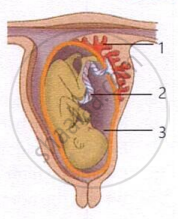
The diagram given below is that of a developing human foetus. Study the diagram and then answer the questions that follow:
- Label the parts numbered 1 to 3 in the diagram.
- Mention any two functions of the part labelled 2 in the diagram.
- Explain the significance of the part numbered 3 in the diagram.
- Define the term ‘Gestation’. What is the normal gestational period of the developing human embryo?
- Mention the sex chromosomes in a male and female embryo.
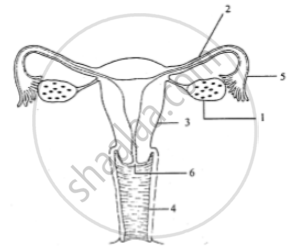
The diagram given below represents a system in the human body. Study the diagram and answer the following questions:
- Identify the system.
- Label the parts marked 5 and 6.
- Name the two hormones secreted by 1.
- Mention the number and the name of the part involved in fertilization and implantation from the above diagram.
- Mention the surgical methods of contraception in:
- Human males.
- Human females.
DO IT RIGHT
Santosh was one day glancing through some magazines when he saw an article on 'Test tube babies. Wanting to know more about this, he asked his aunt, an eminent surgeon. To clarify his doubts and to develop his scientific temper, she took him to her clinic. On reaching the fertility department, he was briefed by doctors who were eager to explain to this young boy. He was taken to various labs and work rooms, and he also had a glimpse at a newborn test tube baby. He was impressed by the advancement and use of latest technologies in India. On returning home, he decided to learn more about how medical science has progressed over the years. Few topics on which he explored are:
- Doctors who worked on test tube babies in India. Who is the first Indian test tube baby? When she was born, her name and where she lives.
- First test tube baby in the world.
- Other technologies used to develop embryo artificially. Success rate of each method.
- Difference between Siamese, identical and conjoined twins. Number of conjoined cases in India and their success rate.
- What is meant by surrogate mother? Why is it given importance in recent times?
Solutions for 13: Reproductive System
Lakhmir Singh solutions for Biology [English] Class 10 ICSE chapter 13 - Reproductive System
Shaalaa.com has the CISCE Mathematics Biology [English] Class 10 ICSE CISCE solutions in a manner that help students grasp basic concepts better and faster. The detailed, step-by-step solutions will help you understand the concepts better and clarify any confusion. Lakhmir Singh solutions for Mathematics Biology [English] Class 10 ICSE CISCE 13 (Reproductive System) include all questions with answers and detailed explanations. This will clear students' doubts about questions and improve their application skills while preparing for board exams.
Further, we at Shaalaa.com provide such solutions so students can prepare for written exams. Lakhmir Singh textbook solutions can be a core help for self-study and provide excellent self-help guidance for students.
Concepts covered in Biology [English] Class 10 ICSE chapter 13 Reproductive System are .
Using Lakhmir Singh Biology [English] Class 10 ICSE solutions Reproductive System exercise by students is an easy way to prepare for the exams, as they involve solutions arranged chapter-wise and also page-wise. The questions involved in Lakhmir Singh Solutions are essential questions that can be asked in the final exam. Maximum CISCE Biology [English] Class 10 ICSE students prefer Lakhmir Singh Textbook Solutions to score more in exams.
Get the free view of Chapter 13, Reproductive System Biology [English] Class 10 ICSE additional questions for Mathematics Biology [English] Class 10 ICSE CISCE, and you can use Shaalaa.com to keep it handy for your exam preparation.
