Advertisements
Advertisements
Question
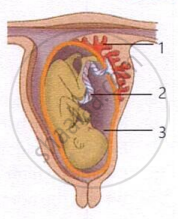
The diagram given below is that of a developing human foetus. Study the diagram and then answer the questions that follow:
- Label the parts numbered 1 to 3 in the diagram.
- Mention any two functions of the part labelled 2 in the diagram.
- Explain the significance of the part numbered 3 in the diagram.
- Define the term ‘Gestation’. What is the normal gestational period of the developing human embryo?
- Mention the sex chromosomes in a male and female embryo.
Very Long Answer
Advertisements
Solution
-
- Placenta
- Umbilical cord
- Amniotic fluid
- Functions of the umbilical cord:
- Carries oxygen and nutrients from the placenta to the foetus.
- Carries carbon dioxide and metabolic wastes from the foetus to the placenta.
- Functions of amniotic fluid:
- Protects the foetus from mechanical shocks and injuries.
- Allows free movement of the foetus and helps maintain a constant temperature.
- Gestation:
- The time period required for the development of the foetus inside the uterus is called gestation.
- The normal gestation period in humans is 280 days (9 months).
- Male sex chromosomes:
- One ‘X’ chromosome and one ‘Y’ chromosome (XY).
- Female sex chromosomes: Two ‘X’ chromosomes (XX).
shaalaa.com
Is there an error in this question or solution?
