Advertisements
Advertisements
Question
The diagram below represents two reproductive cells A and B. Study the same and then answer the questions that follow:
 |
- Identify the reproductive cells A and B.
- Name the specific part of the reproductive system where the above cells are produced.
- Where in the female reproductive system do these cells unite?
- Name the main hormones secreted by the (1) ovary (2) testes.
- Name an accessory gland found in the male reproductive system and state the function of its secretion.
Answer in Brief
Advertisements
Solution
-
- Ovum
- Sperm
- Follicles of ovary → ovum, Seminiferous tubules in testes → sperm
- Fallopian tube
- (1) Oestrogen, Progesterone,
(2) Testosterone - The glands found in the male reproductive system are the prostate gland and the seminal vesicle.
Function of the prostate gland: The secretion of thin, milky, alkaline fluid enhances sperm motility.
Function of the Seminal Vesicle: The seminal vesicles produce an alkaline fluid. It is combined with sperm to produce spermatic fluid or semen.
shaalaa.com
Is there an error in this question or solution?
RELATED QUESTIONS
If a woman is using copper-T for contraception, will it protect her from sexually transmitted diseases?
the Biological/technical term for The canal through which the testes descend into the scrotum just before the birth of a male baby
Which part of the human body produces ova?
Name the liquid that contains sperms.
What is the name of the narrow opening between the uterus and the vagina.
Write two examples of sexually transmitted diseases caused by virus.
Name the membrane that surrounds the foetus and secretes a protective fluid.
Choose the correct answer:
Fertilization occurs in _____________
Identify the given diagram.
Name the parts 1 to 5. 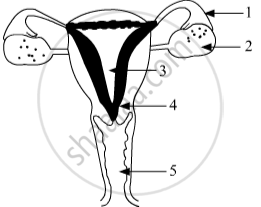
The membranous cover of the ovum at ovulation is ______.
