Advertisements
Advertisements
Questions
Describe the human male reproductive system.
Describe in brief the male reproductive system of human.
Advertisements
Solution
The human male reproductive system comprises testes, epididymis, vas deferens, Cowper’s glands, prostate gland and penis.
- Testes
- Testes produce male gametes and sperms.
- To maintain the temperature 2–3°C lower than the body temperature, the scrotum is located outside the body cavity.
- Epididymis
- The epididymis stores sperms temporarily.
- Vas deferens
- Each epididymis continues further as a sperm duct or vas deferens.
- Seminal vesicles
- The seminal vesicles produce a secretion which is responsible for the transport of sperms.
- Prostate gland
- It is a bilobed structure which surrounds the urethra.
- It pours an alkaline secretion into the semen.
- Cowper’s glands
- These are two small ovoid glands.
- They open into the urethra.
- Its secretion serves as a lubricant.
- Penis
- The urethra passes through the penis.
- It carries either urine or semen at a given time.
- Scrotum
- A skin-covered pouch outside the body cavity that houses the testes.
- Keeps testes 2–3°C cooler than body temperature for normal spermatogenesis (via dartos & cremaster muscle adjustments, sweat glands)
- Urethra
- Common duct for urine and semen (not at the same time).
- About 18–20 cm long in males; parts: prostatic → membranous → spongy (penile).
- Internal urethral sphincter prevents urine mixing during ejaculation and opens at the external urethral meatus at the tip of the penis.
RELATED QUESTIONS
Why are the human testes located outside the abdominal cavity? Name the pouch in which they are present.
Choose the ODD one out of the following terms given and name the CATEGORY to which the others belong:
ACTH, TSH, ADH, FSH
What is semen?
Write important function of the following:
Inguinal canal
Describe the functions of the following:
Testis
What are the accessory reproductive organs?
Sketch the labelled diagram.
Human male reproductive system.
Given below is the outline of the male reproductive system.
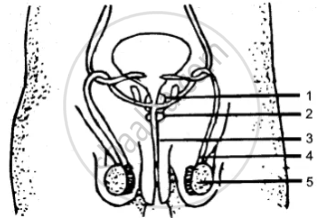
(i) Name the parts labeled 1 to 5.
(ii) State the functions of the parts labeled 1 and 4.
(iii) Name the cells of part 5 that produce testosterone.
(iv) Why is structure 5 present outside the body in the scrotal sacs?
(v) What is semen?
Give Technical Term:
Name the male gamete of a mammal.
Give Technical Term:
Name the male reproductive cells of mammals.
Mention, if the following statement is True or False. If false rewrite the wrong statement in its correct form:
Tubectomy involves the cutting and tying of the vas deferens in males.
In humans, there are ____________ pairs of chromosomes.
Why are the human testes located outside the abdominal cavity? Name the pouch in which they are present.
Which of the following is a secondary sexual character observed in males?
lf vasectomized man attempts to rape, then the presence of which of the following confirms it?
In the following diagram, what are A and its function?

Which of the following produces sperms in spermatogenesis?
Sertoli cells are regulated by the pituitary hormone known as ______.
Vas deferens receives the duct of seminal vesicle and forms the ______.
Seminal vesicles are located in ______.
In human males, the testes lie in the scrotum, because it helps in the ______
Explain the function of the following structure in the human male reproductive system.
Leydig cells
Explain the function of the following structure in the human male reproductive system.
Male accessory glands
Given below is a certain situation. Analyze and describe its possible impact on a person:
Testes of a male boy are not able to descend into the scrotum during his embryonic development.
Give significance of Leydig's cells.
Draw a neat labeled diagram of T.S. of testis.
Choose the odd one out from the group of terms given below and write the category for the remaining terms:
What is the primary role of the testes?
What is the length of the epididymis when uncoiled?
