Advertisements
Online Mock Tests
Chapters
1: Cell Cycle and Cell Division
2: Structure of Chromosome
3: Genetics
Unit 2: Plant Physiology
▶ 4: Absorption by Roots
5: Transpiration
6: Photosynthesis
7: Chemical Coordination in Plants
Unit 3: Human Anatomy and Physiology
8: Circulatory System
9: Human Excretory System
10: Nervous System
11: Sense Organs
12: Endocrine System
13: Reproductive System
Unit 4: Population
14: Population
Unit 5: Human Evolution
15: Human Evolution
Unit 6: Pollution
16: Pollution
![Lakhmir Singh solutions for Biology [English] Class 10 ICSE chapter 4 - Absorption by Roots - Shaalaa.com](/images/biology-english-class-10-icse_6:7181a54a5d284da8b50dd2f92022a1f6.jpg "Lakhmir Singh solutions for Biology [English] Class 10 ICSE chapter 4 - Absorption by Roots")
Advertisements
Solutions for Chapter 4: Absorption by Roots
Below listed, you can find solutions for Chapter 4 of CISCE Lakhmir Singh for Biology [English] Class 10 ICSE.
Lakhmir Singh solutions for Biology [English] Class 10 ICSE 4 Absorption by Roots Intex Quesions [Pages 56 - 67]
TEST YOUR UNDERSTANDING - 1 Fill in the Blanks
The surface area of roots is increased due to the presence of ______.
______ is the main constituent of protoplasm of plant cells.
True or False.
Cell sap with higher concentration than the surrounding water helps in absorption of water.
True or False.
The absorption of water by the roots does not depend on the thickness of its walls.
Multiple Choice Questions
Root hairs absorb ______.
Water and ions
Water and minerals
Water and Oxygen
Only Water
Cell membrane of root cells are ______.
Semi-permeable
Freely permeable
Impervious
Hard
THINK AND ANSWER
How are red blood cells and root hair cells similar?
How do roots help maintain the ecology of a region?
Not all roots exist underground; there are some above the soil also. Can you name?
Why do plants growing in dry regions have very deep root systems?
TEST YOUR UNDERSTANDING - 2 Fill in the Blanks
The plant cells absorb ______ by osmosis.
The cells shrink in ______ solution.
Dry seeds kept in water swell due to ______.
True or False.
Extra input of energy is required during osmosis.
True or False.
Hypotonic solution contains a low concentration of solute relative to another solution.
True or False.
During osmosis, the flow of water through semi-permeable membrane is from both sides of semi-permeable membrane with unequal flow rates.
Multiple Choice Questions
Water is transported in and out of the cells primarily due to ______.
Active transport
Diffusion
Osmosis
All of these
An unripe mango placed in a concentrated salt solution to prepare pickle, shrivels because ______.
it gains water due to osmosis.
it loses water due to reverse osmosis.
it gains water due to reverse osmosis.
it loses water due to osmosis.
TEST YOUR UNDERSTANDING - 3 Fill in the Blanks
Plasmolysis is as a result of ______.
Flaccid guard cells cause the ______ openings to close.
When stem of a plant is cut, water comes out and this is due to ______.
True or False.
Plasmolysis occurs only in plant cells.
True or False.
Guttation is also referred to as bleeding.
Mention whether the following statement is true (T) or false (F) and give explanation in support of your answer.
Plasmolysis is reverse of deplasmolysis.
True
False
Multiple Choice Questions
During plasmolysis water is lost from the ______.
Cytoplasm
Vacuole
Cytoplasm first and then from the vacuole
Vacuole first and then from the cytoplasm
Turgor pressure helps in the:
Opening and closing of stomata
Folding of leaves in insectivorous plants
Emergence of seedling from the soil
All of these
TEST YOUR UNDERSTANDING - 4 Fill in the Blanks
A layer of oil is added in the experiment in the test tube to prevent the loss of water due to ______.
The force exerted by xylem vessels is known as ______.
The tendency of water molecules to stick together is known as ______.
True or False.
The girdling experiments show the importance of phloem tissues.
True or False.
Phloem tissues are located deeper in the stem.
True or False.
In the ringing experiment, the stem below the ring stops growing due to exhaustion of food.
Multiple Choice Questions
The factors that are responsible for transpiration pull are:
Loss of water due to transpiration
Cohesive force of water molecules
Adhesive forces of water
All of these
In the ringing experiment when phloem tissues are removed, we observe swelling on the upper part of the ring. This is due to:
Accumulation of water
Healing of the cut part
Accumulation of sugars that are not translocated
None of these
Lakhmir Singh solutions for Biology [English] Class 10 ICSE 4 Absorption by Roots EXERCISE [Pages 69 - 72]
Objective Questions
True or False.
Water absorption is mainly through the root hairs.
True or False.
Root hairs increase the surface area for effective absorption of water.
True or False.
Deplasmolysis is recovery of plasmolysed plant cell.
True or False.
Plasmolysis occurs in both animal and plant cells.
True or False.
Capillarity is responsible for guttation.
Fill in the Blanks
The bending movement of some flowers towards the sun is due to ______.
The absorption of water by root hairs is through ______.
Energy supplied by the cell for active transport is in the form of ______.
On placing a cell in a concentrated solution, the cell contents will ______.
The continuous flow of water through the xylem vessels is maintained due to the ______ of water.
Match the Following:
| Column I | Column II |
| (i) Root pressure | (a) Turgor pressure |
| (ii) Closing of leaves due to touch | (b) Upward flow of water |
| (iii) Movement against the gradient | (c) Guttation |
| (iv) Swelling of a cell | (d) Diffusion |
| (v) Xylem | (e) Active transport |
| (vi) Tendency of water molecules to stick | (f) Endosmosis |
| (vii) Movement of molecules from high to low concentration | (g) Cohesion |
Give One Word Answer.
The process of living or dead cell absorbing water by surface tension.
Give One Word Answer.
Removal of water from the stomata.
Give One Word Answer.
The state of a cell in which the cell wall is rigid and stretched by increase in the volume of vacuoles due to water absorption.
Give the equivalent term for the following:
Loss of water through a cut stem.
Give One Word Answer.
Flow of water from the cell to the outside.
The process by which root hairs absorb water from the soil.
Multiple Choice Questions
A cell kept in a solution does not change its shape or size. The solution is:
Hypertonic
Hypotonic
Isotonic
Salt solution
A balsam plant kept in eosin stain for few hours will show pink colour in its:
Xylem
Phloem
Pith
All of these
Movement of molecules from a region of their higher concentration to a lower concentration without a semi-permeable membrane is ______.
Osmosis
Active transport
Capillarity
Diffusion
Osmosis and diffusion are the same except that in osmosis there is ______.
Cell wall
Use of energy
Semi-permeable membrane
Freely permeable membrane
A plant cell bursts if ______.
Turgor pressure is equal to wall pressure
Wall pressure exceeds turgor pressure
Turgor pressure exceeds wall pressure
None of these
Descriptive Questions Short Answer Questions
Why is excessive salt added to pickles?
What will happen if resins are kept in water?
Give two examples of turgor movements in plants.
What two substances enter the root hair and what is their significance for plants?
A closed can of dry seeds bursts open if some water enters by mistake. Why?
Give suitable biological reasons for the following statement:
Root hairs become flaccid and droop when excess fertilizers are added to the moist soil around them.
Define the following term:
Imbibition
Define the following:
Turgor pressure
Define the following term:
Active transport
Define the term:
Plasmolysis
Differentiate between the following:
Turgidity and Flaccidity
Distinguish between Diffusion and Osmosis.
Distinguish between the following:
Hypotonic and Hypertonic solutions
Differentiate between the following:
Turgor pressure and wall pressure
Differentiate between the following:
Plasmolysis and Deplasmolysis.
Long Answer Questions
Excessive fertilisers should not be added to the soil. Explain.
What is wilting?
What do you mean by transpiration pull ?
Explain the role of cohesive force in the ascent of sap.
Explain with the help of an experiment about osmosis observed in plants.
What is tonicity?
Briefly describe the types of tonicity?
Describe experiments on:
To show that water is conducted upwards through the xylem.
Describe experiments on:
To prove phloem conducts food.
Diagram Based Questions
The diagram given below represents a plant cell after being placed in a strong sugar solution. Study the diagram and answer the questions that follow:

- What is the state of the cell shown in the diagram?
- Name the structure that acts as a selectively permeable membrane.
- Label the parts numbered 1 to 4 in the diagram.
- How can the above cell be brought back to its original condition? Mention the scientific term for the recovery of the cell.
- State any two features of the above plant cell which is not present in animal cells.
The figure given is a diagrammatic representation of a part of the cross section of the root in the root-hair zone. Study the same and then answer the questions that follow:
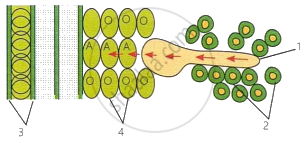
- Name the parts indicated by the guidelines 1 to 4.
- Which is the process that enables the passage of water from the soil into the root hair?
- Name the pressure that is responsible for the movement of water in the direction indicated by the arrows. Define it.
- Due to an excess of this pressure, sometimes drops of water are found along the leaf margins of some plants especially in the early mornings.What is the phenomenon called?
- Draw a well-labelled diagram of the root-hair cell as it would appear if excess of fertiliser is added to the soil close to it.
The diagram below represents a layer of epidermal cells showing fully grown root hair. Study the diagram and answer the questions that follow:

- Name the parts labelled A, B, C and D.
- The root hair cell is in a turgid state. Name and explain the process that caused this state.
- Mention one distinct difference between the parts labelled A and B.
- Draw a diagram of the above root hair cell as it would appear when a concentrated solution of fertiliser is added near it.
Given below is the diagram of an apparatus set up to study a very important physiological process:
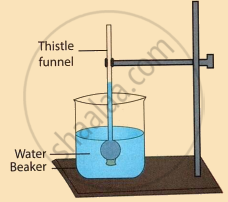
- Name the process being studied.
- Explain the process.
- What change would you observe in the thistle funnel containing sugar solution after about 10 minutes?
- Is sugar solution hypertonic or hypotonic?
- Name the part of the plant cell which is represented by the sugar solution.
- Explain why more salt is added to pickles.
DO IT RIGHT
Your teacher has demonstrated various experiments of this chapter. She/he decided to organise a group discussion on these experiments. The students were divided into six groups and were asked to prepare for a particular experiment. They were further asked to learn about the latest experiments conducted related to this chapter and the scientists involved in it. A round of questionnaires would be given to each group to know about their concept and approach and to generate new thoughts towards 'Absorption by roots'.
Solutions for 4: Absorption by Roots
Lakhmir Singh solutions for Biology [English] Class 10 ICSE chapter 4 - Absorption by Roots
Shaalaa.com has the CISCE Mathematics Biology [English] Class 10 ICSE CISCE solutions in a manner that help students grasp basic concepts better and faster. The detailed, step-by-step solutions will help you understand the concepts better and clarify any confusion. Lakhmir Singh solutions for Mathematics Biology [English] Class 10 ICSE CISCE 4 (Absorption by Roots) include all questions with answers and detailed explanations. This will clear students' doubts about questions and improve their application skills while preparing for board exams.
Further, we at Shaalaa.com provide such solutions so students can prepare for written exams. Lakhmir Singh textbook solutions can be a core help for self-study and provide excellent self-help guidance for students.
Concepts covered in Biology [English] Class 10 ICSE chapter 4 Absorption by Roots are .
Using Lakhmir Singh Biology [English] Class 10 ICSE solutions Absorption by Roots exercise by students is an easy way to prepare for the exams, as they involve solutions arranged chapter-wise and also page-wise. The questions involved in Lakhmir Singh Solutions are essential questions that can be asked in the final exam. Maximum CISCE Biology [English] Class 10 ICSE students prefer Lakhmir Singh Textbook Solutions to score more in exams.
Get the free view of Chapter 4, Absorption by Roots Biology [English] Class 10 ICSE additional questions for Mathematics Biology [English] Class 10 ICSE CISCE, and you can use Shaalaa.com to keep it handy for your exam preparation.
