Advertisements
Advertisements
What is the role of graphite rod in the electrometallurgy of aluminium?
Concept: undefined >> undefined
How does the presence of double bonds in rubber molecules influence their structure and reactivity?
Concept: undefined >> undefined
Advertisements
Discuss the main purpose of vulcanisation of rubber.
Concept: undefined >> undefined
Identify the monomer in the following polymeric structures.

Concept: undefined >> undefined
An organic compound with the molecular formula C9H10O forms 2, 4-DNP derivative, reduces Tollens’ reagent and undergoes Cannizzaro reaction. On vigorous oxidation, it gives 1, 2-benzenedicarboxylic acid. Identify the compound.
Concept: undefined >> undefined
Describe the following:
Cannizzaro reaction
Concept: undefined >> undefined
Ortho and para nitrophenols are more acidic than phenol. Draw the resonance structures of the corresponding phenoxide ions.
Concept: undefined >> undefined
Show how will you synthesize pentan-1-ol using a suitable alkyl halide.
Concept: undefined >> undefined
Give the equation of the following reaction:
Oxidation of propan-1-ol with alkaline KMnO4 solution.
Concept: undefined >> undefined
Give the equation of the following reaction:
Dilute HNO3 with phenol.
Concept: undefined >> undefined
Give the equation of the following reaction:
Treating phenol with chloroform in the presence of aqueous NaOH.
Concept: undefined >> undefined
Write the mechanism of acid-catalysed dehydration of ethanol to yield ethene.
Concept: undefined >> undefined
Name the reagent used in the following reaction:
Oxidation of a primary alcohol to carboxylic acid.
Concept: undefined >> undefined
Name the reagent used in the following reaction:
Oxidation of a primary alcohol to aldehyde.
Concept: undefined >> undefined
Name the reagent used in the following reaction:
Benzyl alcohol to benzoic acid.
Concept: undefined >> undefined
When 3-methylbutan-2-ol is treated with HBr, the following reaction takes place:
\[\begin{array}{cc}
\phantom{...................................}\ce{Br}\\
\phantom{..................................}|\\
\ce{CH3 - CH - CH - CH3 ->[HBr] CH3 - C - CH2 - CH3}\\
|\phantom{.........}|\phantom{...................................}|\phantom{...........}\\
\ce{CH3}\phantom{...}\ce{OH}\phantom{...............................}\ce{CH3}\phantom{.......}\\
\end{array}\]
Give a mechanism for this reaction.
(Hint: The secondary carbocation formed in step II rearranges to a more
stable tertiary carbocation by a hydride ion shift from 3rd carbon atom.)
Concept: undefined >> undefined
Identify A, B, C, D, E, R and R1 in the following:
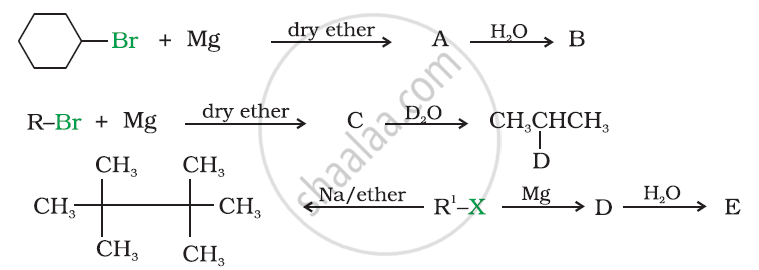
Concept: undefined >> undefined
How will you bring about the following conversion?
Bromomethane to propanone
Concept: undefined >> undefined
How will you bring about the following conversion?
1-Chlorobutane to n-octane
Concept: undefined >> undefined
Explain why Grignard reagents should be prepared under anhydrous conditions?
Concept: undefined >> undefined
