Advertisements
Advertisements
Question
An organic compound with the molecular formula C9H10O forms 2, 4-DNP derivative, reduces Tollens’ reagent and undergoes Cannizzaro reaction. On vigorous oxidation, it gives 1, 2-benzenedicarboxylic acid. Identify the compound.
Advertisements
Solution
It is given that the compound (with molecular formula C9H10O) forms 2, 4-DNP derivative and reduces Tollen’s reagent. Therefore, the given compound must be an aldehyde.
Again, the compound undergoes Cannizzaro reaction and on oxidation gives 1, 2-benzenedicarboxylic acid. Therefore, the −CHO group is directly attached to a benzene ring and this benzaldehyde is ortho-substituted. Hence, the compound is 2-ethylbenzaldehyde.

2-Ethylbenzaldehyde
The given reactions can be explained by the following equations:

APPEARS IN
RELATED QUESTIONS
Complete the following reactions:

Write a note on the self oxidation-reduction reaction of an aldehyde with a suitable example.
Write the chemical equation for the reaction involved in Cannizzaro reaction.
Describe the following:
Cannizzaro reaction
Write the reactions involved in the following reactions: Clemmensen reduction
Write the product(s) in the following reactions

Complete the following reactions:

How will you convert acetone to acetone cyanohydrin?
Write the product formed when p-nitro chlorobenzene is heated with aqueous NaOH at 443K followed by acidification?
complete the following reaction:
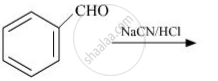
complete the following reaction:
\[\begin{array}{cc}
\phantom{...}\ce{CH3} \\
| \\
\phantom{.................}\ce{CH3-CH-COOH ->[(i) Br2/Red P4][(ii)H2O]}
\end{array}\]
\[\begin{array}{cc}
\ce{D}\phantom{........................}\\
|\phantom{.........................}\\
\ce{2D - C = O + OH^- ->[Cannizzaro] X and Y}
\end{array}\]
(Y is alcohol, D is deuterium)
X and Y will have the structure:
In the Cannizzaro reaction given below:
\[\ce{2Ph-CHO ->[OH^-] Ph-CH2OH + PhC\overset{-}{O}_2}\]
the slowest step is:
Which of the following does not give Cannizzaro reaction?
Write the chemical reaction involved in Cannizzaro reaction of methanal.
Calcium acetate, on heating, gives:
Benzaldehyde can be prepared by the hydrolysis of:
Which product is formed when the compound benzaldehyde is treated with concentrated aqueous KOH solution?
