Please select a subject first
Advertisements
Advertisements
How many planes can be made to pass through a line and a point not on the line?
Concept: undefined >> undefined
How many planes can be made to pass through two points?
Concept: undefined >> undefined
Advertisements
How many planes can be made to pass through three distinct points?
Concept: undefined >> undefined
Find the area of a triangle whose base and altitude are 5 cm and 4 cm respectively.
Concept: undefined >> undefined
Find the area of a triangle whose sides are 3 cm, 4 cm and 5 cm respectively.
Concept: undefined >> undefined
Find the area of an isosceles triangle having the base x cm and one side y cm.
Concept: undefined >> undefined
Find the measure of each angle of an equilateral triangle.
Concept: undefined >> undefined
CDE is an equilateral triangle formed on a side CD of a square ABCD. Show that ΔADE ≅ΔBCE.
Concept: undefined >> undefined
Prove that the sum of three altitudes of a triangle is less than the sum of its sides.
Concept: undefined >> undefined
In the given figure, if AB = AC and ∠B = ∠C. Prove that BQ = CP.
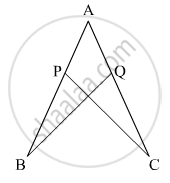
Concept: undefined >> undefined
Mark the correct alternative in each of the following:
If ABC ≅ ΔLKM, then side of ΔLKM equal to side AC of ΔABC is
Concept: undefined >> undefined
If ΔABC ≅ ΔABC is isosceles with
Concept: undefined >> undefined
ΔPQR and ΔABC is not congruent to ΔRPQ, then which of the following is not true:
Concept: undefined >> undefined
In triangles ABC and PQR three equality relations between some parts are as follows:
AB = QP, ∠B = ∠P and BC = PR
State which of the congruence conditions applies:
Concept: undefined >> undefined
In triangles ABC and PQR, if ∠A = ∠R, ∠B = ∠P and AB = RP, then which one of the following congruence conditions applies:
Concept: undefined >> undefined
In ΔPQR ≅ ΔEFD then ED =
Concept: undefined >> undefined
If ΔPQR≅ ΔEFD, then ∠E =
Concept: undefined >> undefined
In a ΔABC, if AB = AC and BC is produced to D such that ∠ACD = 100°, then ∠A =
Concept: undefined >> undefined
In an isosceles triangle, if the vertex angle is twice the sum of the base angles, then the measure of vertex angle of the triangle is
Concept: undefined >> undefined
Which of the following is not a criterion for congruence of triangles?
Concept: undefined >> undefined
