Advertisements
Advertisements
Question
CDE is an equilateral triangle formed on a side CD of a square ABCD. Show that ΔADE ≅ΔBCE.
Advertisements
Solution
We have to prove that ΔADE ≅ ΔBCE
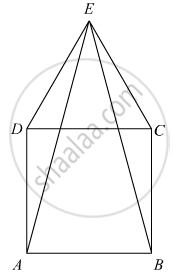
Given ABCDis a square
So AB = BC = CD = AD
Now in ΔEDC is equilateral triangle.
So DE = EC = CB
In ΔAED and ΔCEB
AD = BC (Side of triangle)
DE = CE (Side of equilateral triangle)
∠ADE = ∠ADC + ∠CDE
= 90 + 60
= 150
And,
∠BCE = ∠BCD + ∠DCE
= 90 + 60
= 150
So ∠ACE = ∠BCDE
Hence from SAS congruence ΔADE ≅ ΔBCE Proved.
APPEARS IN
RELATED QUESTIONS
ΔPQR and ΔABC is not congruent to ΔRPQ, then which of the following is not true:
In ΔPQR ≅ ΔEFD then ED =
In the given figure, AB ⊥ BE and FE ⊥ BE. If BC = DE and AB = EF, then ΔABD is congruent to

In the following example, a pair of triangles is shown. Equal parts of triangles in each pair are marked with the same sign. Observe the figure and state the test by which the triangle in each pair are congruent.
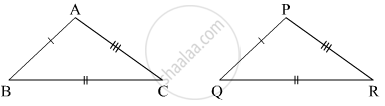
By ______ test
Δ ABC ≅ ΔPQR
In the following example, a pair of triangles is shown. Equal parts of triangle in each pair are marked with the same sign. Observe the figure and state the test by which the triangles in each pair are congruent.
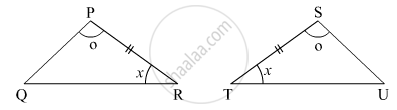
By ______ test
ΔPRQ ≅ ΔSTU
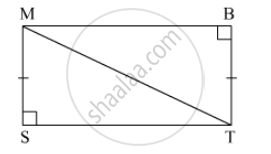
In the pair of triangles given below, the parts shown by identical marks are congruent. State the test and the one-to-one correspondence of vertices by which the triangles in the pair are congruent, the remaining congruent parts.
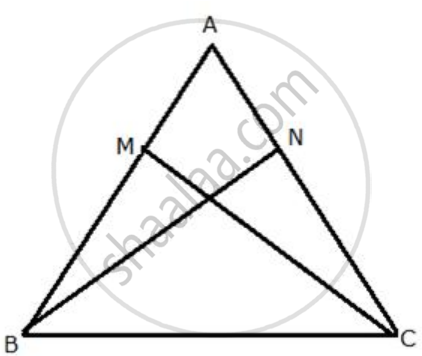
The following figure has shown a triangle ABC in which AB = AC. M is a point on AB and N is a point on AC such that BM = CN.
Prove that: (i) AM = AN (ii) ΔAMC ≅ ΔANB
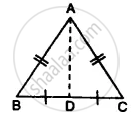
Prove that:
- ∆ ABD ≅ ∆ ACD
- ∠B = ∠C
- ∠ADB = ∠ADC
- ∠ADB = 90°
In the figure, ∠CPD = ∠BPD and AD is the bisector of ∠BAC. Prove that ΔCAP ≅ ΔBAP and CP = BP.
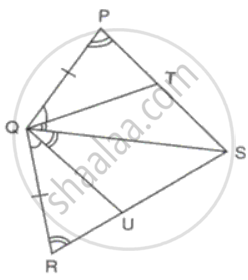
PQRS is a quadrilateral and T and U are points on PS and RS respectively such that PQ = RQ, ∠PQT = ∠RQU and ∠TQS = ∠UQS. Prove that QT = QU.