Advertisements
Advertisements
प्रश्न
CDE is an equilateral triangle formed on a side CD of a square ABCD. Show that ΔADE ≅ΔBCE.
Advertisements
उत्तर
We have to prove that ΔADE ≅ ΔBCE

Given ABCDis a square
So AB = BC = CD = AD
Now in ΔEDC is equilateral triangle.
So DE = EC = CB
In ΔAED and ΔCEB
AD = BC (Side of triangle)
DE = CE (Side of equilateral triangle)
∠ADE = ∠ADC + ∠CDE
= 90 + 60
= 150
And,
∠BCE = ∠BCD + ∠DCE
= 90 + 60
= 150
So ∠ACE = ∠BCDE
Hence from SAS congruence ΔADE ≅ ΔBCE Proved.
APPEARS IN
संबंधित प्रश्न
Prove that the sum of three altitudes of a triangle is less than the sum of its sides.
In the given figure, if AB = AC and ∠B = ∠C. Prove that BQ = CP.

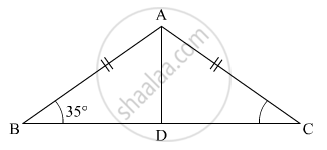
ABC is an isosceles triangle such that AB = AC and AD is the median to base BC. Then, ∠BAD =
On the sides AB and AC of triangle ABC, equilateral triangle ABD and ACE are drawn. Prove that:
- ∠CAD = ∠BAE
- CD = BE
In the following diagram, ABCD is a square and APB is an equilateral triangle.
(i) Prove that: ΔAPD≅ ΔBPC
(ii) Find the angles of ΔDPC.
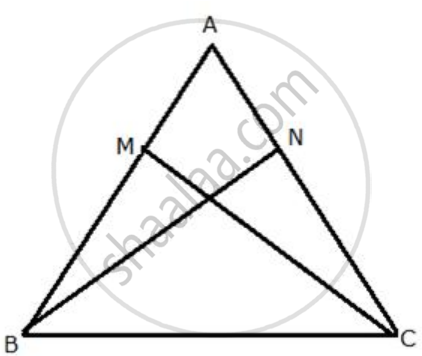
The following figure has shown a triangle ABC in which AB = AC. M is a point on AB and N is a point on AC such that BM = CN.
Prove that: (i) BN = CM (ii) ΔBMC ≅ ΔCNB
Which of the following pairs of triangles are congruent? Give reasons
ΔABC;(AB = 8cm,BC = 6cm,∠B = 100°);
ΔPQR;(PQ = 8cm,RP = 5cm,∠Q = 100°).
Which of the following pairs of triangles are congruent? Give reasons
ΔABC;(∠B = 90°,BC = 6cm,AB = 8cm);
ΔPQR;(∠Q = 90°,PQ = 6cm,PR = 10cm).
In a circle with center O. If OM is perpendicular to PQ, prove that PM = QM.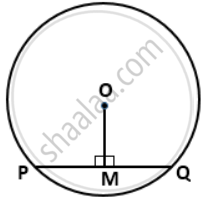
Two right-angled triangles ABC and ADC have the same base AC. If BC = DC, prove that AC bisects ∠BCD.
