Advertisements
Advertisements
Factorise:
6x2 + 5x – 6
Concept: undefined >> undefined
Factorise:
3x2 – x – 4
Concept: undefined >> undefined
Advertisements
Factorise:
x3 – 2x2 – x + 2
Concept: undefined >> undefined
Factorise:
x3 – 3x2 – 9x – 5
Concept: undefined >> undefined
Factorise:
x3 + 13x2 + 32x + 20
Concept: undefined >> undefined
Factorise:
2y3 + y2 – 2y – 1
Concept: undefined >> undefined
In an isosceles triangle ABC, with AB = AC, the bisectors of ∠B and ∠C intersect each other at O. Join A to O. Show that:
- OB = OC
- AO bisects ∠A
Concept: undefined >> undefined
In ΔABC, AD is the perpendicular bisector of BC (see the given figure). Show that ΔABC is an isosceles triangle in which AB = AC.

Concept: undefined >> undefined
ABC is an isosceles triangle in which altitudes BE and CF are drawn to equal sides AC and AB respectively (see the given figure). Show that these altitudes are equal.

Concept: undefined >> undefined
ABC is a triangle in which altitudes BE and CF to sides AC and AB are equal (see the given figure). Show that
- ΔABE ≅ ΔACF
- AB = AC, i.e., ABC is an isosceles triangle.
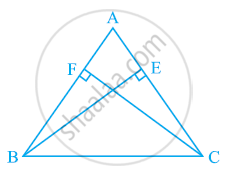
Concept: undefined >> undefined
ABC and DBC are two isosceles triangles on the same base BC (see the given figure). Show that ∠ABD = ∠ACD.
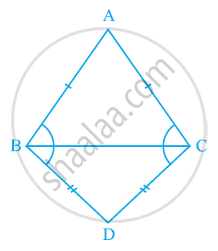
Concept: undefined >> undefined
ΔABC is an isosceles triangle in which AB = AC. Side BA is produced to D such that AD = AB (see the given figure). Show that ∠BCD is a right angle.

Concept: undefined >> undefined
Show that the angles of an equilateral triangle are 60° each.
Concept: undefined >> undefined
ABCD is a quadrilateral in which P, Q, R and S are mid-points of the sides AB, BC, CD and DA (see the given figure). AC is a diagonal. Show that:
- SR || AC and SR = `1/2AC`
- PQ = SR
- PQRS is a parallelogram.

Concept: undefined >> undefined
ABCD is a rhombus and P, Q, R and S are the mid-points of the sides AB, BC, CD and DA respectively. Show that the quadrilateral PQRS is a rectangle.
Concept: undefined >> undefined
ABCD is a rectangle and P, Q, R and S are mid-points of the sides AB, BC, CD and DA respectively. Show that the quadrilateral PQRS is a rhombus.
Concept: undefined >> undefined
ABCD is a trapezium in which AB || DC, BD is a diagonal and E is the mid-point of AD. A line is drawn through E parallel to AB intersecting BC at F (see the given figure). Show that F is the mid-point of BC.
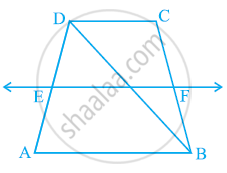
Concept: undefined >> undefined
In a parallelogram ABCD, E and F are the mid-points of sides AB and CD respectively (see the given figure). Show that the line segments AF and EC trisect the diagonal BD.
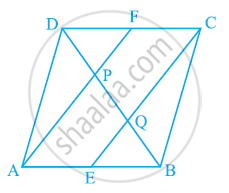
Concept: undefined >> undefined
Show that the line segments joining the mid-points of the opposite sides of a quadrilateral bisect each other.
Concept: undefined >> undefined
ABC is a triangle right angled at C. A line through the mid-point M of hypotenuse AB and parallel to BC intersects AC at D. Show that
- D is the mid-point of AC
- MD ⊥ AC
- CM = MA = `1/2AB`
Concept: undefined >> undefined
