Advertisements
Advertisements
Consider a uniform electric field in the ẑ direction. The potential is a constant ______.
- in all space.
- for any x for a given z.
- for any y for a given z.
- on the x-y plane for a given z.
Concept: undefined >> undefined
Equipotential surfaces ______.
- are closer in regions of large electric fields compared to regions of lower electric fields.
- will be more crowded near sharp edges of a conductor.
- will be more crowded near regions of large charge densities.
- will always be equally spaced.
Concept: undefined >> undefined
Advertisements
The work done to move a charge along an equipotential from A to B ______.
- cannot be defined as `- int_A^B E.dl`
- must be defined as `- int_A^B E.dl`
- is zero.
- can have a non-zero value.
Concept: undefined >> undefined
Prove that a closed equipotential surface with no charge within itself must enclose an equipotential volume.
Concept: undefined >> undefined
Find the equation of the equipotentials for an infinite cylinder of radius r0, carrying charge of linear density λ.
Concept: undefined >> undefined
Two identical current carrying coaxial loops, carry current I in an opposite sense. A simple amperian loop passes through both of them once. Calling the loop as C ______.
- `oint B.dl = +- 2μ_0I`
- the value of `oint B.dl` is independent of sense of C.
- there may be a point on C where B and dl are perpendicular.
- B vanishes everywhere on C.
Concept: undefined >> undefined
An e.m.f is produced in a coil, which is not connected to an external voltage source. This can be due to ______.
- the coil being in a time varying magnetic field.
- the coil moving in a time varying magnetic field.
- the coil moving in a constant magnetic field.
- the coil is stationary in external spatially varying magnetic field, which does not change with time.
Concept: undefined >> undefined
A circular coil expands radially in a region of magnetic field and no electromotive force is produced in the coil. This can be because ______.
- the magnetic field is constant.
- the magnetic field is in the same plane as the circular coil and it may or may not vary.
- the magnetic field has a perpendicular (to the plane of the coil) component whose magnitude is decreasing suitably.
- there is a constant magnetic field in the perpendicular (to the plane of the coil) direction.
Concept: undefined >> undefined
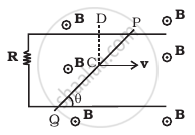
Find the current in the wire for the configuration shown in figure. Wire PQ has negligible resistance. B, the magnetic field is coming out of the paper. θ is a fixed angle made by PQ travelling smoothly over two conducting parallel wires separated by a distance d.
Concept: undefined >> undefined
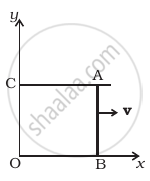
A magnetic field B = Bo sin ( ωt )`hatk` wire AB slides smoothly over two parallel conductors separated by a distance d (Figure). The wires are in the x-y plane. The wire AB (of length d) has resistance R and the parallel wires have negligible resistance. If AB is moving with velocity v, what is the current in the circuit. What is the force needed to keep the wire moving at constant velocity?
Concept: undefined >> undefined
A rectangular loop of wire ABCD is kept close to an infinitely long wire carrying a current I(t) = Io (1 – t/T) for 0 ≤ t ≤ T and I(0) = 0 for t > T (Figure). Find the total charge passing through a given point in the loop, in time T. The resistance of the loop is R.

Concept: undefined >> undefined
A rod of mass m and resistance R slides smoothly over two parallel perfectly conducting wires kept sloping at an angle θ with respect to the horizontal (Figure). The circuit is closed through a perfect conductor at the top. There is a constant magnetic field B along the vertical direction. If the rod is initially at rest, find the velocity of the rod as a function of time.

Concept: undefined >> undefined
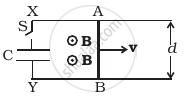
Find the current in the sliding rod AB (resistance = R) for the arrangement shown in figure. B is constant and is out of the paper. Parallel wires have no resistance. v is constant. Switch S is closed at time t = 0.
Concept: undefined >> undefined
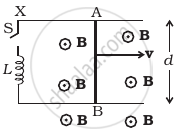
Find the current in the sliding rod AB (resistance = R) for the arrangement shown in figure. B is constant and is out of the paper. Parallel wires have no resistance. v is constant. Switch S is closed at time t = 0.
Concept: undefined >> undefined
Two source S1 and S2 of intensity I1 and I2 are placed in front of a screen [Figure (a)]. The pattern of intensity distribution seen in the central portion is given by Figure (b).
 (a) |
 (b) |
- S1 and S2 have the same intensities.
- S1 and S2 have a constant phase difference.
- S1 and S2 have the same phase.
- S1 and S2 have the same wavelength.
Concept: undefined >> undefined
The binding energy of a H-atom, considering an electron moving around a fixed nuclei (proton), is B = `- (Me^4)/(8n^2ε_0^2h^2)`. (m = electron mass). If one decides to work in a frame of reference where the electron is at rest, the proton would be moving around it. By similar arguments, the binding energy would be
B = `- (Me^4)/(8n^2ε_0^2h^2)` (M = proton mass)
This last expression is not correct because ______.
Concept: undefined >> undefined
The simple Bohr model cannot be directly applied to calculate the energy levels of an atom with many electrons. This is because ______.
Concept: undefined >> undefined
For the ground state, the electron in the H-atom has an angular momentum = h, according to the simple Bohr model. Angular momentum is a vector and hence there will be infinitely many orbits with the vector pointing in all possible directions. In actuality, this is not true ______.
Concept: undefined >> undefined
A set of atoms in an excited state decays ______.
Concept: undefined >> undefined
An ionised H-molecule consists of an electron and two protons. The protons are separated by a small distance of the order of angstrom. In the ground state ______.
- the electron would not move in circular orbits.
- the energy would be (2)4 times that of a H-atom.
- the electrons, orbit would go around the protons.
- the molecule will soon decay in a proton and a H-atom.
Concept: undefined >> undefined
