Advertisements
Advertisements
Question
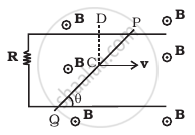
Find the current in the wire for the configuration shown in figure. Wire PQ has negligible resistance. B, the magnetic field is coming out of the paper. θ is a fixed angle made by PQ travelling smoothly over two conducting parallel wires separated by a distance d.
Advertisements
Solution
This problem is based upon the motional emf. Consider a conducting rod of length l moving with a uniform velocity v perpendicular to a uniform magnetic field B bar, directed into the plane of the paper. Let the rod be moving to the right as shown in figure. The conducting electrons also move to the right as they are trapped within the rod.
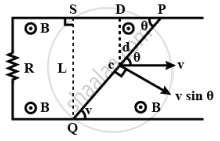
Conducting electrons experience a magnetic force Fm = evB. So they move from P to Q within the rod. The end P of the rod becomes positively charged while end Q becomes negatively charged, hence an electric field is set up within the rod which opposes the further downward movement of electrons, i.e., an equilibrium is reached and in equilibrium Fe = Fm, i.e., eE = evB or R = vB ⇒ Inducted emf e = `El = Bwl [E = V/l]`
If rod is moved by making an angle θ with the direction of magnetic field or length. Induced emf, `e = Bvl sin θ`
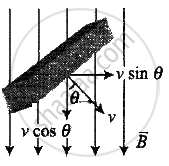 (A) |
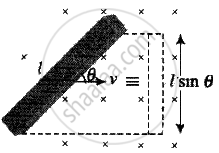 (B) |
Emf induced across PQ due to its motion or change in magnetic flux linked with the loop change due to the change of enclosed area.
The induced electric field E along the dotted line CD (Perpendicular to both `vecv` and `vecB` along `vecv xx vecB`) = `vB`
Therefore, the emotional emf along
PQ = (length PQ) × (field along PQ)
= (length PQ) × (vB sin θ)
= `(d/sin theta) xx (vB sin theta) = vBd`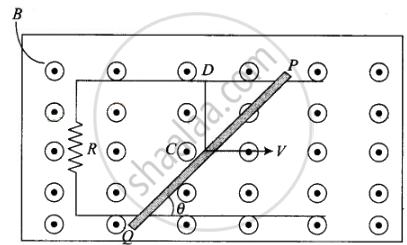
This induced emf make flow of current in closed circuit of resistance R.
`I = (dvB)/R` and is independent of θ.
APPEARS IN
RELATED QUESTIONS
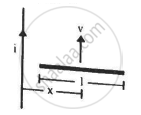
Figure shows a straight, long wire carrying a current i and a rod of length l coplanar with the wire and perpendicular to it. The rod moves with a constant velocity v in a direction parallel to the wire. The distance of the wire from the centre of the rod is x. Find the motional emf induced in the rod.
A cycle wheel of radius 0.6 m is rotated with constant angular velocity of 15 rad/s in a region of magnetic field of 0.2 T which is perpendicular to the plane of the wheel. The e.m.f generated between its center and the rim is, ____________.
The emf induced across the ends of a conductor due to its motion in a magnetic field is called motional emf. It is produced due to magnetic Lorentz force acting on the free electrons of the conductor. For a circuit shown in the figure, if a conductor of length l moves with velocity v in a magnetic field B perpendicular to both its length and the direction of the magnetic field, then all the induced parameters are possible in the circuit.
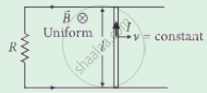
A 0.1 m long conductor carrying a current of 50 A is held perpendicular to a magnetic field of 1.25 mT. The mechanical power required to move the conductor with a speed of 1 ms-1 is ______.
An e.m.f is produced in a coil, which is not connected to an external voltage source. This can be due to ______.
- the coil being in a time varying magnetic field.
- the coil moving in a time varying magnetic field.
- the coil moving in a constant magnetic field.
- the coil is stationary in external spatially varying magnetic field, which does not change with time.
A circular coil expands radially in a region of magnetic field and no electromotive force is produced in the coil. This can be because ______.
- the magnetic field is constant.
- the magnetic field is in the same plane as the circular coil and it may or may not vary.
- the magnetic field has a perpendicular (to the plane of the coil) component whose magnitude is decreasing suitably.
- there is a constant magnetic field in the perpendicular (to the plane of the coil) direction.
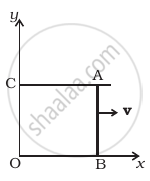
A magnetic field B = Bo sin ( ωt )`hatk` wire AB slides smoothly over two parallel conductors separated by a distance d (Figure). The wires are in the x-y plane. The wire AB (of length d) has resistance R and the parallel wires have negligible resistance. If AB is moving with velocity v, what is the current in the circuit. What is the force needed to keep the wire moving at constant velocity?
A simple pendulum with a bob of mass m and conducting wire of length L swings under gravity through an angle θ. The component of the earth's magnetic field in the direction perpendicular to the swing is B. Maximum emf induced across the pendulum is ______.
(g = acceleration due to gravity)

A wire 5 m long is supported horizontally at a height of 15 m along an east-west direction. When it is about to hit the ground, calculate the average e.m.f. induced in it. (g = 10 m/s2)
Derive an expression for the total emf induced in a conducting rotating rod.
A magnetic flux associated with a coil changes by 0.04 Wb in 0.2 second. The induced emf with coil is ______.
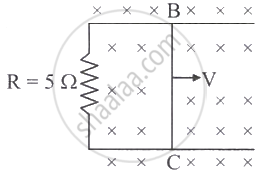
Figure shows a rectangular frame situated in a constant magnetic field. A wire BC of length 1 m is moved out with velocity 4 m/s. Magnetic field strength is 0.15 T. Force acting on the wire BC is:
What is the magnitude of motional emf for the perpendicular arrangement of a straight conductor?
In \[e=Blv\], what does \[l\] represent?
What is the magnitude of the induced EMF when the Faraday's Law derivation gives \[e=-Blv\]?
What is the motional EMF across a small element \[dr\] of a rotating rod?
A metallic rod rotates at \[50\,\mathrm{rev/s}\]. What is its angular velocity?
Earth's horizontal magnetic field is \[H_E=0.4\,\mathrm{G}\]. What value of \[B\] is used in tesla?
A wheel rotates at \[120\,\mathrm{rev/min}\]. What is its angular velocity?
