Advertisements
Advertisements
Question
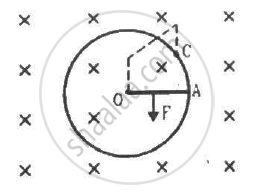
Consider the situation shown in the figure. Suppose the wire connecting O and C has zero resistance but the circular loop has a resistance Runiformly distributed along its length. The rod OA is made to rotate with a uniform angular speed ω as shown in the figure. Find the current in the rod when ∠ AOC = 90°.
Advertisements
Solution
Calculation of the emf induced in the rotating rod:-
It is given that the angular velocity of the disc is ω and the magnetic field perpendicular to the disc is having magnitude B.
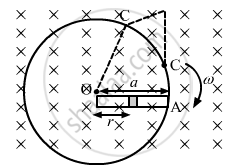
Let us take an element of the rod of thickness dr at a distance r from the centre.
Now,
Linear speed of the element at r from the centre, v = ωr
\[de = Blv\]
\[de = B \times dr \times \omega r\]
\[ \Rightarrow e = \int_0^a \left( B\omega r \right)dr\]
\[= \frac{1}{2}B\omega a^2\]
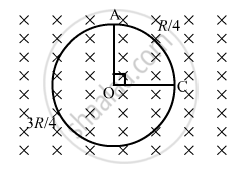
As ∠AOC = 90°, the minor and major segments of AC are in parallel with the rod.
The resistances of the segments are `R/4` and `(3R)/4.`
The equivalent resistance is given by
`R'=(R/4xx(3R/4))/R=(3R)/16`
The motional emf induced in the rod rotating in the clockwise direction is given by
`e=1/2Bomegaa^2`
The current through the rod is given by
\[i = \frac{e}{R'}\]
\[ = \frac{B a^2 \omega}{2R'}\]
\[ = \frac{B a^2 \omega}{2 \times 3R/16}\]
\[ = \frac{B a^2 \omega \times 16}{2 \times 3R} = \frac{8B a^2 \omega}{3R}\]
APPEARS IN
RELATED QUESTIONS
A conducting disc of radius r rotates with a small but constant angular velocity ω about its axis. A uniform magnetic field B exists parallel to the axis of rotation. Find the motional emf between the centre and the periphery of the disc.
Mechanical force per unit area of a charged conductor is ______
A straight conductor of length 2 m moves in a uniform magnetic field of induction 2.5 x `10^-3` T with a velocity. of 4 m/s in a direction perpendicular to its length and also perpendicular to the field. The e.m.f. induced between the ends of the conductor is ______.
The emf induced across the ends of a conductor due to its motion in a magnetic field is called motional emf. It is produced due to magnetic Lorentz force acting on the free electrons of the conductor. For a circuit shown in the figure, if a conductor of length l moves with velocity v in a magnetic field B perpendicular to both its length and the direction of the magnetic field, then all the induced parameters are possible in the circuit.
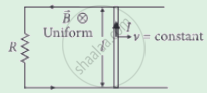
A conducting rod of length l is moving in a transverse magnetic field of strength B with velocity v. The resistance of the rod is R. The current in the rod is ______.
An e.m.f is produced in a coil, which is not connected to an external voltage source. This can be due to ______.
- the coil being in a time varying magnetic field.
- the coil moving in a time varying magnetic field.
- the coil moving in a constant magnetic field.
- the coil is stationary in external spatially varying magnetic field, which does not change with time.
A rod of mass m and resistance R slides smoothly over two parallel perfectly conducting wires kept sloping at an angle θ with respect to the horizontal (Figure). The circuit is closed through a perfect conductor at the top. There is a constant magnetic field B along the vertical direction. If the rod is initially at rest, find the velocity of the rod as a function of time.

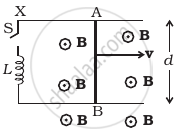
Find the current in the sliding rod AB (resistance = R) for the arrangement shown in figure. B is constant and is out of the paper. Parallel wires have no resistance. v is constant. Switch S is closed at time t = 0.
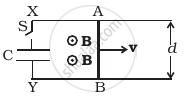
Find the current in the sliding rod AB (resistance = R) for the arrangement shown in figure. B is constant and is out of the paper. Parallel wires have no resistance. v is constant. Switch S is closed at time t = 0.
A simple pendulum with a bob of mass m and conducting wire of length L swings under gravity through an angle θ. The component of the earth's magnetic field in the direction perpendicular to the swing is B. Maximum emf induced across the pendulum is ______.
(g = acceleration due to gravity)

An aircraft of wing span of 60 m flies horizontally in earth’s magnetic field of 6 × 10⁻⁵ T at a speed of 500 m/s. Calculate the e.m.f. induced between the tips of the wings of the aircraft.
A wire of length 1 m moving with velocity 8 m/s at right angles to a magnetic field of 2 T. The magnitude of induced emf, between the ends of wire will be ______.
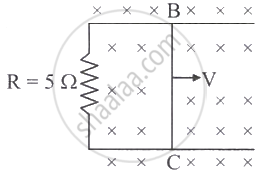
Figure shows a rectangular frame situated in a constant magnetic field. A wire BC of length 1 m is moved out with velocity 4 m/s. Magnetic field strength is 0.15 T. Force acting on the wire BC is:
In \[e=Blv\], what does \[l\] represent?
If a rod moves a distance \[dx\] in time \[dt\], what is the change in magnetic flux used in the Faraday's Law derivation?
What happens to motional EMF if \[\vec{v}\parallel\vec{l}\]?
What is the motional EMF across a small element \[dr\] of a rotating rod?
Earth's horizontal magnetic field is \[H_E=0.4\,\mathrm{G}\]. What value of \[B\] is used in tesla?
A wheel has \[10\] metallic spokes, each \[0.5\,\mathrm{m}\] long. It rotates at \[120\,\mathrm{rev/min}\] in a plane normal to Earth's horizontal magnetic field \[H_E=0.4\,\mathrm{G}\]. What is the induced EMF between the axle and rim?
