Advertisements
Advertisements
Question
The emf induced across the ends of a conductor due to its motion in a magnetic field is called motional emf. It is produced due to magnetic Lorentz force acting on the free electrons of the conductor. For a circuit shown in the figure, if a conductor of length l moves with velocity v in a magnetic field B perpendicular to both its length and the direction of the magnetic field, then all the induced parameters are possible in the circuit.
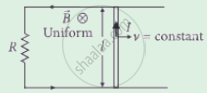
A bicycle generator creates 1.5 V at 15 km/hr. The EMF generated at 10 km/hr is ______.
Options
1.5 volts
2 volts
0.5 volts
1 volts
Advertisements
Solution
A bicycle generator creates 1.5 V at 15 km/hr. The EMF generated at 10 km/hr is 1 volts.
Explanation:
Emf induced, ε = Blv
Here, `vec"B", vecl and vec "v"` are mutually perpendicular
For given B and l. ε ∝ v.
`therefore epsilon_1/epsilon_2 = "v"_1/"v"_2`
Here, ε1 = 1.5 V, v1 = 15 km/hr = `15 xx 5/18` ms-1
v2 = 10 km/hr = `10 xx 5/18`ms-1, ε2 = ?
So, `1.5/epsilon_2 = (15 xx 5/18)/(10 xx 5/18) = 3/2`;
`epsilon_2 = 1 "V"`
