Advertisements
Advertisements
Question
Consider a closed loop C in a magnetic field (Figure). The flux passing through the loop is defined by choosing a surface whose edge coincides with the loop and using the formula φ = B1.dA1 + B2.dA2 +... Now if we chose two different surfaces S1 and S2 having C as their edge, would we get the same answer for flux. Jusity your answer.

Advertisements
Solution
One gets the same answer for flux. Flux can be thought of as the number of magnetic field lines passing through the surface (we draw dN = B ∆ A lines in an area ∆ A ⊥to B), As lines of B cannot end or start in space (they form closed loops) number of lines passing through surface S1 must be the same as the number of lines passing through the surface S2.
APPEARS IN
RELATED QUESTIONS
A square loop MNOP of side 20 cm is placed horizontally in a uniform magnetic field acting vertically downwards as shown in the figure. The loop is pulled with a constant velocity of 20 cm s−1 till it goes out of the field.
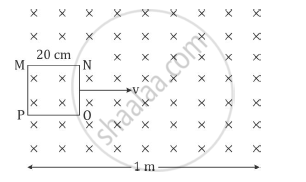
(i) Depict the direction of the induced current in the loop as it goes out of the field. For how long would the current in the loop persist?
(ii) Plot a graph showing the variation of magnetic flux and induced emf as a function of time.
A metallic loop is placed in a nonuniform magnetic field. Will an emf be induced in the loop?
An inductor is connected to a battery through a switch. Explain why the emf induced in the inductor is much larger when the switch is opened as compared to the emf induced when the switch is closed.
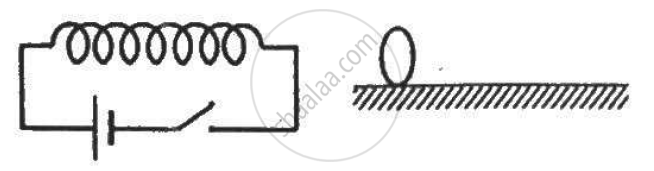
Figure shows a horizontal solenoid connected to a battery and a switch. A copper ring is placed on a frictionless track, the axis of the ring being along the axis of the solenoid. As the switch is closed, the ring will __________ .
The magnetic flux linked with the coil (in Weber) is given by the equation- Փ = 5t2 + 3t + 16. The induced EMF in the coil at time, t = 4 will be ______.
The dimensional formula of magnetic flux is ______.
A circular coil of 1000 turns each with area 1 m2 is rotated about its vertical diameter at the rate of one revolution per second in a uniform horizontal magnetic field of 0.07T. The maximum voltage generation will be ______ V.
In a coil of resistance 100 Ω a current is induced by changing the magnetic flux through it. The variation of current with time is shown in the figure. The magnitude of change in flux through the coil is ______.

A circular coil has radius ‘r', number of turns ‘N’ and carries a current ‘I’. Magnetic flux density ‘B’ at its centre is ______.
The Figure below shows an infinitely long metallic wire YY' which is carrying a current I'.
P is a point at a perpendicular distance r from it.
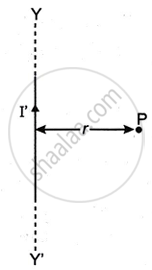
- What is the direction of magnetic flux density B of the magnetic field at the point P?
- What is the magnitude of magnetic flux density B of the magnetic field at the point P?
- Another metallic wire MN having length l and carrying a current I is now kept at point P. If the two wires are in vacuum and parallel to each other, how much force acts on the wire MN due to the current I' flowing in the wire YY'?
Which symbol represents magnetic flux?
What does \[\vec A\] represent in the magnetic flux formula?
What condition is specified for using \[\Phi=NBA\cos\theta\] as the magnetic flux linkage of a coil?
What is the nature of magnetic flux?
What is the dimensional formula of magnetic flux?
When is magnetic flux zero relative to the plane of the surface?
What happens to magnetic flux when magnetic field \[B\] increases while area and orientation remain unchanged?
Which factor describes how orientation affects magnetic flux?
Which expression relates induced emf to the change in magnetic flux for a coil of \[N\] turns?
