Advertisements
Advertisements
प्रश्न
Consider a closed loop C in a magnetic field (Figure). The flux passing through the loop is defined by choosing a surface whose edge coincides with the loop and using the formula φ = B1.dA1 + B2.dA2 +... Now if we chose two different surfaces S1 and S2 having C as their edge, would we get the same answer for flux. Jusity your answer.

Advertisements
उत्तर
One gets the same answer for flux. Flux can be thought of as the number of magnetic field lines passing through the surface (we draw dN = B ∆ A lines in an area ∆ A ⊥to B), As lines of B cannot end or start in space (they form closed loops) number of lines passing through surface S1 must be the same as the number of lines passing through the surface S2.
APPEARS IN
संबंधित प्रश्न
Ram is a student of class X in a village school. His uncle gifted him a bicycle with a dynamo fitted in it. He was very excited to get it. While cycling during night, he could light the bulb and see the objects on the road. He, however, did not know how this device works. he asked this question to his teacher. The teacher considered it an opportunity to explain the working to the whole class.
Answer the following questions:
(a) State the principle and working of a dynamo.
(b) Write two values each displayed by Ram and his school teacher.
A rectangular coil having 60 turns and area of 0.4m2 is held at right angles to a uniform magnetic field of flux density 5 × 10⁻⁵T. Calculate the magnetic flux passing through it.
Calculate magnetic flux density of the magnetic field at the centre of a circular coil of 50 turns, having a radius of 0.5m and carrying a current of 5 A.
Answer the following question.
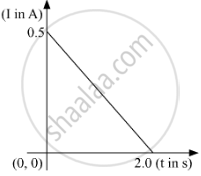
When a conducting loop of resistance 10 Ω and area 10 cm2 is removed from an external magnetic field acting normally, the variation of induced current-I in the loop with time t is as shown in the figure.
Find the
(a) total charge passed through the loop.
(b) change in magnetic flux through the loop
(c) magnitude of the field applied
The magnetic flux linked with the coil (in Weber) is given by the equation- Փ = 5t2 + 3t + 16. The induced EMF in the coil at time, t = 4 will be ______.
The unit of magnetic flux in SI is ______
A circular coil of 1000 turns each with area 1 m2 is rotated about its vertical diameter at the rate of one revolution per second in a uniform horizontal magnetic field of 0.07T. The maximum voltage generation will be ______ V.
What is magnetic flux linked with any surface?
What does \[\vec B\] represent in the magnetic flux formula?
How is a surface handled when calculating flux through a non-uniform magnetic field or a curved surface?
Which equivalent unit of magnetic flux uses tesla and square metres?
What is the nature of magnetic flux?
What is the flux when the magnetic field is at an angle \[\theta\] to the area vector?
What is the flux when the magnetic field is perpendicular to the area vector?
What happens to magnetic flux when area \[A\] increases while magnetic field and orientation remain unchanged?
Which expression relates induced emf to the change in magnetic flux for a coil of \[N\] turns?
Why does the number of magnetic field lines entering a closed surface equal the number leaving it?
