Advertisements
Advertisements
प्रश्न
A loop, made of straight edges has six corners at A(0, 0, 0), B(L, O, 0) C(L, L, 0), D(0, L, 0) E(0, L, L) and F(0, 0, L). A magnetic field `B = B_o(hati + hatk)`T is present in the region. The flux passing through the loop ABCDEFA (in that order) is ______.
विकल्प
`B_o L^2 Wb`
`2B_o L^2 Wb`
`sqrt(2) B_o L^2 Wb`
`4B_o L^2 Wb`
Advertisements
उत्तर
A loop, made of straight edges has six corners at A(0, 0, 0), B(L, O, 0) C(L, L, 0), D(0, L, 0) E(0, L, L) and F(0, 0, L). A magnetic field `B = B_o(hati + hatk)`T is present in the region. The flux passing through the loop ABCDEFA (in that order) is `underline(2B_o L^2 Wb`).
Explanation:
In this problem first we have to analyse area vector, loop ABCDA lies in x-y plane whose area vector `vecA_1 = L^2 hatk` whereas loop ADEFA lies in y-z plane whose area vector `vecA_2 = L^2 hati`
And the magnetic flux is `phi_m = vecB * vecA`
`vecA = vecA_1 + vecA_2 = (L^2 hatk + L^2 hati)`
And `vecB = B_0(hati + hatk)`
Now, `phi_m = vecB * vecA = B_0(hati + hatk)*(L^2 hatk + L^2hati)`
= `2B_0L^2 Wb`

APPEARS IN
संबंधित प्रश्न
Ram is a student of class X in a village school. His uncle gifted him a bicycle with a dynamo fitted in it. He was very excited to get it. While cycling during night, he could light the bulb and see the objects on the road. He, however, did not know how this device works. he asked this question to his teacher. The teacher considered it an opportunity to explain the working to the whole class.
Answer the following questions:
(a) State the principle and working of a dynamo.
(b) Write two values each displayed by Ram and his school teacher.
A pair of adjacent coils has a mutual inductance of 1.5 H. If the current in one coil changes from 0 to 20 A in 0.5 s, what is the change of flux linkage with the other coil?
Figure shows a rectangular loop conducting PQRS in which the arm PQ is free to move. A uniform magnetic field acts in the direction perpendicular to the plane of the loop. Arm PQ is moved with a velocity v towards the arm Rs. Assuming that the arms QR, RS and SP have negligible resistances and the moving arm PQ has the resistance r, obtain the expression for (i) the current in the loop (ii) the force and (iii) the power required to move the arm PQ.
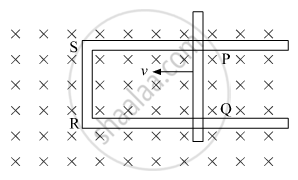
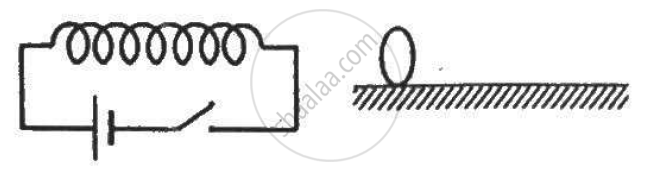
Figure shows a horizontal solenoid connected to a battery and a switch. A copper ring is placed on a frictionless track, the axis of the ring being along the axis of the solenoid. As the switch is closed, the ring will __________ .
The magnetic flux linked with a coil of N turns of area of cross-section A held with its plane parallel to the field B is ______.
Two inductors of inductance L each are connected in series with the opposite? magnetic fluxes. The resultant inductance is ______.
The dimensions of magnetic flux are ______
A circular coil of 1000 turns each with area 1 m2 is rotated about its vertical diameter at the rate of one revolution per second in a uniform horizontal magnetic field of 0.07T. The maximum voltage generation will be ______ V.
In a coil of resistance 100 Ω a current is induced by changing the magnetic flux through it. The variation of current with time is shown in the figure. The magnitude of change in flux through the coil is ______.

A circular coil has radius ‘r', number of turns ‘N’ and carries a current ‘I’. Magnetic flux density ‘B’ at its centre is ______.
The Figure below shows an infinitely long metallic wire YY' which is carrying a current I'.
P is a point at a perpendicular distance r from it.
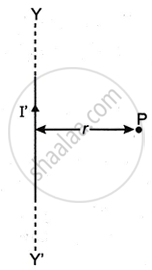
- What is the direction of magnetic flux density B of the magnetic field at the point P?
- What is the magnitude of magnetic flux density B of the magnetic field at the point P?
- Another metallic wire MN having length l and carrying a current I is now kept at point P. If the two wires are in vacuum and parallel to each other, how much force acts on the wire MN due to the current I' flowing in the wire YY'?
How is a surface handled when calculating flux through a non-uniform magnetic field or a curved surface?
When every turn of a coil of \[N\] turns contributes equally, what is its magnetic flux linkage?
What is the flux when the magnetic field is at an angle \[\theta\] to the area vector?
What is the flux when the magnetic field is perpendicular to the area vector?
What happens to magnetic flux when magnetic field \[B\] increases while area and orientation remain unchanged?
What happens to magnetic flux when area \[A\] increases while magnetic field and orientation remain unchanged?
Which factor describes how orientation affects magnetic flux?
