Advertisements
Advertisements
प्रश्न
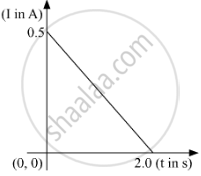
In a coil of resistance 100 Ω a current is induced by changing the magnetic flux through it. The variation of current with time is shown in the figure. The magnitude of change in flux through the coil is ______.

विकल्प
200 Wb
275 Wb
225 Wb
250 Wb
Advertisements
उत्तर
In a coil of resistance 100 Ω a current is induced by changing the magnetic flux through it. The variation of current with time is shown in the figure. The magnitude of change in flux through the coil is 250 Wb.
Explanation:
e = `(ΔPhi)/(Δt), I = 1/R(ΔPhi)/(Δt)`
I Δt = `(ΔPhi)/R` = Area under l - t graph, R = 100 ohm
∴ ΔΦ = `100 xx 1/2 xx 10 xx 0.5 = 250` Wb
APPEARS IN
संबंधित प्रश्न
Draw a schematic sketch of an ac generator describing its basic elements. State briefly its working principle. Show a plot of variation of
(i) Magnetic flux and
(ii) Alternating emf versus time generated by a loop of wire rotating in a magnetic field.
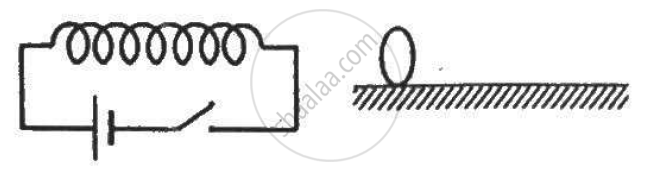
Figure shows a horizontal solenoid connected to a battery and a switch. A copper ring is placed on a frictionless track, the axis of the ring being along the axis of the solenoid. As the switch is closed, the ring will __________ .
Calculate magnetic flux density of the magnetic field at the centre of a circular coil of 50 turns, having a radius of 0.5m and carrying a current of 5 A.
Find magnetic flux density at a point on the axis of a long solenoid having 5000 tums/m when it carrying a current of 2 A.
Answer the following question.
When a conducting loop of resistance 10 Ω and area 10 cm2 is removed from an external magnetic field acting normally, the variation of induced current-I in the loop with time t is as shown in the figure.
Find the
(a) total charge passed through the loop.
(b) change in magnetic flux through the loop
(c) magnitude of the field applied
What is \[\theta\] in \[\Phi_B=BA\cos\theta\]?
How is a surface handled when calculating flux through a non-uniform magnetic field or a curved surface?
What is the nature of magnetic flux?
What is the flux when the magnetic field is at an angle \[\theta\] to the area vector?
What is the flux when the magnetic field is perpendicular to the area vector?
