Advertisements
Advertisements
Question
A rod of mass m and resistance R slides smoothly over two parallel perfectly conducting wires kept sloping at an angle θ with respect to the horizontal (Figure). The circuit is closed through a perfect conductor at the top. There is a constant magnetic field B along the vertical direction. If the rod is initially at rest, find the velocity of the rod as a function of time.

Advertisements
Solution
Let us first divide the magnetic field in the components one is along the inclined plane = B sin θ and other component of magnetic field is perpendicular the plane = B cos θ
Now, the conductor moves with speed v perpendicular to B cos θ, component of magnetic field. This causes motional emf across two ends of rod, which is given by = v(B cos θ)d
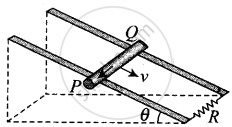 (A) |
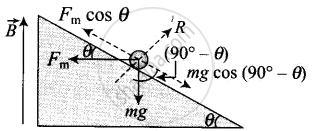 (B) |
This makes flow of induced current `i = (v(B cos theta)d)/R` where R is the resistance of rod. Now, current carrying rod experience a magnetic force which is given by `F_m = iBd` (horizontally in backwards direction). Now, the component of magnetic force parallel to the inclined plane in upward direction
`F_(||) = F_m cos θ = -Bd cos θ = ((v(B cos θ)d)/R) Bd cos θ`
Where, `v = (dx)/(dt)`
Also, the component of weight (mg) parallel to the inclined plane along downward direction = mg sin θ.
Now, by Newton's second law of motion
`m (d^2x)/(dl^2) = mg sin θ - (B cos θ d)/R ((dx)/(dt)) xx (Bd) cos θ`
⇒ `(dv)/(dt) = g sin θ - (B^2d^2)/(mR) (cos theta)^2v`
⇒ `(dv)/(dt) + (B^2d^2)/(mR) (cos θ)^2v = g sin θ`
But, this is the linear differential equation.
On solving, we get
`v = ((g sin θ)/(B^2d^2 cos^2 θ))/(mR) + A exp(- (B^2d^2)/(mR) (cos^2 θ)t)`
A is a constant to be determined by initial conditions.
The required expression of velocity as a function of time is given by
= `(mgR sin θ)/(B^2d^2 cos^2θ) (1 - exp (- (B^2d^2)/(mR) (cos^2θ)t))`
APPEARS IN
RELATED QUESTIONS
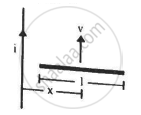
Figure shows a straight, long wire carrying a current i and a rod of length l coplanar with the wire and perpendicular to it. The rod moves with a constant velocity v in a direction parallel to the wire. The distance of the wire from the centre of the rod is x. Find the motional emf induced in the rod.
A metal disc of radius 30 cm spins at 20 revolution per second about its transverse symmetry axis in a uniform magnetic field of 0.20 T. The field is parallel to the axis of rotation. Calculate
(a) the area swept out per second by the radius of the disc
(b) the flux cut per second by a radius of the disc
(c) the induced emf between the axle and rim of the disc.
Mechanical force per unit area of a charged conductor is ______
A conducting square loop of side l and resistance R moves in its plane with a uniform velocity v perpendicular to one of its side. A magnetic induction B constant in time and space, pointing perpendicular and into the plane of the loop exists everywhere. The current induced in the loop is ______.
A circular coil expands radially in a region of magnetic field and no electromotive force is produced in the coil. This can be because ______.
- the magnetic field is constant.
- the magnetic field is in the same plane as the circular coil and it may or may not vary.
- the magnetic field has a perpendicular (to the plane of the coil) component whose magnitude is decreasing suitably.
- there is a constant magnetic field in the perpendicular (to the plane of the coil) direction.
A magnetic field B = Bo sin ( ωt )`hatk` wire AB slides smoothly over two parallel conductors separated by a distance d (Figure). The wires are in the x-y plane. The wire AB (of length d) has resistance R and the parallel wires have negligible resistance. If AB is moving with velocity v, what is the current in the circuit. What is the force needed to keep the wire moving at constant velocity?
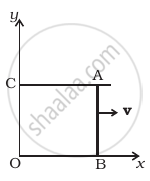
A rectangular loop of wire ABCD is kept close to an infinitely long wire carrying a current I(t) = Io (1 – t/T) for 0 ≤ t ≤ T and I(0) = 0 for t > T (Figure). Find the total charge passing through a given point in the loop, in time T. The resistance of the loop is R.

A simple pendulum with a bob of mass m and conducting wire of length L swings under gravity through an angle θ. The component of the earth's magnetic field in the direction perpendicular to the swing is B. Maximum emf induced across the pendulum is ______.
(g = acceleration due to gravity)

A magnetic flux associated with a coil changes by 0.04 Wb in 0.2 second. The induced emf with coil is ______.
An aircraft of wing span of 60 m flies horizontally in earth’s magnetic field of 6 × 10⁻⁵ T at a speed of 500 m/s. Calculate the e.m.f. induced between the tips of the wings of the aircraft.
A wire of length 1 m moving with velocity 8 m/s at right angles to a magnetic field of 2 T. The magnitude of induced emf, between the ends of wire will be ______.
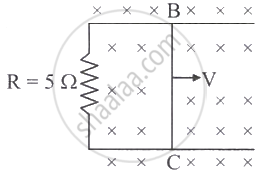
Figure shows a rectangular frame situated in a constant magnetic field. A wire BC of length 1 m is moved out with velocity 4 m/s. Magnetic field strength is 0.15 T. Force acting on the wire BC is:
If a rod moves a distance \[dx\] in time \[dt\], what is the change in magnetic flux used in the Faraday's Law derivation?
What is the magnitude of the induced EMF when the Faraday's Law derivation gives \[e=-Blv\]?
Which orientation gives maximum motional EMF?
For a rotating rod, what is the velocity of a small element at distance \[r\] from the centre?
A wheel rotates at \[120\,\mathrm{rev/min}\]. What is its angular velocity?
A wheel has \[10\] metallic spokes, each \[0.5\,\mathrm{m}\] long. It rotates at \[120\,\mathrm{rev/min}\] in a plane normal to Earth's horizontal magnetic field \[H_E=0.4\,\mathrm{G}\]. What is the induced EMF between the axle and rim?
