CBSE Science (English Medium) Class 12 Important Questions for Physics - Electrostatic Potential and Capacitance
Advertisements
Advertisements
Chapter wise important questions with answers and solutions for Physics in CBSE Science (English Medium) Class 12.
A slab of material of dielectric constant K has the same area as that of the plates of a parallel plate capacitor but has the thickness 2d/3, where d is the separation between the plates. Find out the expression for its capacitance when the slab is inserted between the plates of the capacitor.
Chapter: [2] Electrostatic Potential and Capacitance
Why is electrostatic potential constant throughout the volume of the conductor and has the same value (as inside) on its surface?
Chapter: [2] Electrostatic Potential and Capacitance
A capacitor of 200 pF is charged by a 300 V battery. The battery is then disconnected and the charge capacitor is connected to another uncharged capacitor of 100 pF. Calculate the difference between the final energy stored in the combined system and the initial energy stored in the single capacitor.
Chapter: [2] Electrostatic Potential and Capacitance
Why is there no work done in moving a charge from one point to another on an equipotential surface?
Chapter: [2] Electrostatic Potential and Capacitance
A hollow metal sphere of radius 10 cm is charged such that the potential on its surface is 5 V. What is the potential at the centre of the sphere?
Chapter: [2] Electrostatic Potential and Capacitance
Find the ratio of energy stored in the two configurations if they are both connected to the same source.
Chapter: [2] Electrostatic Potential and Capacitance
Depict the equipotential surfaces for a system of two identical positive point charges placed a distance(d) apart?
Chapter: [2] Electrostatic Potential and Capacitance
Deduce the expression for the potential energy of a system of two point charges q1 and q2 brought from infinity to the points `vecr_1`and `vecr_2`respectively in the presence of external electric field `vecE`.
Chapter: [2] Electrostatic Potential and Capacitance
A parallel-plate capacitor is charged to a potential difference V by a dc source. The capacitor is then disconnected from the source. If the distance between the plates is doubled, state with reason how the following change:
(i) electric field between the plates
(ii) capacitance, and
(iii) energy stored in the capacitor
Chapter: [2] Electrostatic Potential and Capacitance
Three identical capacitors C1, C2 and C3 of capacitance 6 μF each are connected to a 12 V battery as shown.
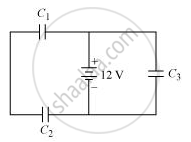
Find
(i) charge on each capacitor
(ii) equivalent capacitance of the network
(iii) energy stored in the network of capacitors
Chapter: [2] Electrostatic Potential and Capacitance
The figure show a network of five capacitors connected to a 10V battery. Calculate the charge acquired by the 5μF capacitor.
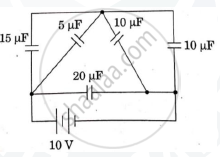
Chapter: [2] Electrostatic Potential and Capacitance
An ac circuit consists of a series combination of circuit elements X and Y. The current is ahead of the voltage in phase by `pi /4` . If element X is a pure resistor of 100Ω ,
(a) name the circuit element Y.
(b) calculate the rms value of current, if rms value of voltage is 141V.
(c) what will happen if the ac source is replaced by a dc source ?
Chapter: [2] Electrostatic Potential and Capacitance
Derive an expression for the electric potential at any point along the axial line of an electric dipole.
Chapter: [2] Electrostatic Potential and Capacitance
Draw the equipotential surfaces due to an electric dipole.
Chapter: [2] Electrostatic Potential and Capacitance
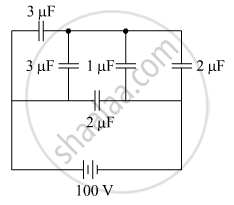
The figure shows a network of five capacitors connected to a 100 V supply. Calculate the total energy stored in the network.
Chapter: [2] Electrostatic Potential and Capacitance
An ac circuit consists of a series combination of circuit elements X and Y. The current is ahead of the voltage in phase by `pi/4`. If element X is a pure resistor of 100 Ω,
(a) name the circuit element Y.
(b) calculate the rms value of current, if rms of voltage is 141 V.
(c) what will happen if the ac source is replaced by a dc source
Chapter: [2] Electrostatic Potential and Capacitance
Three circuits, each consisting of a switch 'S' and two capacitors, are initially charged, as shown in the figure. After the switch has been closed, in which circuit will the charge on the left-hand capacitor
(i) increase,
(ii) decrease, and
(iii) remains the same? Give reasons.
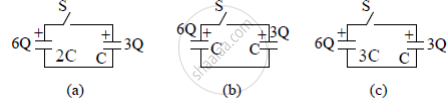
Chapter: [2] Electrostatic Potential and Capacitance
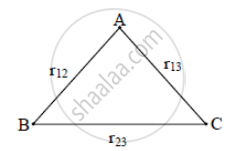
Define electrostatic potential at a point. Write its S.I. unit. Three-point charges q1, q2 and q3 are kept respectively at points A, B, and C as shown in the figure, Derive the expression for the electrostatic potential energy of the system.
Chapter: [2] Electrostatic Potential and Capacitance
Depict the equipotential surface due to
(i) an electric dipole,
(ii) two identical positive charges separated by a distance.
Chapter: [2] Electrostatic Potential and Capacitance
Obtain the expression for capacitance for a parallel plate capacitor.
