Advertisements
Advertisements
Calculate the value of the resistance R in the circuit shown in the figure so that the current in the circuit is 0.2 A. What would b the potential difference between points B and E?

Concept: Kirchhoff’s Laws
Calculate the value of the resistance R in the circuit shown in the figure so that the current in the circuit is 0.2 A. What would b the potential difference between points A and B?

Concept: Kirchhoff’s Laws
A magnetised needle of magnetic moment 4.8 × 10⁻² JT−1 is placed at 30° with the direction of uniform magnetic field of magnitude 3 × 10⁻² T. Calculate the torque acting on the needle.
Concept: Torque on a Rectangular Current Loop in a Uniform Magnetic Field
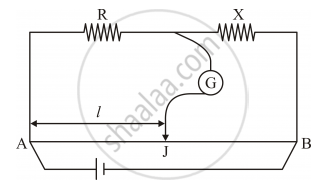
In the meter bridge experiment, balance point was observed at J with AJ = l.
(i) The values of R and X were doubled and then interchanged. What would be the new position of balance point?
(ii) If the galvanometer and battery are interchanged at the balance position, how will the alance point get affected?
Concept: Moving Coil Galvanometer
In the given circuit, assuming point A to be at zero potential, use Kirchhoff’s rules to determine the potential at point B.

Concept: Kirchhoff’s Laws
State the principle of the working of a moving coil galvanometer, giving its labeled diagram ?
Concept: Moving Coil Galvanometer
Outline the necessary steps to convert a galvanometer of resistance RG into an ammeter of a given range ?
Concept: Moving Coil Galvanometer
Using Ampere’s circuital law, obtain the expression for the magnetic field due to a long solenoid at a point inside the solenoid on its axis ?
Concept: Ampere’s Circuital Law
In what respect is a toroid different from a solenoid?
Concept: Solenoid
Draw and compare the pattern of the magnetic field lines in the two cases ?
Concept: Solenoid
How is the magnetic field inside a given solenoid made strong?
Concept: Solenoid
A long straight wire of a circular cross-section of radius ‘a’ carries a steady current ‘I’. The current is uniformly distributed across the cross-section. Apply Ampere’s circuital law to calculate the magnetic field at a point ‘r’ in the region for (i) r < a and (ii) r > a.
Concept: Ampere’s Circuital Law
State the underlying principle of working of a moving coil galvanometer. Write two reasons why a galvanometer can not be used as such to measure current in a given circuit. Name any two factors on which the current sensitivity of a galvanometer depends.
Concept: Moving Coil Galvanometer
Derive the expression for force per unit length between two long straight parallel current carrying conductors. Hence define one ampere.
Concept: Force Between Two Parallel Currents (Ampere’s Law)
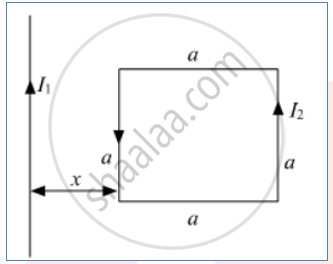
A square loop of side 'a' carrying a current I2 is kept at distance x from an infinitely long straight wire carrying a current I1 as shown in the figure. Obtain the expression for the resultant force acting on the loop.
Concept: Torque on a Rectangular Current Loop in a Uniform Magnetic Field
Explain the significance of a radial magnetic field when a current-carrying coil is kept in it.
Concept: Moving Coil Galvanometer
Answer the following question.
Two infinitely long straight wire A1 and A2 carrying currents I and 2I flowing in the same direction are kept' distance apart. Where should a third straight wire A3 carrying current 1.5 I be placed between A1 and A2 so that it experiences no net force due to A1 and A2? Does the net force acting on A3 depend on the current flowing through it?
Concept: Force Between Two Parallel Currents (Ampere’s Law)
Twelve wires each having a resistance of 3 Ω are connected to form a cubical network. A battery of 10 V and negligible internal resistance is connected across the diagonally opposite corners of this network. Determine its equivalent resistance and the current along each edge of the cube.
Concept: Kirchhoff’s Laws
A planar loop of rectangular shape is moved within the region of a uniform magnetic field acting perpendicular to its plane. What is the direction and magnitude of the current induced in it?
Concept: Torque on a Rectangular Current Loop in a Uniform Magnetic Field
Assertion (A): On Increasing the current sensitivity of a galvanometer by increasing the number of turns may not necessarily increase its voltage sensitivity.
Reason (R): The resistance of the coil of the galvanometer increases on increasing the number of turns.
Select the most appropriate answer from the options given below:
Concept: Moving Coil Galvanometer
