Advertisements
Advertisements
Question
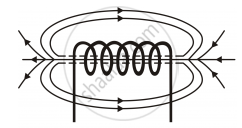
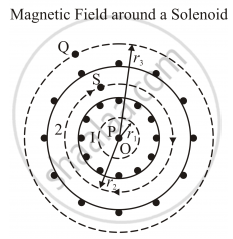
Draw and compare the pattern of the magnetic field lines in the two cases ?
Advertisements
Solution
Magnetic field diagrams are as followed
APPEARS IN
RELATED QUESTIONS
Use this law to obtain the expression for the magnetic field inside an air cored toroid of average radius 'r', having 'n' turns per unit length and carrying a steady current I.
A circular coil of one turn of radius 5.0 cm is rotated about a diameter with a constant angular speed of 80 revolutions per minute. A uniform magnetic field B = 0.010 T exists in a direction perpendicular to the axis of rotation. Suppose the ends of the coil are connected to a resistance of 100 Ω. Neglecting the resistance of the coil, find the heat produced in the circuit in one minute.
A capacitor of capacitance 100 µF is connected to a battery of 20 volts for a long time and then disconnected from it. It is now connected across a long solenoid having 4000 turns per metre. It is found that the potential difference across the capacitor drops to 90% of its maximum value in 2.0 seconds. Estimate the average magnetic field produced at the centre of the solenoid during this period.
A long solenoid carrying a current produces a magnetic field B along its axis. If the current is doubled and the number of turns per cm is halved, the new value of magnetic field will be equal to ______.
In the formula \(B = \mu_0 n I\) for the magnetic field inside a long solenoid, what does the quantity \(n\) represent?
In the working principle of a solenoid, how does each individual turn of the coil behave?
The net effect of a current-carrying solenoid is that it behaves like a bar magnet whose polarity is determined by which rule?
In the Ampere's Law derivation for a solenoid, why does side \(cd\) (lying outside the solenoid) contribute nothing to \(\oint \vec{B} \cdot d\vec{l}\)?
Which of the following correctly compares the field inside a toroid with the field inside a solenoid?
