Advertisements
Advertisements
Question
Obtain the expression for the magnetic energy stored in an inductor of self-inductance L to build up a current I through it.
Advertisements
Solution
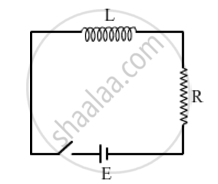
Consider the circuit shown above consisting of an inductor L and a resistor R, connected to a source of emf E. As the connections are made, the current grows in the circuit and the magnetic field increases in the inductor. Part of the work done by the battery during the process is stored in the inductor as magnetic field energy and the rest appears as thermal energy in the resistor. After sufficient time, the current, and hence the magnetic field, becomes constant and further work done by the battery appears completely as thermal energy. If i be the current in the circuit at time t, we have
`E-L(di)/dt=iR`
`=>Eidt=i^2Rdt+Lidi`
`=>int_0^tEidt=int_0^ti^2Rdt+int_0^iLidi`
`=>int_0^t Eidt=int_0^ti^2Rdt+1/2Li^2`
Now (idt) is the charge flowing through the circuit during the time t to t+dt. Thus (Eidt) is the work done by the battery in this period. The quantity on the left-hand side of the equation (i) is, therefore, the total work done by the battery in time 0 to t. Similarly, the first term on the right-hand side of equation (i) is the total thermal energy developed in the resistor at time t. Thus
`1/2Li^2`is the energy stored in the inductor as the current in it increases from 0 to i. As the energy is zero when the current is zero, the energy in an inductor carrying a current i, is `U=1/2Li^2`
APPEARS IN
RELATED QUESTIONS
Obtain an expression for the energy stored in a solenoid of self-inductance ‘L’ when the current through it grows from zero to ‘I’.
Define the term self-inductance of a solenoid.
A wire AB is carrying a steady current of 10 A and is lying on the table. Another wire CD carrying 6 A is held directly above AB at a height of 2 mm. Find the mass per unit length of the wire CD so that it remains suspended at its position when left free. Give the direction of the current flowing in CD with respect to that in AB. [Take the value of g = 10 ms−2]
A long solenoid is fabricated by closely winding a wire of radius 0.5 mm over a cylindrical nonmagnetic frame so that the successive turns nearly touch each other. What would be the magnetic field B at the centre of the solenoid if it carries a current of 5 A?
The magnetic field inside a long solenoid is given by which of the following formulas?
The net effect of a current-carrying solenoid is that it behaves like a bar magnet whose polarity is determined by which rule?
In the Ampere's Law derivation for a solenoid, if the Amperian loop has length \(l\) and the turns per unit length is \(n\), what is the total enclosed current \(I_{\text{enc}}\) when current \(I\) flows through the wire?
What is the magnetic field at the ends (edge) of a long solenoid carrying current \(I\)?
What is the magnetic field inside a long solenoid with an iron core, compared to the standard air-core expression?
Solenoid valves used in washing machines and car engines serve what function?
