Advertisements
Advertisements
Question
Derive the expression for the magnetic field due to a solenoid of length ‘2l’, radius ‘a’ having ’n’ number of turns per unit length and carrying a steady current ‘I’ at a point
on the axial line, distance ‘r’ from the centre of the solenoid. How does this expression compare with the axial magnetic field due to a bar magnet of magnetic moment ‘m’?
Advertisements
Solution
Consider a solenoid of length 2l, radius a and having n turns per unit length. It is carrying a current I.
We have to evaluate the axial field at a point P at a distance r from the centre of the solenoid
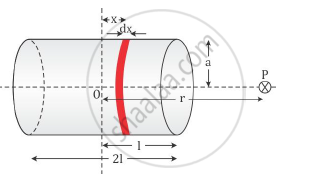
Consider a circular element of thickness dx of the solenoid at a distance x from its centre.
The magnitude of the field due to this circular loop carrying a current I is given as
`dB=(mu_0dxnIa^2)/(2[(r-x)^2+a^2]^(3/2))`
The magnitude of the total field is obtained by integrating over all the elements from x = −l to x = +l.
`B=(mu_0nIa^2)/2int_(-1)^(+1)dx/(2[(r-x)^2+a^2]^(3/2))`
Consider the far axial field of the solenoid, so r ≫a and r≫l. Hence, we have
[(r-x)2+a2]3/2 ≈ r3
So, we get
`B=(mu_0nIa^2)/(2r^3)int_(-1)^(+1)dx`
`B=(mu_0nIa^2)/(2r^3)2l`
The magnitude of the magnetic moment of the solenoid is
m Total number of turns current cross-sectional area
m=(nx2l)xIx(πa2)
Therefore, we get the magnetic field as
`B=(mu_0)/(4pi) (2m)/r^3`
This is the expression for magnetic field due to a solenoid on the axial line at a distance r from the centre.
This magnetic field is also the field due to a bar magnet of magnetic moment m.
APPEARS IN
RELATED QUESTIONS
Use this law to obtain the expression for the magnetic field inside an air cored toroid of average radius 'r', having 'n' turns per unit length and carrying a steady current I.
How is the magnetic field inside a given solenoid made strong?
A tightly-wound solenoid of radius a and length l has n turns per unit length. It carries an electric current i. Consider a length dx of the solenoid at a distance x from one end. This contains n dx turns and may be approximated as a circular current i n dx. (a) Write the magnetic field at the centre of the solenoid due to this circular current. Integrate this expression under proper limits to find the magnetic field at the centre of the solenoid. (b) verify that if l >> a, the field tends to B = µ0ni and if a >> l, the field tends to `B =(mu_0nil)/(2a)` . Interpret these results.
A capacitor of capacitance 100 µF is connected to a battery of 20 volts for a long time and then disconnected from it. It is now connected across a long solenoid having 4000 turns per metre. It is found that the potential difference across the capacitor drops to 90% of its maximum value in 2.0 seconds. Estimate the average magnetic field produced at the centre of the solenoid during this period.
The length of a solenoid is 0.4 m and the number turns in it is 500. A current of 3 amp, is flowing in it. In a small coil of radius 0.01 m and number of turns 10, a current of 0.4 amp. is flowing. The torque necessary to keep the axis of this coil perpendicular to the axis of solenoid will be ______.
A solenoid has a total of \(N\) turns wound uniformly over a length \(l\). What is the expression for the number of turns per unit length?
Why is the magnetic field approximately zero outside a long solenoid?
In the Ampere's Law derivation for a solenoid, if the Amperian loop has length \(l\) and the turns per unit length is \(n\), what is the total enclosed current \(I_{\text{enc}}\) when current \(I\) flows through the wire?
What is the magnetic field inside a long solenoid with an iron core, compared to the standard air-core expression?
Which of the following correctly compares the field inside a toroid with the field inside a solenoid?
